Marion McKeone: Trump’s tilt at Greenland is a challenge for all of Europe
Threatened takeover comes at the bidding of billionaires and amid a power struggle within the White House: The EU’s best bet may be to appeal to the good sense of US Republican politicians
Marion McKeone: Trump’s tilt at Greenland is a challenge for all of Europe

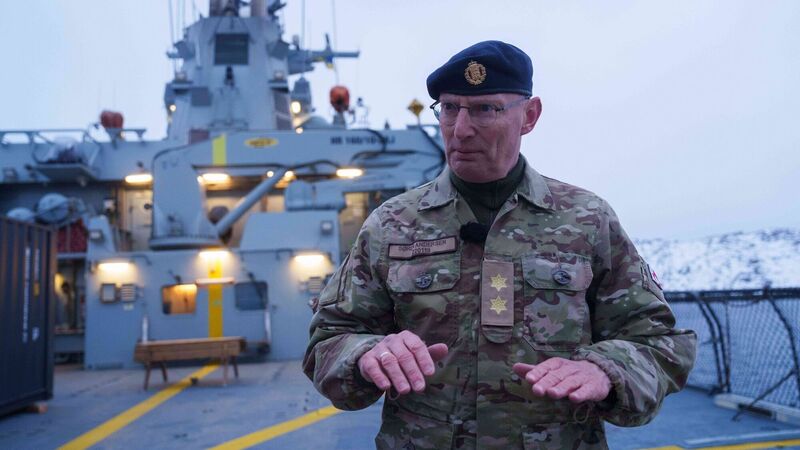
Major General Søren Andersen on board the Royal Danish Navy's HDMS Knud Rasmussen in Nuuk on Saturday. Several other European countries including France, Germany, the UK, Norway, Sweden, and the Netherlands also sent troops to Greenland in recent days.  Picture: Evgeniy Maloletka/AP

In August 2019, when US president Donald Trump first mused about the acquisition of Greenland, he framed the prospect as a workaday real estate transaction, casting the island as a fixer-upper that could be snapped up on the cheap. 

The Danes were indignant, while the rest of Europe dismissed it as another example of Trump’s buffoonery and bluster.


When he shrugged it off as “essentially a large real estate deal” that was “not No 1 on the burner”, it seemed Greenland was another of the forgotten whims that characterised his first stint in the Oval Office.

'Watch Greenland' 

Early last year, an administration official from Trump’s first term advised this reporter to “watch Greenland” when discussing Trump’s foreign policy checklist.

The Danish territory has catapulted to the top of Trump’s chaotic foreign policy to-do list for reasons that are part peacock, part lion, and part payback.

A protest rally marching towards the US consulate in Nuuk, Greenland, on Saturday to protest against Donald Trump's threatened takeover of the Danish territory. 	Picture: Evgeniy Maloletka/AP
A protest rally marching towards the US consulate in Nuuk, Greenland, on Saturday to protest against Donald Trump's threatened takeover of the Danish territory. Picture: Evgeniy Maloletka/AP

Becoming the first president to expand US territory in 130 years appeals to his vanity.

Trump’s second-term foreign policy is underpinned by a swaggering machismo that is part-revival of the long-discarded Monroe Doctrine and part emulation of US presidents such as William McKinley and Theodore Roosevelt.

Emboldened by the success of his Venezuela operation, and the sugar high of consequence-free military strikes on a range of targets — from nuclear facilities in Iran to fishing boats in the Caribbean — Trump has shown an increased appetite for using military force to achieve his goals.

Ego and desire for awards and accolades may influence his decision-making, but there is little dispute about Greenland’s strategic importance from a US and European security perspective.

Its location between key North Atlantic shipping routes and emerging new corridors along the North West Passage and both Russia and China’s ambitions to make their presence felt demand a coherent strategic response.

Still, claims that anything less than US ownership will lead to a Russian or Chinese invasion of Greenland ring hollow.

A series of agreements with Denmark give the US virtual carte blanche when it comes to beefing up its military presence on the island.

Nuuk, Greenland: ‘Claims that anything less than US ownership will lead to a Russian or Chinese invasion of Greenland ring hollow.’ 	Picture: Evgeniy Maloletka/AP
Nuuk, Greenland: ‘Claims that anything less than US ownership will lead to a Russian or Chinese invasion of Greenland ring hollow.’  Picture: Evgeniy Maloletka/AP

And an attack on Greenland by Russia or China would immediately mobilise Nato.

Military analysts have pointed out that Russian president Vladimir Putin, bogged down in a bloody quagmire in Ukraine, is in no position to do anything that would provoke the combined military force of Nato’s 32 members.

Last Tuesday, Nato secretary general Mark Rutte pointed out that as many as 25,000 Russian soldiers are dying each month in Ukraine, a level of carnage that he says is “unsustainable”.

A British intelligence assessment puts the number of Russian battlefield casualties at 1.2m.

China has undeniably increased its presence in the region since its 2017 self-declaration as a ‘near-Arctic state’ but the 2024 US Department of Defense Arctic strategy concluded its ambitions were progressing slowly.

White House power struggle 

The war of words over Greenland is playing out against the backdrop of a power struggle within the White House between US vice president JD Vance and Marco Rubio, Trump’s secretary of state and national security adviser, who are each positioning themselves as Trump’s successors.

US vice president JD Vance, centre, with Usha Vance; White House national security adviser Mike Waltz and his wife, former homeland security adviser, Julia Nesheiwat; and Secretary of Energy Chris Wright visiting the US military's Pituffik Space Base in Greenland in March of last year. File picture: Jim Watson/AP 

Aside from Dick Cheney, few vice presidents have managed to exert significant power or influence in an office that was famously referred to as “not worth a bucket of warm piss” by a previous incumbent.

But Vance has succeeded in carving out a significant role for himself, aligning himself closely with Stephen Miller, Trump’s powerful deputy chief of staff.  

Vance has largely ceded Latin America to Rubio but has repeatedly inserted himself into matters concerning the EU, Russia, and China.

Billionaires' designs on Greenland 

Vance’s interest in Greenland mirrors that of the Silicon Valley billionaires who helped fund his and Trump’s 2024 campaign.

Peter Thiel, Vance’s mentor and main political donor, has invested in a venture that intends to use Greenland as the base for an experimental technologically advanced city that would operate free of government constraints and regulations.

Priscilla Chan, Mark Zuckerberg (Facebook/Meta), Lauren Sánchez, Jeff Bezos (Amazon), Sundar Pichai (Google), and Elon Musk (Twitter/X) at Donald Trump's inauguration on January 20, 2025. Picture: Chip Somodevilla/Pool/AP 

Mark Zuckerberg, Bill Gates, Jeff Bezos, and Sam Altman are among Trump mega donors who are eyeing Greenland’s rare earth minerals and suitability as a data centre hub.

Denmark has pointed out that US ownership is not required for the development of Greenland and the mining of its natural resources.

The territory’s 57,000 inhabitants are open to proposals from potential US investors.

However, it seems that Trump is determined to forge ahead with plans to gain control of Greenland, despite a lack of support at home or abroad for his latest imperial adventure.

Recent polls suggest that fewer than one in five Americans support Trump’s bid for ownership of Greenland and fewer than one in 10 support the use of military force to acquire it.

For all of its pushback, Denmark may decide that acquiescence is the lesser of the two evils: Rather than fighting a losing battle against Trump that would scuttle Nato in the process, it could instead settle for getting the highest possible price.

Figures doing the rounds on Capitol Hill put the price tag for an agreed purchase at around $700bn (€603bn).

Putting this in perspective, the entire US defence budget for 2026 is $900bn. A $700bn impulse buy is unlikely to improve Trump’s approval ratings, which have been tanked by the affordability crisis uppermost in the minds of most Americans.

Life goes on for Greenlandic fishermen working in the harbor of Nuuk amid the furore precipitated by US president Donald Trump. 	Picture: Evgeniy Maloletka/AP
Life goes on for Greenlandic fishermen working in the harbor of Nuuk amid the furore precipitated by US president Donald Trump.  Picture: Evgeniy Maloletka/AP

Rather than enter protracted and costly negotiations, Trump may decide to move quickly and simply declare US control of Greenland much as he declared the Gulf of Mexico was now the Gulf of America.

If he settled for the sort of hollow branding exercise he appears to revel in, adding acting president of Greenland to the faked-up Wikipedia page that already proclaims him acting president of Venezuela, Denmark and the EU could simply shrug and hope for a post-2028 return to business as usual in US-EU relations. 

Trump has already breezed through Article 2.4 of the UN Charter which prohibits members from using the threat of force against the territorial integrity of any state.

In the event that he makes good on his threat, Denmark’s — and the EU’s — options are limited.

Nato would be paralysed. Article 5 would be unenforceable. Article 42.7 of the EU’s common defence pact

obliges member states to provide ‘aid and assistance’ to any member state under attack but it requires unanimity amongst member states and there is little chance that Hungary would sign up to a pact requiring it to act against the US.

While individual members of the EU or Nato could provide military support to Greenland, Miller’s blunt assertion that “nobody’s going to fight the United States for Greenland” is very likely correct.

The EU's options on Greenland

The EU has a range of economic and diplomatic weapons in its arsenal but each one carries the risk of mutual economic destruction.

EU states currently hold up to $2 trillion in US treasuries.

Dumping them would send US interest rates soaring but carries serious risks for the global economy.

Invoking its Anti-Coercion Instrument to block or restrict US market access or investment would certainly lead to US retaliation.

Refusing the US access to EU airspace and shuttering its EU military bases are options but they’re unlikely to persuade Trump to reverse course.

An EU boycott of the World Cup and the US’s 250th celebrations this year, while humiliating for Trump, would have little effect.

US Republican politicians hold the key

The best bet may be to appeal to Congressional Republicans, several of whom have expressed anger and alarm at the prospect of a military operation to seize control.

Senator Thom Tillis warned that Republicans would join forces with Democrats in sufficient numbers to pass a war powers resolution, while House Republican Don Bacon predicted that taking Greenland by force would lead to Trump’s impeachment.

A bipartisan Congressional delegation arrived in Copenhagen on Friday to stress that there is no support for anything short of an agreed transfer of ownership to the US.

It’s unlikely this will be enough to reassure the Danes. US Republicans have a long and undistinguished record of crumbling in the face of pressure from Trump.

More in this section

Revoiced

Newsletter

Sign up to the best reads of the week from irishexaminer.com selected just for you.

Cookie Policy Privacy Policy Brand Safety FAQ Help Contact Us Terms and Conditions

© Examiner Echo Group Limited