Habitats report a stark contrast to nitrates decision
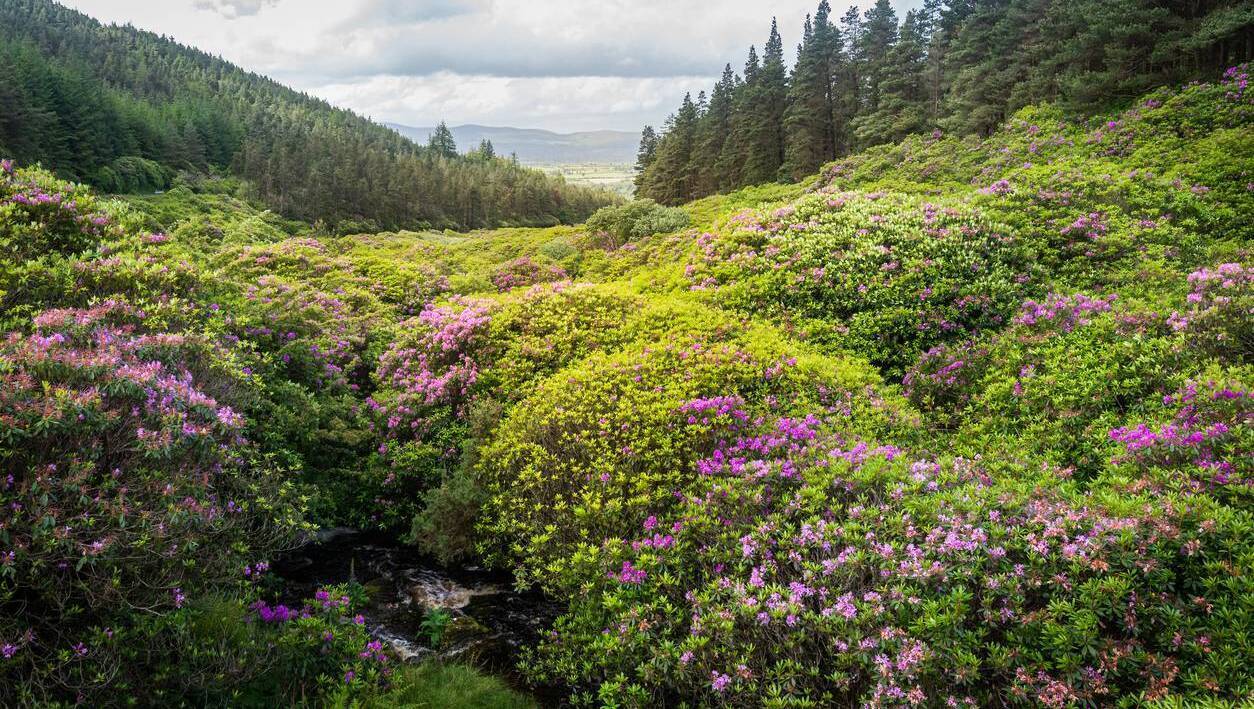
Amid mounting biodiversity loss we still have no plan for dealing with invasive rhododendron.
Earlier this month, Ireland was granted another three-year extension to its derogation from the nitrates directive, an EU law in place since 1991 to protect water quality from farm pollution.
Agriculture minister Martin Heydon told the Dáil in November that “the nitrates derogation has been my number one priority since I was appointed minister” and hailed the decision this week as a “good news day for Irish agriculture”.
The decision came only a week after the European Court of Justice found Ireland had failed to implement the Water Framework Directive, following a number of reports from the Environmental Protection Agency showing water quality was disimproving.
Ireland had been granted previous derogations on the basis that water quality would achieve required standards, so the decision from Brussels is all the more baffling.
Only two days after receiving confirmation of the derogation extension, the National Parks and Wildlife Service (NPWS) published a report into the status of habitats and species in Ireland which are protected under the EU’s Habitats Directive.

These are the most important habitats on a European level and include peatlands, flower-rich grasslands, sand dunes, ancient forests and submarine reefs. It also includes species from whales, bats, otters and freshwater pearl mussels (but not birds, which are evaluated under a separate directive). The news is pitiful.
In the six years since the last assessment was published in 2019, ironically the year the Dáil declared a climate and biodiversity emergency, the proportion of habitats in inadequate or bad condition has increased from a dire 85% to a woeful 90% — nearly all of them.
The picture for the species which are assessed is a little better, with 58% in "favourable" condition, but this barely takes away from the overall picture that the Irish countryside is increasingly uninhabitable unless you are a cow or a sheep.
What makes this report so devastating is it shows the damage being done has yet to even stabilise: 51% of habitats are still "deteriorating".
The results will come as a blow to the many people who have worked hard in recent years to reverse this tide of destruction. This includes the innumerable community and voluntary groups, businesses and NGOs, as well as those hardy individuals in Government agencies, such as local authorities, civil servants and regulatory authorities, who work to bring about change from within the system.
The NPWS itself has undergone a substantial, if faltering, transformation in the last five years, with increased staffing and funding for actual conservation works. I have seen myself the impact of bog restoration, invasive species removal and pollinator plans across Ireland, all of which are making a difference. But it’s not enough.

The minister in charge of the NPWS, Fianna Fáil’s Christopher O’Sullivan, responded to the report saying: “Given the huge efforts to turn the tide on biodiversity loss in recent years, these will be disappointing findings.”
It’s easy to see why O’Sullivan is disappointed but can we really say there have been "huge efforts" to turn the tide? His Government removed funding set aside from the Climate and Nature Fund, which was to have financed the implementation of Ireland’s Nature Restoration Plan, something that must be published by mid-2026.
Despite repeated promises, there is still no sign of legislation to allow for the creation of marine protected areas, or to give legal backing for national parks. With regard to invasive species such as rhododendron or deer, there is no strategy or plan for their control.
In 2023, the European Court of Justice found Ireland had failed to implement the Habitats Directive because there were no management measures in hundreds of special areas of conservation that were demarcated in the late 1990s.
We still have bottom trawling, mechanical turf extraction, arterial drainage works, free-roaming sheep and much more in these SACs.
However, it is Mr Heydon’s department, more than any other, that is responsible for how our land and seas are used, not only agriculture, but forestry and fishing in Irish waters and so is chiefly responsible for the dire state of biodiversity in Ireland.
All of the destructive fishing that goes on within 12 nautical miles of our coast, the forestry system welded to Sitka spruce monocultures and the farming policy that puts the maintenance of 6.3 million cattle, 3.6 million sheep and 1.5 million pigs above our food security and the survival of nature, is on Heydon’s desk.
For anyone looking for positives, there is comfort in that at least we have a clear picture of what needs to be done. In 2024, the publication of the fourth (yes the fourth) National Biodiversity Action Plan set out a worthy road map and called for an “all of government, all of society” response.

Yet, this plan has no delivery mechanism, no senior minister leading the drive, and no way for the various arms of the State to be held accountable when targets are not reached.
In 2023, the Citizens’ Assembly made a number of excellent recommendations on reversing biodiversity loss, but their key suggestion that Ireland’s food policy be reviewed, from one that is dominated by the demands of export-driven companies to one that is focused on food security, climate resilience and the protection of nature, has gone ignored.
The collapse in biodiversity is not a lost cause. In fact, nature can rebound incredibly quickly when the circumstances are right. A chink of light in the NPWS report is the improving trends in some habitats such as raised bogs and hay meadows, as a result of targeted measures.
Something that has also vastly changed in recent years is the public awareness of the miserable state of our natural environment, even if this is coming from high-profile disasters like Lough Neagh, Lady’s Island Lake in Wexford or the Blackwater fish kill.
People are not happy that our lands and seas are plainly in crisis. It points to a shift in attitude that, with more work, will filter into Government departments so maybe soon we’ll hear a minister for agriculture declare that improving the state of biodiversity is their ‘number one priority’.
- Pádraic Fogarty is an ecologist and author of the 2017 book
CLIMATE & SUSTAINABILITY HUB