Trump's actions in Venezuela straight out of the Nazi playbook for home repression
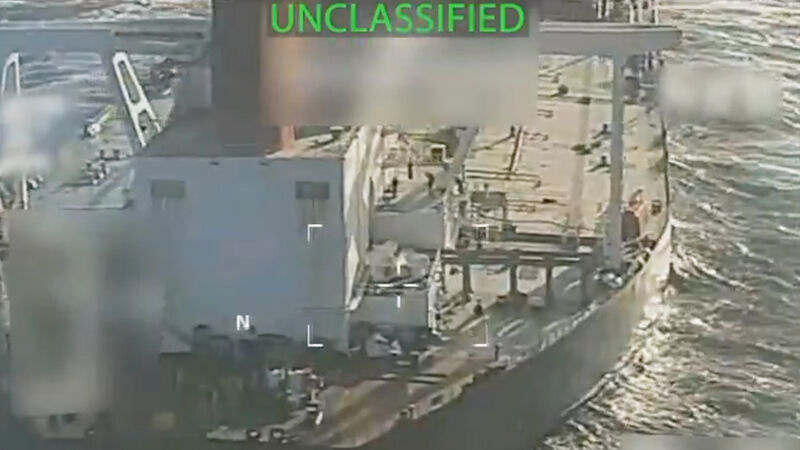
An oil tanker being seized by US forces off the coast of Venezuela last week. Photo: US Attorney General's Office/X via AP
In certain ways, this autumn in the United States has recalled the autumn of 1938 in Nazi Germany, when mass deportation of undocumented people was one of Hitler’s most ambitious coercive policies before the start of the Second World War.
In the US, too, the connection between domestic repression and foreign aggression is coming into focus.
That autumn, the German police and SS rounded up 17,000 Jews with Polish citizenship and dumped them across the border, into neighbouring Poland. This set off a chain of events which provides a useful perspective on where the US is now.
A family was deported; a desperate refugee took revenge; the government organized a pogrom and re-organized its police; war followed.
The family was the Grynszpans. The father and mother had moved to Germany in 1911 from the Russian Empire. Their children were born in Germany, spoke German, and saw themselves as Germans. Their son Herschel had left to stay with relatives in Paris, where he faced a series of disappointments with his documentation, including the loss of his citizenship.

Denied permanent residence in France in the summer of 1938, Herschel was hiding in an attic to avoid deportation when a postcard from his sister arrived: “Everything is finished for us.” Herschel took revenge.
On November 7, 1938, he walked into the German embassy in Paris and shot the diplomat Ernst vom Rath. A policy of mass deportation had led to a reaction that, although unpredictable in its details, was not surprising.
In Berlin, the Nazis saw an opportunity. Joseph Goebbels invoked a conspiracy and conflated the actions of one person with the responsibility of a group, and Hitler allowed Goebbels to organize a nationwide pogrom — Kristallnacht — two days later.
The SA, the SS, and the Hitler Youth, joined by many other Germans, destroyed Jewish businesses, burned Jewish books, desecrated Torah scrolls, and invaded Jewish homes.
Some 91 Jews were killed, and hundreds died by suicide. Tens of thousands of Jewish men were sent to concentration camps.
Nine decades later, no one could foresee exactly what would happen when the Trump administration made deportation of the undocumented its basic policy, with the National Guard deployed in Los Angeles and Washington — cities that should be seen as “training grounds for our military” and “war zones”.
But it was predictable that there would be some consequence. It arrived in the form of the recent shooting of two National Guard soldiers patrolling in Washington. One subsequently died from her wounds.
The accused is a refugee from Afghanistan who had assisted the US war effort in his homeland. Like Grynszpan, he is someone who experienced trauma and dehumanization.

Having fought and killed for a foreign government in his own country, the assassin had reason to expect some sort of shelter after he and his family were evacuated from Afghanistan to the US. It appears he faced only a series of disappointments.
His experience, as reported by , was eerily similar to Grynszpan’s. While “it was unclear what exactly triggered” the attacker, a volunteer who worked with the family “sensed part of it was his frustrations with the uncertainty of America’s immigration process” and his family’s fear that they would be “deported to Afghanistan as his application for a Special Immigrant Visa dragged on”.
This is not an excuse for a horrible act. It is a fact that is necessary to understand the structure of the historical moment.
It was foreseeable that US President Donald Trump would seek to exploit such violence. He announced his intention to target “Third World countries”, blamed all of America’s problems on migrants, and called Somalis “garbage”.
Trump expressed his desire to deport millions of people and to denaturalize — strip citizenship from — Americans whose values he disparages or whom he deems incompatible with “Western civilization”. Life will be made even harder for non-citizens in the US.
For the Nazis, the mass deportation and pogrom of autumn 1938 were steps toward creating a centralized national police agency, the Reich Security Main Office, the following year.
In the US, something similar is unfolding with Immigration and Customs Enforcement: initially tasked to carry out deportations, ICE has taken on espionage roles, provoked citizens, and been reinforced by soldiers of the National Guard. In these respects, it is becoming something like a national police force, with ideological propaganda and links to the armed forces.
In one way, mass deportations and Kristallnacht advanced the consolidation of the Nazi regime. But this kind of instability was unpopular in Germany — much as ICE raids are unpopular in US cities.
The radical next steps were possible only under cover of war. That would be the classic next step in the regime change that Trump seems determined to carry out in the US. War is the easy way to eliminate internal enemies by identifying them with an external enemy.
For Trump, starting a war with Venezuela (or someone) would be the next logical move in advancing regime change at home.
It is not hard to see that Trump understands this, given his escalating provocations since the summer, when the US began attacking alleged drug smugglers in the Caribbean Sea, including shipwrecked survivors killed in obvious violation of international law.

The past never repeats, but it does instruct — and it instructs everyone. The people who want authoritarianism in America know that seizing on the emotions associated with political belonging can lead to turmoil and regime change.
While the people who want democracy in America can see the pattern and, by naming it, take the crucial first step toward bringing the process to a halt.
- Timothy Snyder, the inaugural Chair in Modern European History at the Munk School of Global Affairs and Public Policy at the University of Toronto and a permanent fellow at the Institute for Human Sciences in Vienna, is the author or editor of 20 books.