TP O'Mahony: Sixty years on, Vatican II's business is still unfinished
The spirit of Vatican II may still live on, but its practical effects (with the exception of Mass in the vernacular) are increasingly difficult to discern, especially in Ireland, writes TP O'Mahony 
TP O'Mahony: Sixty years on, Vatican II's business is still unfinished

From the moment Pope John XXIII announced the Second Vatican Council on January 25, 1959, speculation about its aims, objectives and outcome intensified.

The 1960s gave us the Beatles, lunar landings, JFK in the White House, the Pill, Women’s Lib, the Northern Ireland Civil Rights Association, the Cuban missile crisis, the death of Marilyn Monroe — and Vatican II.

The latter — properly known as the Second Vatican Council — formally ended on this day 60 years ago after the last of its 16 documents — the Declaration on Religious Liberty — was promulgated by Pope Paul VI.


The council, which opened on October 11, 1962, in St Peter’s Basilica, would come to be regarded as the most important religious event of the 20th century, with far-reaching repercussions. From the moment Pope John XXIII announced the council on January 25, 1959, speculation about its aims, objectives and outcome intensified.

In the long history of the Church there had been just 20 previous councils, starting in 325 with the Council of Nicaea. In fact, at the end of last month Pope Leo XIV traveled to Turkey (Nicaea is now the Turkish city of Iznik) to mark the 1700 anniversary of that event, from which emerged the Nicene Creed, recited at all Masses today.

Prior to Pope John XXIII’s surprising announcement, the most recent council had been Vatican I (1869-70), which promulgated the controversial doctrines of papal primacy and papal infallibility. Some scholars thought that after Vatican I there would never be a need for a new council but Pope John thought otherwise. 

Pope John XXIII was like no other Pope of the 20th century; he had no time for the fortress mentality behind which the papacy had retreated since the French Revolution, nor for the papacy’s negativity towards the modern world. File photo: AFP via Getty Images)

And in his opening address he declared that aggiornamento (updating) would be one of its main themes.

John XXIII was like no other Pope of the 20th century; he had no time for the fortress mentality behind which the papacy had retreated since the French Revolution, nor for the papacy’s negativity towards the modern world. It was time, he said, to throw open the windows and let in some fresh air. 

So the assembled bishops threw out the original position papers prepared by the bureaucrats of the Roman Curia and wrote their own. It was a statement of intent. The battle for control of the council was underway.

Initially widely regarded as a transformative event, today six decades later the council’s legacy is a very mixed one. This is due in no small measure to the determined opposition to its reforms from Pope John Paul II during his long pontificate, an opposition continued by Pope Benedict XVI.

When one of the key council documents redefined the Church as “the people of God” — with its stress on the fundamental equality of all members of the Church — the Archbishop of Krakow, Karol Wojtyla (who would become John Paul II) voted against it. A vital portent.

The doctrine of collegiality emerged only half-formed, and was swiftly euthanised by Karol Wojtyla shortly after he became Pope John Paul II (pictured). File photo: Vincenzo Pinto/AFP via Getty Images

At the outset, Cardinal Suenens of Belgium, who would emerge as one of the “stars” of the council, asked a surprising question. As he surveyed the serried ranks of 2,400 mitred bishops in the long rows of tiered seating erected in the central nave of St Peter’s, he turned to a colleague and said: “Where is the other half of humanity?” 

No women. No female participation. Yes, a handful of mother superiors were present, but only as “observers”. More seriously, when the council agenda was finalised no place was found for a re-examination of the status and role of women in the Church. And birth control had been reserved to a papal commission.

The main work of the council was done in four plenary sessions in the autumn of the four years 1962-65. The 16 documents which comprise the legacy of the council covered subjects such as the nature of the Church, divine revelation, the pastoral challenges of modernity, the office of bishops, priestly ministry, ecumenism, missionary activity, relations with the Orthodox Church, relations with non-Christian religions, the apostolate of the laity, a document on the liturgy and also one containing an overdue apology to Jews.

The big three documents were the Dogmatic Constitution on the Church, the Pastoral Constitution on the Church in the Modern World, and the Declaration on Religious Liberty. Astonishing as it will seem to some, it was only in 1965, with the publication of this declaration, that the Catholic Church acknowledged “freedom of conscience”.

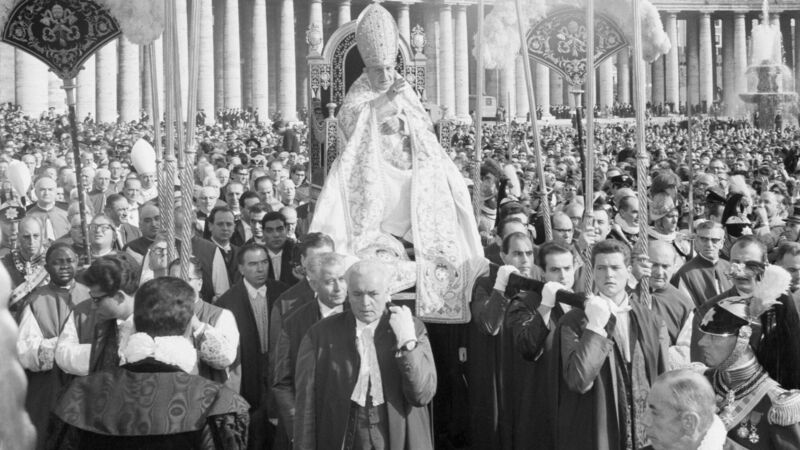
The Second Vatican Council would come to be regarded as the most important religious event of the 20th century, with far-reaching repercussions. File photo: Keystone-France/Gamma-Keystone via Getty Images

The tragedy of Vatican II was that it was, in the words of Professor Diarmaid MacCulloch of Oxford University, “half a revolution”. The doctrine of collegiality emerged only half-formed, and was swiftly euthanised by Karol Wojtyla shortly after he became Pope John Paul II (following the 33-day pontificate of John Paul I, who might have taken the Church in a different direction).

The spirit of Vatican II may still live on, but its practical effects (with the exception of Mass in the vernacular) are increasingly difficult to discern, especially in Ireland. Pope Francis’s emphasis on synodality was an attempt to re-vivify the essence of collegiality, which was intended to ensure that a Pope would not make major decisions in isolation from the College of Bishops, but it is unclear whether or to what extent Pope Leo XIV will continue on this path. 

The Vatican’s recent response to polygamy in certain African countries — a document extolling the virtues of monogamy, approved by Pope Leo — has led some commentators to say, since there was no dialogue with African bishops, he has flunked the first test of synodality of his papacy.

Today we are still struck with a monarchical papacy (despite Pope Francis’s efforts to move away from it), a model of the papacy that owes far more to the Emperor Constantine than to Matthew, Mark, Luke or John. We still have a top-down authority structure in a clerical Church, with the “people of God” sidelined.

And an American Pope, even one who spent over 10 years in Latin America, is unlikely to significantly alter the Eurocentric, heavily patriarchal theology still dominant in Rome. As for women priests any time soon, don’t hold your breath.

Vatican II left unfinished business (“half a revolution”). Collegiality pointed the way to a new form of governance in the Church, but there was no follow-up, mainly because of opposition at the highest level in Rome. Pope Francis tried to steer the Church back onto a collegial path but with mixed results. Nobody knows what Pope Leo XIV wants. 

So the big question remains — where does ultimate authority in the Church reside, with Pope or council?

x

More in this section

Revoiced

Newsletter

Sign up to the best reads of the week from irishexaminer.com selected just for you.

Cookie Policy Privacy Policy Brand Safety FAQ Help Contact Us Terms and Conditions

© Examiner Echo Group Limited