Roderic O’Gorman: Budapest Pride was a rebuke to Orbán, we must keep an eye on his response
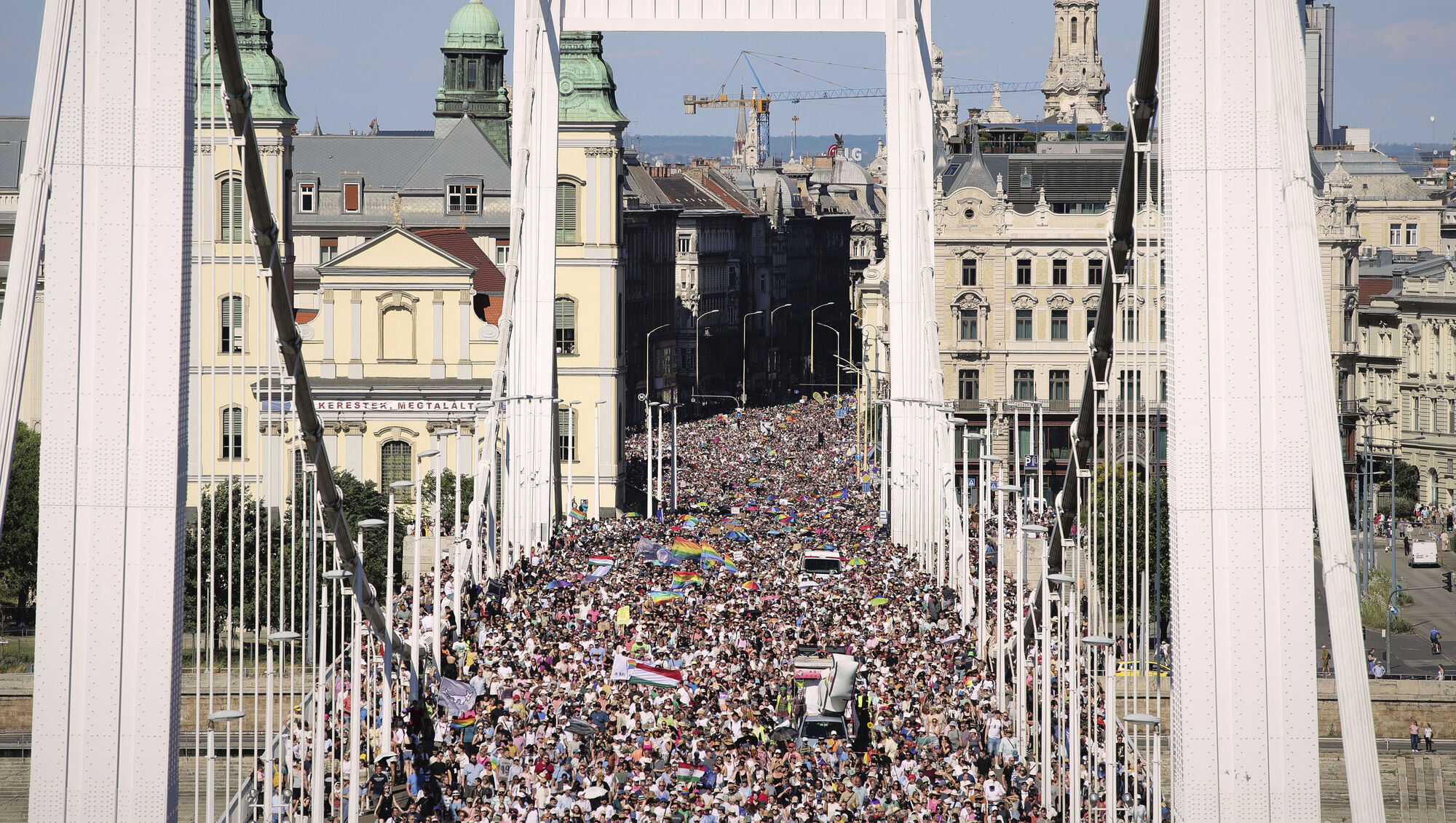
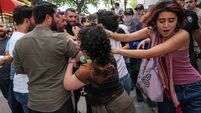
The LGBT+ Community were joined by tens of thousands of ordinary Hungarians, young and old, single and in families, in a vast show of solidarity in Budapest on Saturday. Photo: AP/Rudolf Karancsi
On Saturday afternoon, I joined up to 200,000 Hungarian citizens who took to the streets of Budapest to show that the attacks by prime minister Viktor Orbán on the gay, lesbian and trans community would be tolerated no more.
In 30 degree heat, this enormous crowd slowly walked the 2.5km Pride Parade route, from the City Hall, crossing the gigantic Elizabeth bridge, and finishing along the west bank of the Danube river. There were so many people, it took over three hours to cover the short route.

The LGBT+ Community were joined by tens of thousands of ordinary Hungarians, young and old, single and in families, in a vast show of solidarity. The mood was different from most pride parades, less celebratory, less music - a more serious display of determination.
This powerful rebuke to Orbán was triggered initially by his announcement in March of this year advising the organisers of Pride “not to bother preparing for this year's parade. It would be a waste of money and time”. This statement was followed up by a new law that allowed the Government to ban events that “promote” homosexuality or trans identity.

People taking part in the parade risked a fine, facial recognition technology was deployed to identify those who were present, and the event organisers were liable to criminal prosecution.
In the days running up to June 28, even though the Pride Parade had been banned, Orbán’s government gave permission for up to four 'counter-demonstrations', including one by the neo-fascist Our Homeland Movement. This gives a clear indication of the Government’s priorities when it comes to freedom of speech.
However, on the day, the counter-protests I saw were miniscule - two individuals holding a crucifix and shouting at the tens of thousands of marchers at one location, about 50 people behind a banner at another.
I travelled to Budapest to take part in this year’s Pride Parade because I felt it was important to take a stand. The Fidesz-KDNP Party government of Viktor Orbán has been consistently chipping away at the rights of Hungary’s gay, lesbian and trans citizens for years.
This is nearly always done by linking restrictions on their rights with child protection, playing on the decades-old trope that the very existence of gay people is a threat to children.

I was joined by over 70 MEPs, including Irish representatives, and 30 members of national parliaments. All were there at the invitation of the mayor of Budapest Gergely Karácsony, a member of the Hungarian Green Party.
The presence of so many international, and especially EU representatives, was seen as particularly important by the event organisers, as it ensured that Europe’s media would be closely scrutinising the actions of the Hungarian government and police over the course of the Pride weekend.
For me, it was important to send a clear message that in a fellow EU member state the rolling back of basic human rights could not, and would not, be tolerated. Equality by definition should know no boundaries.
Should our ambition for a truly equal society end at the Irish Sea? As Europeans, citizens of a union founded to improve all lives on the continent in peace and security, we have every right to turn up and show our solidarity.
As legislators and members of parliament, we have an obligation to show that there are lines in a free society that cannot and should not be crossed because of hate, because of fear and the craven political forces that use both as tools to manipulate, to divide and to acquire power.
When it was politically radioactive in Ireland to voice support for LGBT+ rights and equality, other countries became a refuge - so many gay and trans sons and daughters of Ireland simply left.
That was a lifelong tragedy for those people, but Irish society as a whole also lost out because of that.
Today I know Hungarians who feel they must live outside Hungary in order to escape the climate of fear and oppression there. That’s been the grim reality for minority communities in Hungary, but the banning of Pride became a moment where we joined with those Hungarians to say “no more, no further”.
Thankfully, despite a hostile social environment, Ireland has never had mainstream political forces openly targeting minorities as scapegoats to advance their own narrow agenda. But we’re not magically immune to it.
Corrosive, ignorant and hate-filled commentary saturates our online discussion spaces, with our trans community being particular targets. This is not spontaneous or manifest of real public opinion - it is by design of the few who seek to manipulate the many.
Undoubtedly, the scale of the public participation in Budapest on Saturday represents a blow to Orbán. He made himself central to the decision to ban the Pride Parade, so the fact that numbers rose from 35,000 last year to close to 200,000 this year is a clear public rebuke.
Opinion polls for the general election that is due next year suggest that a centre-right opposition party, TISZA, is on track to comfortably beat Fidesz. But after being in Government for over 15 years, large parts of Hungarian society - the media, the courts, most commercial enterprises - are all controlled by the Fidesz party.
April’s election will not be fought on a level playing field.
It is also vital that, in the weeks ahead, we continue to watch the actions of Orbán’s government with respect to the aftermath of the Pride parade. Will he seek to issue fines to those who participated, or will he seek to target the organisers with criminal prosecution?
He may feel it is best to cut his losses following the massive march, or he may seek to double down and look to get revenge on his opponents in civil society. The Irish government must not be silent on this.