Tough task of enforcing online safety is top priority for Coimisiún na Meán
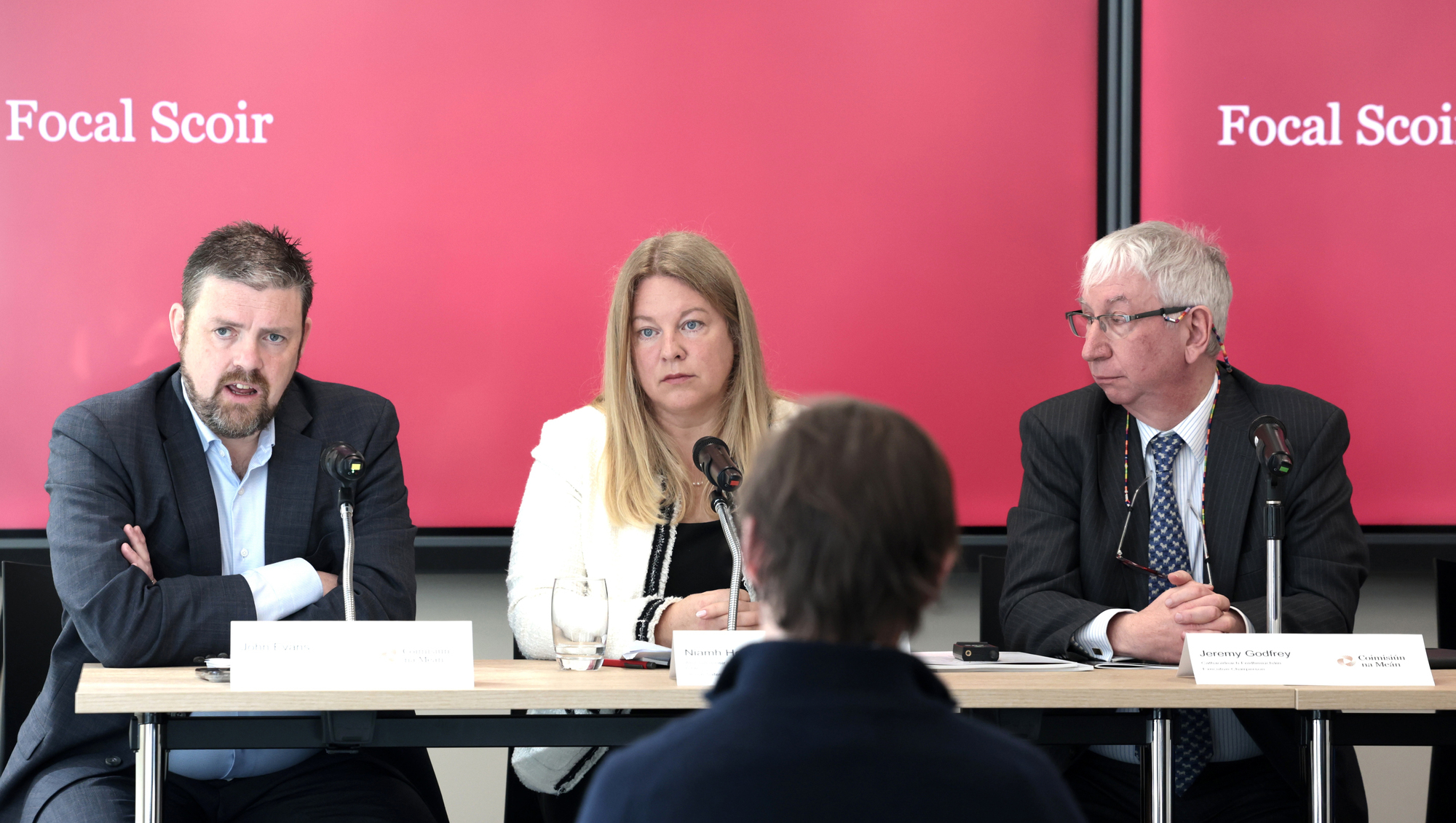
Digital services commissioner John Evans, online safety commissioner Niamh Hodnett, and executive chairperson Jeremy Godfrey at a press conference to launch Coimisiún na Meán's launch their strategy statement. Picture: Leah Farrell/RollingNews.ie

Even in the two short years since the country’s media regulator was established, the sectors it is tasked with holding to account have changed substantially.
Critics of Twitter, who had long said it was a cauldron of misinformation and hate, could scarcely have imagined the fresh depths it would plunge to under Elon Musk’s stewardship. Emboldened by the power he wields through the White House, Musk has shown disdain for European efforts to step up regulation.
Following the way the authoritarian winds were blowing, Mark Zuckerberg took up the example in January by getting rid of independent fact checkers in the US and making Facebook a free-for-all again as Donald Trump took office.
Toxic algorithms persist on the apps young people are glued to, guiding them down rabbit holes with studies showing these “recommender systems” are rapidly amplifying misogynistic and male supremacist content.
The Irish Medical Organisation (IMO) said on Friday that children as young as 10 are exposed to extreme pornography that is fuelling sexual and gender-based violence.
And that’s without even touching the other key remit of Coimisiún na Meán — public service broadcasting and RTÉ.
Oh, and election integrity too. It hardly needs emphasising how important it is that the body tasked with all this is on top of it all and does its job effectively.
Now with a staff of over 200 in its Dublin HQ, Coimisiún na Meán is entering a critical period as it ponders investigations into some of the big firms it regulates and sees its landmark online safety code fully come into force.
Last Thursday, it invited the media in as it outlined its work plan for the year and set out its strategy for the next three years. Executive chairman Jeremy Godfrey admitted that their aims are “very aspirational” and they “don’t expect to achieve them in full in the three-year period”.
For a body with such an important job, the means it will use to hold these companies to account can appear labyrinthian and difficult to parse.
For starters, it has something called its “online safety framework”. That’s three different sets of laws giving it powers to crack down on online platforms. Within that framework, it has the Digital Services Act (DSA), which is a mammoth piece of EU legislation aimed at preventing illegal and harmful activities online and the spread of disinformation.
Then it has Irish legislation underpinning something called the online safety code, to protect children and the public from harmful and illegal content. And then it has another EU law called the terrorist content online regulation, to counteract the dissemination of terrorist content.
There’s plenty of overlap across the different laws too.
Coimisiún na Meán can initiate investigations into firms under any one of these laws. It is also collaborating with the European Commission on existing probes into potential breaches.
Breaches of any of these laws can result in fines that could stretch into hundreds of millions of euro for the biggest firms. With us so far?

A common source of frustration for social media users are platforms leaving up content that so blatantly breaches its rules.
For a person who has been abused online and finds the social media site won’t take the offending content down, it’s not immediately clear how this framework can help.
One of the most important people at Coimisiún na Meán is Niamh Hodnett. Her title is quite simple, she’s the country’s online safety commissioner.
And, depite the complex system in which the regulator operates, in a one-on-one with the Irish Examiner after last Thursday’s event, she made the case that it is quite simple if someone is experiencing harm online that could fall under this framework.
“We have different setups in order to simplify it for ourselves, and everyone else externally,” said Ms Hodnett. “How we deal with it is, I lead the policy, research, and strategy division and John [Evans] leads the supervision, enforcement, and complaints division.
So whether it’s DSA, terrorist content or the online safety code, we treat it all the same. It’s harmful or illegal content or something that has happened to someone online.
“If our contact centre gets a contact by phone or email, we have a risk-based approach to how we prioritise.
“Priority one is if we’re concerned about imminent harm or imminent danger to a child.
“Another would be terrorist content as well as public safety elements, something like we would have seen with the [Dublin] riots back in the day.”
And they do get these priority one cases. Mr Evans, whose title is digital services commissioner, told Thursday’s event he had handled one such case of a child in harm the day before.
And both he and Ms Hodnett hinted that things may be coming to a head with some of the platforms in the very near future.
Last September, it wrote to companies including Meta, TikTok, Youtube, and X, demanding they give “comprehensive detail” on their approach for users to report illegal content on the platforms.
It appears that Coimisiún na Meán isn’t happy with the answers from at least some of these companies with the next step being a formal investigation that could lead to a substantial fine.
Mr Evans said they’ve been receiving “pushback” from platforms over its efforts to regulate them and “engagement doesn’t necessarily translate into compliance”.
Ms Hodnett, meanwhile, said there had been “extensive engagement” and the aim was getting them to change their behaviour rather than having to dish out substantial fines.
If the supervisory team come to the view they’ve reached a dead end or the end of the road in relation to supervisory dialogue, and the behaviours haven’t changed, then the matter gets escalated to the enforcement team, who then open the matter for investigation.
She diplomatically added “again, not prejudging anything”.
Nevertheless, it does appear clashes between the regulator and these social media companies will rear their head sooner rather than later.
Another looming battle on the horizon is X’s challenge to the online safety code.
From July, X will be obliged to do age assurance checks for users to watch pornography on its platform. It has taken a High Court case against the code, which will be heard in June.
Ms Hodnett revealed X has not yet told them how it will check users ages to prevent children accessing such content.
But if, as it has already done when Reddit and Tumblr challenged the code, Coimisiún na Meán wins the court case Musk’s X will have to play ball. If it doesn’t, another front will open up in its battle to hold these firms to account.
An important few months lie ahead for Ireland’s still-relatively-new media regulator. Given the scale of the harms that can be and are being caused online, it must prove itself to be up to the task.
CONNECT WITH US TODAY
Be the first to know the latest news and updates