Cork is home to Apple — why not use a slice of the €13bn to invest in city's infrastructure?
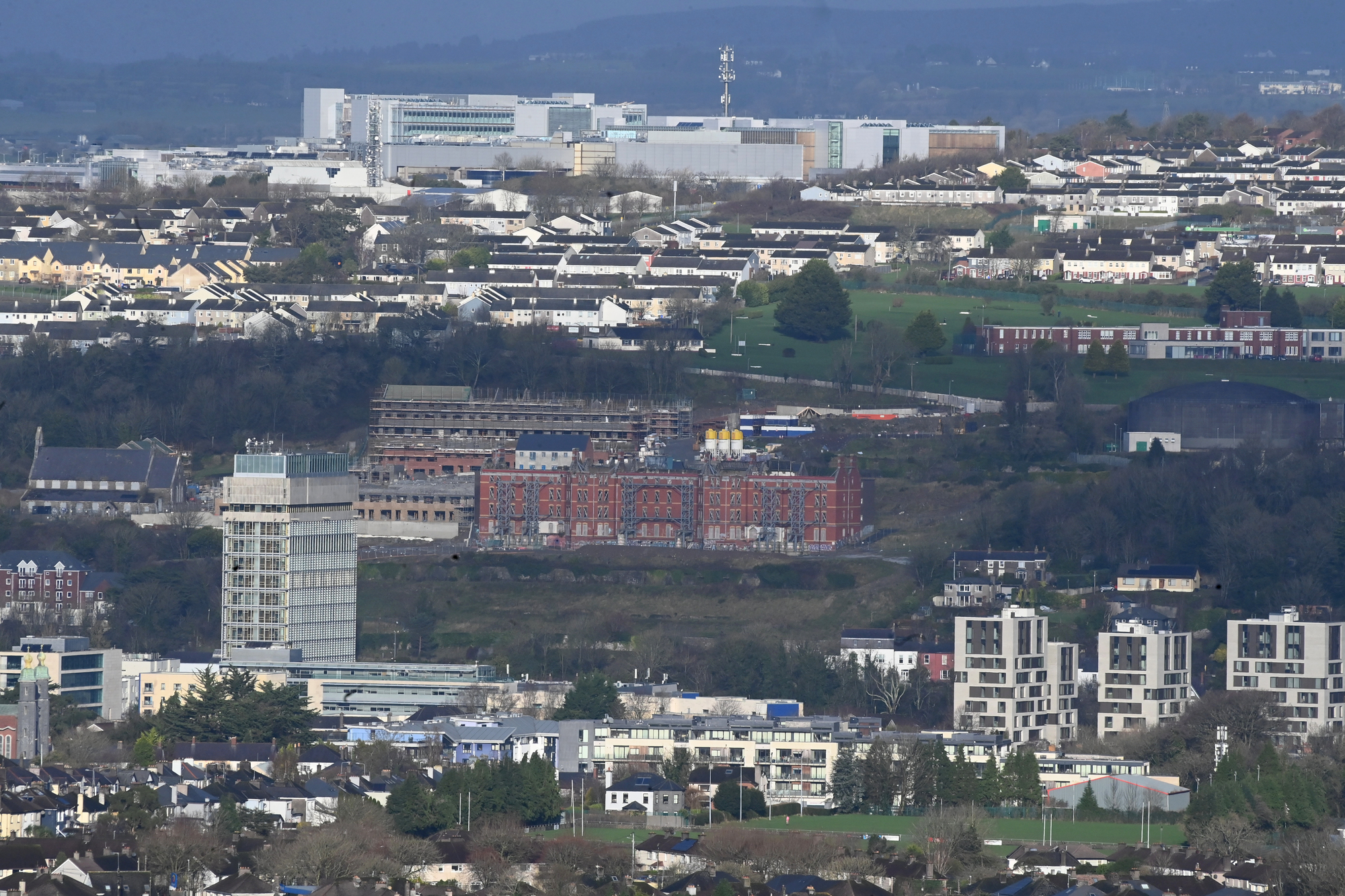
Apple’s campus atop Hollyhill overlooking the west side of Cork City. Landmarks in the foreground include Cork County Hall and the Crow’s Nest student accommodation.
Enhanced infrastructure is essential for attracting investment, improving the movement of goods and people, and fostering overall regional growth. Addressing this critical issue must be a top priority for the new Government to ensure Cork can compete effectively on the European stage.
In December 2024, a decision was made by An Bord Pleanála which will result in a possible 10-year delay in the delivery of over 1,300 apartments in Cork City. The reason for the planning refusal? Poor road infrastructure.
One of Ireland’s largest employers, Apple, is responsible for over 6,000 jobs at its European headquarters on the northside of Cork City.
Currently, the road network in the city is insufficient in relation to catering for the commuter needs of these Cork-based employees, not to mention the needs of the residents in the area.
The proposed northern distributor road is essential in helping to resolve the transport issues in the area, but funding is not forthcoming.
It begs the question why at least some of the €13bn in Apple tax received by the Government could not be invested here. This employer is already setting up new offices in London and Dublin, and the risk of investment not being made by Government in infrastructure in Cork City could lead to the loss of jobs in the region.
At what point does the cost of investment by Government outweigh the loss of investment by key employers? At what point does the cost of enabling the advancement of our essential infrastructure outweigh the risk of the alternative? We are already witnessing the answer to these questions.
The Cork event centre is symptomatic of the issues in Cork in relation to infrastructure delivery. We must see this and other projects delivered:
- The N25;
- The northern distributor road;
- The M28 Cork to Ringaskiddy road;
- The R624 Cobh to Cork road and Belvelly Bridge upgrade;
- The proposed light rail system;
- The M20 Cork to Limerick Road.
These are essential projects for the continued development of the region.
Cork is the fastest-growing city in Ireland and plays a key role in the economy of the south of Ireland.
What the Cork region needs to facilitate and enhance its ongoing economic development and population growth is targeted, strategic infrastructure investment and delivery.
The delivery of critical infrastructure, such as the M20 Cork to Limerick motorway, the M28 motorway, the N25 Carrigtwohill to Midleton upgrade, the event centre, and Cork’s light rail system, should be set out in the National Planning Framework (NPF).
Committing to the delivery of such strategic projects will, in turn, help to build Cork’s competitiveness and further contribute to its progress as a true economic counterweight.
It is difficult, if not impossible, to direct population growth as was anticipated in the 2018 NPF as people will be drawn to live close to where they work and businesses will be drawn to locate where business opportunities exist.
It is for this reason that it is essential that Cork is given specific attention to increase its attractiveness to large-scale employers and as a place to live.
We need to accept that the growth of Dublin cannot be stymied but what we require is for Cork to become so attractive in itself that businesses and new population will be drawn to Cork rather than being compelled to live there because they cannot get houses in Dublin.
The event centre would be a catalyst in this shift and would be an essential gateway to improving our transport routes and networks into and around the city. It would boost the economy in the region and have a natural impact on tourism and greater employment opportunities.
These initiatives would further incentivise foreign direct investment which increases tax revenue, releasing more funding for investment in infrastructure thus creating a circular economy within Cork itself.
There is a need for forward planning and investment by Transport Infrastructure Ireland, Uisce Éireann, ESB, and the Department of Education to ensure sufficient infrastructure with adequate capacity, including electricity supply for large industry, and to ensure sufficient numbers of school places in targeted growth areas.
There’s an urgent requirement for the identification of sites to cater for large-scale multinational investment of advanced manufacturing facilities and locations for the development of data centres.
There must also be early and adequate investment in social and amenity infrastructure to increase the attractiveness of targeted growth areas.
Only by means of such sufficient, timely investment can Cork and other regions compete with Dublin and act as the counterbalance that is urgently needed for social and economic sustainability.
The absence of a co-ordinated approach and forward investment in infrastructure has been highlighted in a number of reports, including the recent Housing Commission report.
The impact this has had on housing delivery and on FDI is also well publicised.
A new funding mechanism for state bodies that are charged with the delivery of key strategic infrastructure should be introduced that would guarantee multi-year funding or funding on a major project basis. This would enable these projects to be delivered with greater efficacy and cost effectiveness.
These state agencies, as well as all other state bodies and government departments, should be tied to the NPF to ensure alignment and secure essential delivery.
The Construction Industry Federation has called on Government to accelerate the delivery of the National Development Plan projects and provide increased funding to contracting authorities and government agencies responsible for the delivery of major infrastructure to enable them to scale up their capabilities in terms of skilled resources and technology.
We must have a strong construction industry to provide an engine for economic growth.
To support the continuity of the construction of infrastructure, similar to the Climate Action Plan, the Government should introduce legislation in the form of an infrastructure action plan act. This will help ensure that key infrastructure is delivered independent of what administration is in government, thus creating confidence in the future and certainty.
With over 600,000 people living in Cork, two thirds within 25km of the city itself, Cork is a thriving second-city region which is poised for significant growth over the next 20 years.
It is critical therefore, that blockages to adequate funding and the coordinated delivery of the necessary infrastructure are urgently addressed.
- Joanne Treacy is southern region director of the Construction Industry Federation
Read More
A collection of the latest business articles and business analysis from Cork.
CONNECT WITH US TODAY



Be the first to know the latest news and updates