The UN needs to intervene to revitalise peace talks between Israel and Hamas
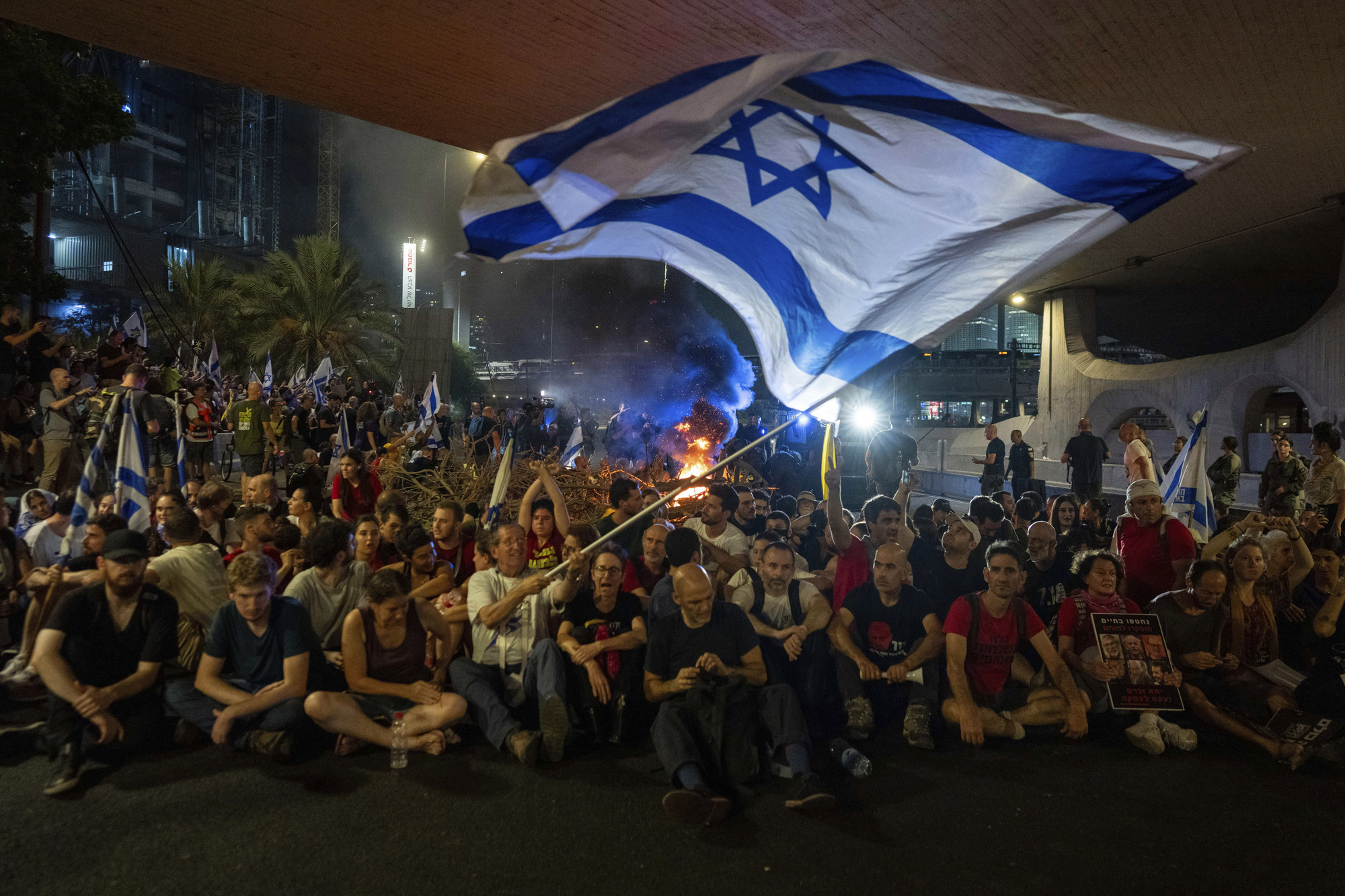
Protestors block a road in Tel Aviv, Israel, on Sunday calling for a deal for the immediate release of hostages held in the Gaza Strip by Hamas. Photo: AP/Ohad Zwigenberg
In the last few days, as this analysis is being updated, six Israeli hostages were found dead in a tunnel, having been killed as the IDF closed in on their location.
As the first anniversary of the October 7 attack approaches, these deaths, and the deaths of over 40,600 Gazans, underline the depths of barbarity and depravity to which the human condition can sink once the dogs of war are unleashed.
At the most recent Israeli Cabinet meeting a row broke out between Prime Minister Benjamin Netanyahu and Defence Minister Gallant. Gallant had produced a plan to fast track the release of Israeli hostages still being held in Gaza. His plan proposed an IDF withdrawal from the Philadelphi Corridor, the strip of land between Egypt and Gaza. A vote was taken, and Gallant’s plan was rejected.
The basic issue has been there since the Hamas attack on October 7. The two main tasks assigned to the IDF were the destruction of Hamas’s military capability to attack Israel and the rescue of the hostages. However, the priority task was never made clear, or perhaps never made public.
The Hamas attack was presented as an existential threat to the State of Israel. As a defence analyst, with experience of living and working in Israel, I have argued elsewhere that Hamas, alone, was not an existential threat. But once the Israeli Government decided it was, the fate of the nation of 10 million people should have taken priority over the fate of 251 hostages.
Since the mid-80s guidelines are in place for how the IDF should respond when military personnel are taken hostage. One of these guidelines is known as the Hannibal Directive. This directive, or protocol, stated, amongst several iterations, that during a kidnapping the main task becomes to rescue our soldier, even at the cost of killing or injury to our soldier.
The Hannibal Directive did not mention civilian hostages. The precise ratio of military to civilian hostages in Gaza is unknown or was not revealed.
Nevertheless, the directive was invoked for follow-up operations on October 7, and a number of hostages were killed or injured by IDF units trying to prevent them being taken into captivity, in Gaza.
There was a view, dating from the early decades of the Israeli State, that Israeli civilians caught up in hostage situations should regard themselves as soldiers. I have heard this said in the past but not mentioned in the present crisis, perhaps because many of the hostages have dual nationality.
The Cairo talks on a ceasefire agreement in Gaza have ended, with lower level technical teams remaining to work on the bridging proposals. The war continues and, unfortunately, without active talks involving the main stakeholders, the momentum to achieve peace has stalled.
As far back as three months ago, Hamas was ready to negotiate a permanent ceasefire with Israel. By then they had achieved their primary objective. With their attack on October 7, they had brought the Palestine situation to the world’s attention.
The ruthlessness with which they conducted the mass killing of Israeli citizens sent a shock wave of fear and anger through the Israeli nation. Predictably, it provoked a monumentally disproportionate reaction by the Israel Government, which, so far, has led to the traumatisation of the entire 2.3 million population of Gaza.

The overwhelming majority of those killed in Gaza were innocent men, women and children. Let us call it for what it is. It is a holocaust. The destruction of Israel is not part of Hamas’s current agenda. It may well be part of a future agenda if the next generation of Palestinians is radicalised to seek vengeance.
The Israeli Government is between a rock and a hard place. Its stated objective is the destruction of Hamas and the release of the Israeli hostages. It is also clear that Hamas has not yet been defeated. The IDF's current strategy to defeat Hamas will take another six months to ensure its success, unless Hamas capitulates.
There is much division in the Israeli Government, with Netanyahu being accused by his own negotiating team of obstructing an agreement. Right-wing ministers are advocating a major escalation in the war, including a ground invasion of Lebanon, and moderate ministers are threatening to resign unless Netanyahu goes along with the current US proposals for a ceasefire and the release of hostages and detainees.
The US Presidential election campaign is entering a final and decisive phase. The Biden administration is getting desperate to achieve a functioning ceasefire in Gaza before Election Day on November 5.
Vice President Kamala Harris’s speech in Chicago showed that, in office, she will broadly pursue the Biden policy. Her two main points were the ongoing US commitment to the security of Israel, and her support for the Palestinian right to self-determination.
It is clear that a Trump victory would favour Netanyahu’s position on the Gaza question. It was, after all, the Trump Administration that agreed to move the US Embassy to Tel Aviv, that recognised Israel’s annexation of Israeli Occupied Golan and withdrew the US from the Iran Nuclear Agreement.
Trump announced that the US no longer considers Israeli settlements on the West Bank a violation of International Law (recently reversed by Biden). There is understandable speculation that Netanyahu may be trying to stall the negotiations until November 5.
Netanyahu has laid down four conditions for Israel to accept the bridging proposals. First, that there is an ongoing IDF presence on the Philadelphi Corridor. Second, that the IDF retains the ability to stop the movement of armed men across the Netzarim Corridor, the recently created line that divides Gaza into Northern and Southern zones.
Third, release of the largest number of living hostages in the first six weeks of the ceasefire. Fourth, that Israel retains the right to continue fighting Hamas until it is destroyed.
However, why not consider UN or EU peacekeepers being deployed along the Philadelphi and Netzarim Corridors? From a defence point of view it is not essential that the IDF ‘man’ these lines.
The third Netanyahu proposal, on hostages, could work in conjunction with the release of Palestinian detainees. However, Hamas agreeing to its own destruction would be, to paraphrase Alice Glenn, like turkeys voting for Christmas. But even on this issue, there is the option of letting Hamas fighters go into exile under a flag of truce.
On the question of international peacekeepers, some of the larger Arab nations are positive but many of the smaller nations have reservations. Most want a clear proposal on a political solution before considering any security arrangement for Gaza. Some want the Palestinian Authority to be reformed before its authority over Gaza is restored.
While tensions between Hezbollah and Israel continue, Iran is holding back its retaliation for the assassination of Hamas political leader, Ismail Haniyah, and has signalled there may be no Iranian response if a ceasefire in Gaza is agreed.
Without ceasefire talks actually in progress, the fighting in Gaza will continue. Some new initiative is necessary. The question is by whom? Is it time for the UN Secretary General to intervene?
- Dorcha Lee is a retired Army Colonel, and defence analyst