Justice for Magdalenes group will be voting no in the care referendum. Here's why
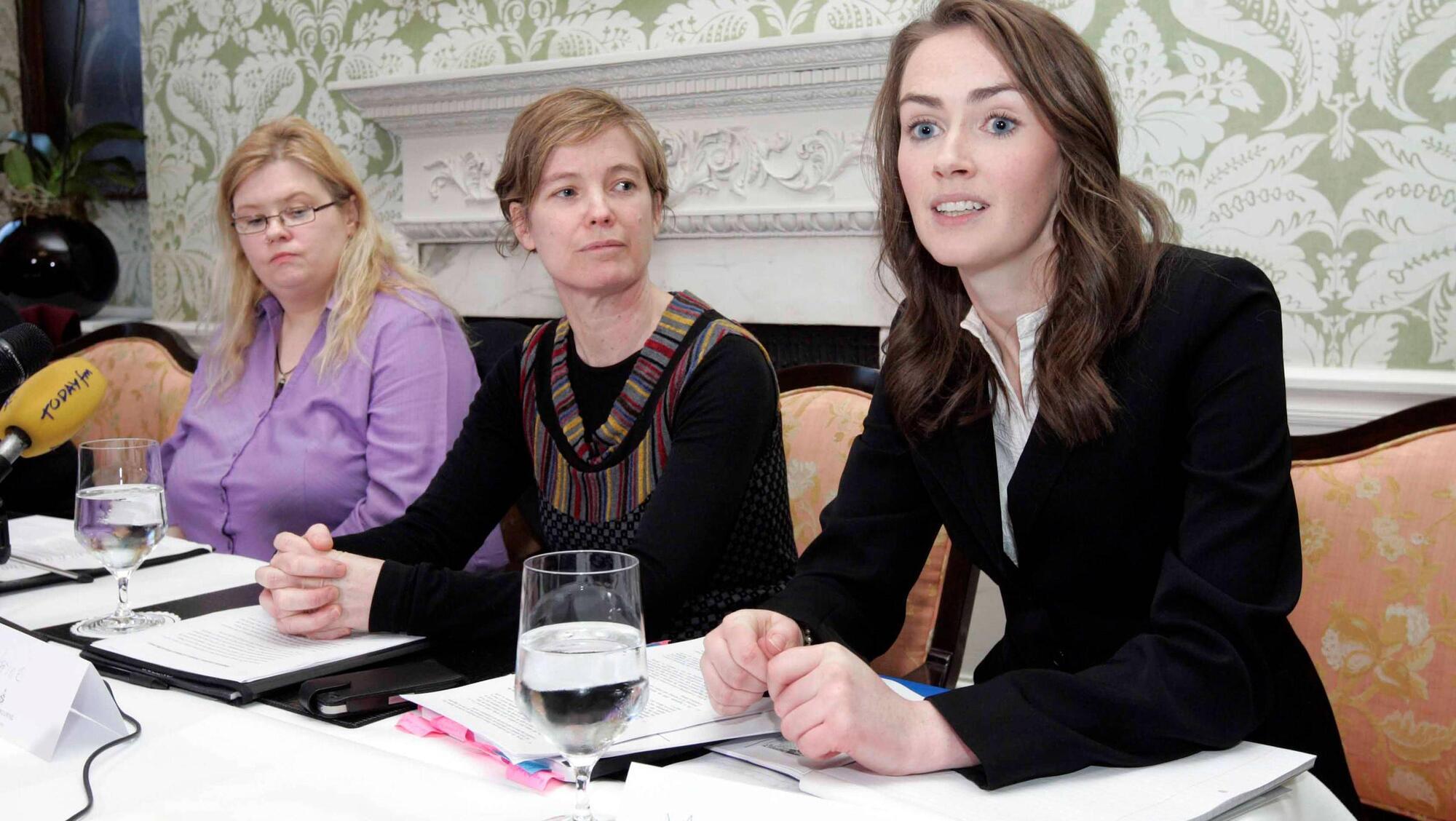
(Left to right) Claire McGettrick, Katherine O'Donnell and Maeve O'Rourke from Justice for Magdalenes in 2013. They are among a growing numbers of Irish feminists who are publicly admitting that they will vote ‘No’ on the Green paper ballot. File photo: Mark Stedman/Photocall Ireland
The upcoming referendum on March 8 has two ballot papers. The white paper asks voters to widen the definition of family to include people living in “other durable relationships” and many Irish feminists seem relatively content to vote yes on that paper.
The Green paper ballot seeks to remove Article 41.2 which discriminatorily characterises women alone as having a "life within the home" and "duties in the home".
As a condition of repeal, the Government is proposing an entirely new, standalone Constitutional Article (42B) entitled ‘Care’ that states: "The State recognises that the provision of care, by members of a family to one another by reason of the bonds that exist among them, gives to Society a support without which the common good cannot be achieved, and shall strive to support such provision."
There are growing numbers of Irish feminists who are publicly admitting that they will vote no on the Green paper ballot. We are among that number.
Foremost among our reasons for voting no on the Green ballot is that this proposed article betrays the committed work of many years by groups who campaigned together to achieve important recommendations from the Citizens’ Assembly and an all-party Oireachtas Committee, only for the Government to propose an entirely opposed understanding of what best constitutes ‘Care.’
A Citizens’ Assembly on Gender Equality comprising 99 members of the public and their independent chairperson started work in 2020, holding hearings and meetings over 16 months (including online during the pandemic).
They concluded: "Article 41.2 of the Constitution should be deleted and replaced with language that is not gender specific and obliges the State to take reasonable measures to support care within the home and wider community."
In December 2022, the all-party Oireachtas Joint Committee on Gender Equality ratified the Citizens’ recommendation, advising Government to hold a referendum to replace Article 41.2 with the following wording: "The State recognises that care within and outside the home and Family gives to the State a support without which the common good cannot be achieved. The State shall, therefore, take reasonable measures to support care within and outside the home and Family."
We have all been children, most of us increasingly live into advanced ages, we all get ill; many of us have disabilities, including temporary or acquired, or were born with complex health issues and care needs. The Citizens Assembly and Oireachtas Joint Committee on Gender Equality imagined a relationship between us all where together we work to ensure that the care we need will be provided. That caring work we provide is valued. That respite is possible.
The Government wants to insist that it is families, first, foremost and solely who must provide care while the State will "strive" to support them. The Government’s proposed clause makes a distance between citizens, presumed clustered in family groupings, and a transcendent State, removed from obligations to care, committed to (at best) offering forms of support for all of the caring work that must be done.
To date, the Supreme Court has refused to find that Article 41.2 imposes legal obligations on the State: because of the wording that the State will merely "endeavour to ensure that mothers shall not be obliged by economic necessity to engage in labour to the neglect of their duties in the home".
So, if the new article on Care 42B is inserted into the Constitution we can expect the State to similarly argue that a phrase such as "striving to support" entails no legal obligations on the State to actually support carers.
In our work together since 2009, firstly on the Justice for Magdalenes Campaign, and later on the Clann Project which sought to engage with the Mother and Baby Homes Commission of Investigation, we have repeatedly seen how the Irish State has practised outsourcing the provision of education, healthcare, and social welfare to private (largely religious) organisations.
This practice means that the State continues to argue to various UN bodies that it is not culpable for any systemic abuse or wrongdoing in those private organisations.
The neural pathways that the Irish State developed in footing the bill to allow the Catholic Church control social care provision in Ireland has morphed now into a neoliberal capitalist model. Government pays, but no legal obligations attach, and those who manage to receive any care do so as the beneficiaries of charity or benevolence: not as rights-holders who are entitled to make demands of the State.
We are an outlier among our neighbouring jurisdictions in our abject lack of legislation relating to effective care provision. If the Government had put forward the Citizens’ Assembly’s Referendum proposal, public debate would surely now be focused on what "reasonable measures to support care within and outside the home and Family" might mean. Inevitably, discussion would have turned to the glaring absence in Ireland of a system of statutory rights to care services and supports.
The potential of the Citizens’ Assembly’s recommendation to bring about some systemic change, or to contribute pressure for faster change than State officials prefer, is perhaps why the Government kept it out of the people’s hands.
Thus, the Care Referendum could have been—but now is not—the first step in expanding the Irish Constitution’s coverage of socio-economic rights, bringing Ireland in line with most countries in the world and demonstrating our capability and confidence as a society beginning our second century of independence to shape our own future.
If next Friday’s Care Referendum is defeated, co-ordinated and strong civil society advocacy will be required—and there will be the opportunity for such advocacy—to ensure that a future Government puts forward a proposal to enshrine support for care as a justiciable right alongside deletion of Article 41.2.
So far, one opposition party leader has promised to do so, and there is a need for further public pressure to convince all politicians of this approach.
We are committed to breaking the bad habits of the past century where our State outsourced responsibility to a private sector and defended itself from accountability towards the citizens.
We will vote Green no and continue to argue we are better when we accept our mutual obligations to support care for all.
- Professor Katherine O’Donnell, Dr Maeve O’Rourke, Dr Claire McGettrick, Justice for Magdalenes Research