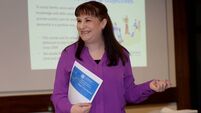
Sarah McEntee: Referendum on family and care just a first step

The Government has confirmed plans to hold referendums on constitutional references to family and care in March.
As a lone parent of two teenage children whose experience of our chronic care system has been nothing short of brutal, I have a huge stake in the outcome of the March referendum replacing the role of “women in the home” in the Constitution with a new clause that explicitly recognises care within the family.
I have been parenting completely alone for the past 14 years with no involvement financially or otherwise from my children’s father.
I am one of hundreds of thousands of women in this country providing care either unpaid, or seriously underpaid.
In fact, 98% of full-time carers are women, and the continuing reliance on us for care and unpaid work has huge consequences for our economic equality.
This is especially true for disabled, lone parents, and women from minority backgrounds.
The human impact for lone parents like me is huge.
As a lone parent I went to college, volunteered, and eventually got offered a part-time contract working for the Department of Education.
I was delighted with this achievement and proud to prove to myself and my children that hard work pays off.
But the financial sacrifice of this meant my household income was going to be reduced by €80 a month.
When I questioned this with social welfare, I was told if I got an extra two hours work a week, I would be able to claim €180 a week on working family payment.
I was able to appeal this decision and was awarded the working family payment.
But there are so many others who aren't in a position to argue.
When my children were younger, I worked part time. I was able to do this only because I was a special needs assistant and was off during school holidays.
Most days I was up at 6am and didn’t stop until 9 or 10pm between working and being a full-time mam.
There was never any time to switch off.
The unpaid care I gave, and still give at home, is completely undervalued and invisible, but the costs are huge.
As a lone parent, I always felt I was being watched.
While in receipt of one parent family payment and rent allowance I was told by social welfare that I needed permission in advance if I wanted a friend to stay overnight.
The result of this was that I was afraid to ask any friends or family to stay with me, which has led to further social exclusion and isolation.
Currently, the one parent family payment ends when the youngest child reaches seven.
A seven-year-old child can't mind themselves.
Parents who have no childcare or family support need to be available to drop and collect their children from school, be available for school holidays, teacher training days, 12 o'clock school finishes, and if a child is sick.
The sad reality of that is there is very little work that will coincide with this — it is a vicious circle leaving lone parents crippled and in deprivation.
Childcare places in Ireland today are difficult to get.
Early Childhood Care and Education Programme places are only available for 38 weeks of the year, and the increase in fees for the remaining weeks can be crippling for some families.
I am currently working with a teen parent who has had to drop out of fifth year in secondary school as she has no childcare.
Why should this young mother have to miss out on her education?
The cost of childcare in Ireland is one of the highest in the EU, according to Social Justice Ireland.
This is a significant barrier to women’s equal participation in the workforce and in society.
As a result of not being able to work full time, I have had to rely on social housing.
My children have lived in 12 different houses, and I have no security that we won't have to move again.
In 2020, I was number 364 on the Dublin city council housing list.
Today, three years later, I am number 328.
Going by that rate, it will be another 20 plus years before I reach the top of that list, I will be close to retirement age by then.
We need to approach care as a human right as well as a gender equality issue, and one where we deliver for those most economically excluded.
The Irish State must invest in care as a social good.
I shared my experience as part of a joint project by ActionAid Ireland and the National Women’s Council on care.
Their paper, launched on Wednesday and written by academic experts on gender Ursula Barry and Ciara Jennings, makes substantial policy recommendations which would recognise the value of care.
The paper says publicly funded, accessible, quality, affordable early years education and childcare for school age children should be provided.
This could be done by increasing the state share of national income spent on childcare from the current 0.37% to at least 1%.
And a statutory home support scheme for older people and people with disabilities should be introduced.
Crucially, the paper recommends that all those working in care, including live-in carers and early years educators, be paid a living wage — and have access to decent regulated working conditions.
It also calls for social protection reforms ensuring lone parents have the same total paid leave as a couple.
By actioning these recommendations, Ireland will ensure that care is rewarded, the burden of unpaid care work on women is reduced, and that care is redistributed within and between households.
Care needs to be reclaimed as a social and public responsibility.
It needs to be recognised as a human right.
Changing the Constitution is a first step, which is why I will be voting “Yes” in March.
But it’s just a first step. Much, much, more needs to happen.
- Sarah McEntee is a teen carer support worker with Doras Buí, a service that provides support and programmes to one-parent families living in the North East Dublin area

CONNECT WITH US TODAY



Be the first to know the latest news and updates