Elaine Loughlin: Martin adds his two-cents to teacher training debate
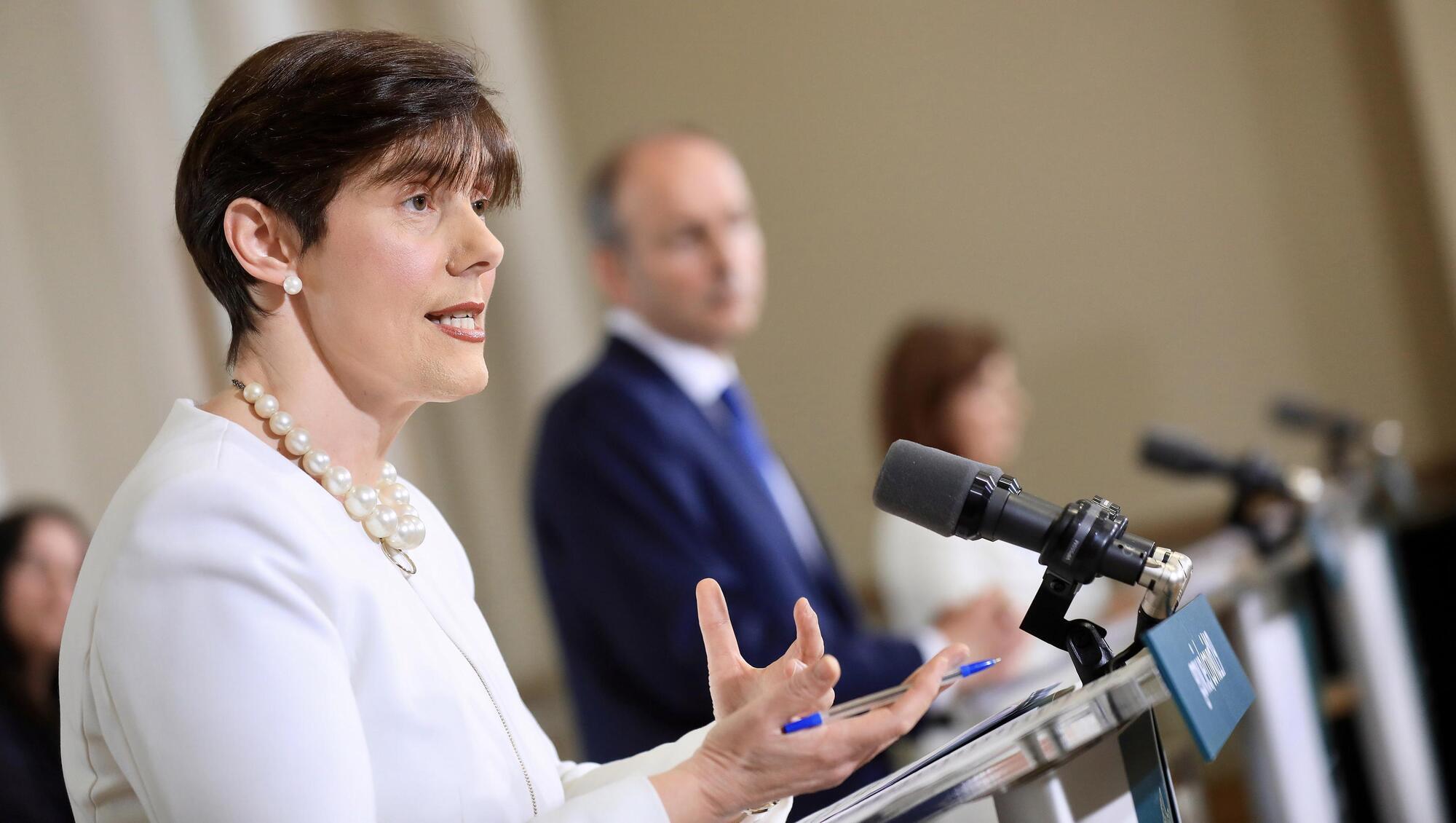
Minister Foley is not afraid to stand up against the unions and in some instances her own party colleagues. However, she is also very cautious. Picture: Julien Behal

“If Micheál was to anoint anyone, she would be the chosen one,” one backbench TD remarked under his breath as he watched the education minister buying a round of drinks for colleagues at the Fianna Fáil think-in, despite being a pioneer herself.
There is no denying that Norma Foley’s political career has accelerated under Micheál Martin’s leadership.
Indeed, there were more than a few raised eyebrows back in 2020 when Foley, a first-time TD, was appointed to what is one of the more senior positions in Cabinet.
And so, Martin’s recent intervention on the future of teacher training courses, which goes completely against what his own hand-picked minister has been arguing for some time, is a curious one.
In a move that has already been welcomed by teaching unions, Martin said the two-year conversion course should be cut by one year.
With principals in many schools now desperately scrambling to recruit and retain teachers, representative bodies have been calling for an overhaul of the current two-year Postgraduate Masters in Education (PME) qualification course for teaching.
Following Martin’s comments, teachers will now be left wondering why the minister hasn’t been able to side with the unions on this issue.
The PME replaced the traditional HDip in 2014. Referring to the old system, Martin said: “When I qualified myself, I did a general degree and then we did a HDip year and there was a natural follow-on.
For someone who had just finished their BA, BSc, or whatever, you had the incentive of saying ‘one more year and I am a qualified teacher’.
At the annual conference last Easter, the Teachers’ Union of Ireland (TUI) claimed that more than 2,400 teachers could be brought into the education system in a year if the Government reformed the route into teaching.
Cutting the PME programme could see some 1,500 post-primary school teachers coming on stream a year earlier.
Unlike other reforms around pay and conditions being demanded, TUI education research officer David Duffy said changing the length of the course could be “done very quickly if Minister [Norma] Foley was behind it. It would be a very significant and very welcome reform.”
Figures from the Irish National Teachers Organisation (INTO) also show there are 917 annual PME graduates at primary level, almost 700 of whom are from the private Hibernia College.
In an interview with the Irish Examiner published this week, Martin, who was a teacher himself before he entered politics, backed the unions, claiming the two-year system puts a massive financial burden on students.
“If you’re working class or your income is limited to what your family can do, the idea of the masters in teaching will be a daunting financial prospect. I think we should be alive to revisiting all that.
“I do think we perhaps have to look at, particularly at the post-primary level, that masters process and the two-year timeline and whether we can shorten that.”
Martin went up against what he described as the “pure educationists” who “might say we need two years”.
“I’m not convinced,” he said bluntly.
However, his own minister, who worked as a teacher at Presentation Secondary School, Tralee up to her election in 2020, has — at least up until now — camped out with the pure educationists.
Under pressure to change the system, Foley remained defiant when she attended the conveyor belt of teacher conferences back in April of this year.
Citing the fact that “more is being asked” of teachers with a constantly changing curriculum, Foley said she had no plans currently to reduce the PME.
I think the two years does ensure that we have very rounded, inclusive, and up-to-the-minute experience of demand teaching today.
She added: “One of the greatest strengths that we have in this country is that we do have very high-calibre teachers, and to do that we need to ensure that they are sufficiently and suitably trained to achieve that.”
Timing is everything and Martin’s comments coming just weeks ahead of the budget will be seen by many as perhaps an indication of where changes might now happen in the lifetime of this Government.
However, some have noted that Martin has the experience and political courage, which Foley lacks, to put forward his own ideas.
A constant criticism of many newly appointed ministers is that they cede too much power to senior civil servants, who then control the narrative and manipulate the policy direction in a given Department.
Bar a few wobbles at the beginning of her tenure, Foley has been a solid performer who has been responsible for the introduction of free schoolbooks and the expansion of the Deis scheme which helps the most disadvantaged.
She is not afraid to stand up against the unions and in some instances her own party colleagues.
But, equally, Foley is a cautious minister.
“She tends to rely on what the Department gives her and sticks rigidly to the line,” said one education source.
It has been pointed out that in 2019, when the recruitment issue was not as pronounced as it is now, her predecessor Joe McHugh went on a fact-finding mission to the UAE in a bid to identify a way to lure teachers back from abroad.
“McHugh used to acknowledge there was a sizeable teacher crisis, but she tends to stick always to the same department lines,” said one observer.
Foley was never going to be the next Donogh O’Malley.
The Fianna Fáil education minister famously infuriated the minister of finance in 1966 when he announced without any prior warning or consultation, the rollout of universal free secondary school education.
O’Malley is now considered a visionary whose radical overhaul of the education system had a significant positive impact on social mobility and cultural change.
But at the time, his off-script decision sparked fury and a financial nightmare for his Cabinet colleagues.
Given her own background in the classroom, those representing teachers have been beyond frustrated at times with Foley’s rigid abidance to the official department line.
In stepping into the teacher-training fray, Martin has shown the difference between political clout and ministerial inexperience.

Subscribe to access all of the Irish Examiner.
Try unlimited access from only €1.50 a week
Already a subscriber? Sign in
CONNECT WITH US TODAY
Be the first to know the latest news and updates