India's landing shows the moon is not just the final frontier for super-powers
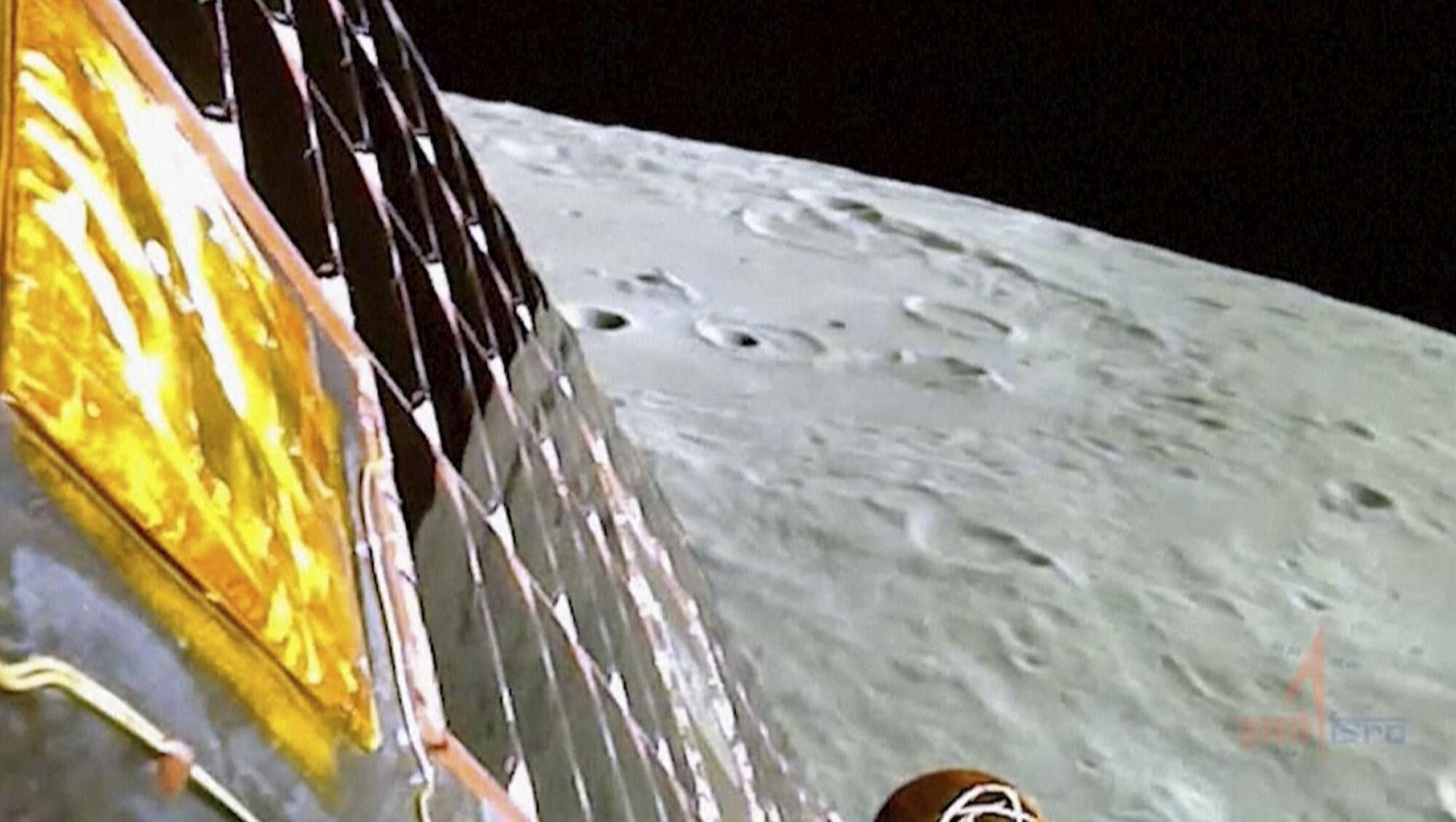
This image from video provided by the Indian Space Research Organisation shows the surface of the moon as the Chandrayaan-3 spacecraft prepares for landing on Wednesday, August 23, 2023. Picture: SRO via AP
When India's small six-wheeled rover rolled out across the surface of the moon this week, it was following a long and honourable tradition.
India's first satellite was rolled out to the launch pad on an ox cart. Another satellite was small enough to be wheeled out on the back carrier of a bicycle.
India's astonishing recent successes, on the moon and around Mars, were hard-won after decades of single-minded determination. They are a triumphant demonstration that countries with limited resources need not be excluded from 'The Final Frontier'.
Space is not just for the superpowers. When Ireland hopefully launches its first satellite later this year, the question really should be: “Why has it taken us so long?”.
Suddenly — or so it may seem — everybody is going to the moon. The lunar south pole region, where Chandrayaan-2 touched down with the Pragyaan rover onboard, is of particular interest due to the presence of water ice in permanently shadowed regions.
This water resource could potentially revolutionise future space exploration by serving as a vital component for life support, fuel generation, and sustaining future missions to Mars. More than a dozen countries have plans for missions to the moon in the coming years, including a mission launched by Japan’s space agency that is expected to lift off later this month.
The United States also has plans to send three commercial lunar landers to the moon starting as early as this year, while Nasa and the European Space Agency continue to work toward the Artemis 3 mission, which might put astronauts back on the moon as soon as 2025, but it may be significantly delayed by recent budget cuts in Washington.
Working alongside allies such as the United States and the European Space Agency, India is part of a second wave of emerging space powers.
The country’s space programme has become one of the world’s busiest in its development of high-tech space technology.
Chandrayaan-3 has been a point of national pride and widespread interest across India. Crowds gathered at the launchpad at Satish Dhawan Space Centre in Sriharikota in Andhra Pradesh state to watch the mission take-off in July.
On Wednesday, more than 8m people tuned in to view a livestream of the landing. Schools throughout India were kept open so students could experience the event together.
India’s mission has taken on even greater significance since Russia’s failed Luna 25 landing attempt.
With the success of Chandrayaan-3, India became the second country to land a spacecraft on the moon in the 21st century after China, which has put three landers on the lunar surface since 2013 — including the first to touch down on the moon’s far side.
Landing on the moon, however, remains a challenging endeavour. India’s last attempt to land a spacecraft on the moon, during the 2019 Chandrayaan-2 mission, failed. And two commercial spacecraft have crash-landed on the lunar surface in recent times — one from Israel in 2019 and the other from Japan just last April.
The Pragyan rover, equipped with advanced instruments, has already begun to traverse the lunar surface and to analyse samples. Powered by sunlight, it will spend the next two weeks travelling across the surface, analysing rocks and peering into craters to see if there are ice deposits in the places that have not seen sunlight in billions of years.
This achievement on the moon comes at a particularly important moment in India's diplomatic push as an ambitious power on the rise in South Asia.
Indian leaders have been advocating in favour of a multipolar world in which New Delhi is seen as indispensable to global solutions.
In space exploration, as in many other fields, the message of prime minister Narendra Modi’s government has been clear: The world will be a fairer place if India takes on a leadership role, even as the world’s most populous nation works to meet its people’s basic needs.
That assertiveness on the world stage is a central campaign message for Mr Modi, who is up for re-election to a third term early next year. The Chandrayaan-3 landing coincided with his trip to South Africa for a meeting of the group of nations known as Brics; nonetheless, Mr Modi’s face beamed into the control room in Bangalore during the landing’s final minutes, and he spoke for 10 minutes after the landing on a video link from South Africa.
Space has suddenly reclaimed a place in the consciousness of nations that it has not occupied since the 1960s. India and other developing nations now see their space programmes as a way of signalling to young people that they must strive for academic success.
India is the only country in the world to elect a space pioneer as president of their nation: the nationally revered and internationally acclaimed Abdul Kalam.
Here in Ireland, there is also a new recognition that success in space technology is a metaphor for a country's commitment to industrial advancement in the 21st century.
Educational Irish Research Satellite 1, EIRSAT-1, is to be Ireland's first satellite, and it is tentatively scheduled to be launched towards the end of this year.
There is absolutely no reason why Ireland's next satellite after that could not be heading to the moon or even Mars. We just need that Indian can-do attitude.
CONNECT WITH US TODAY



Be the first to know the latest news and updates