State must stop treating young people as substandard with sub minimum wage
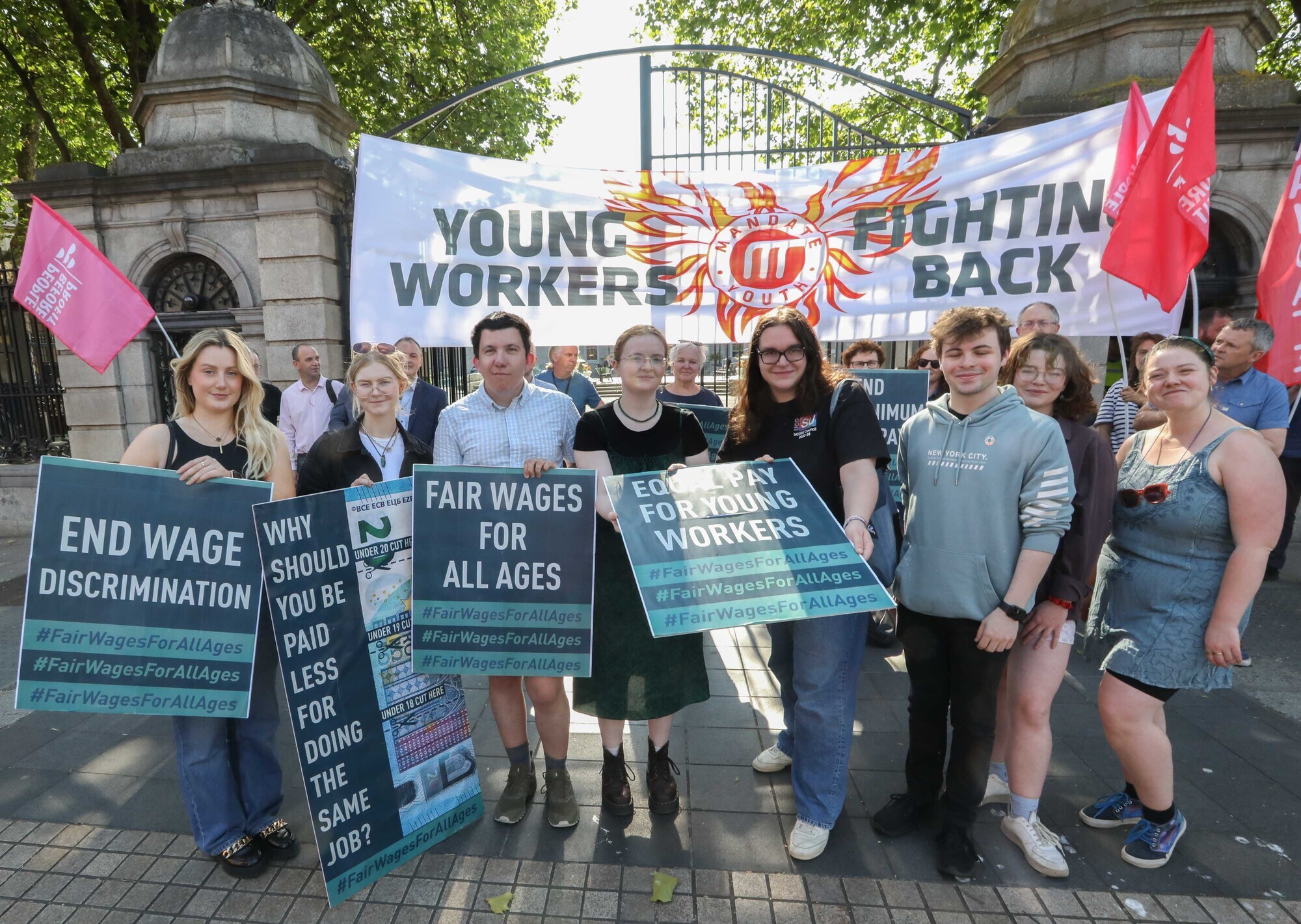
A rally outside Leinster House last month calling for all TDs to support passage of National Minimum Wage (Equal Pay for Young Workers) Bill 2022 to end wage discrimination against young workers.
In 2019, the planet watched as young people took to the streets. We had never seen such power coming directly from the hands of the youth, and that power influenced other young people to join in and call for climate action.
Young people were seen as citizens, people with valid opinions and valid electoral influence, even if they were too young to vote.
Many of us who participated in those initial strikes and the organising that followed are now older. We grew up within a movement of social change, where we were constantly lionised for our eloquence, our understanding of certain concepts beyond our years and so on and so forth.
And yet the politicians who owe their positions directly to these young people, clearly continue to view us as irrelevant and inconsequential.
The sub-minimum wage allows for young people below the age of 20 to be paid at decreasing rates dependent on age. The common argument against its abolition centres on businesses not being able to afford higher wages. According to this argument, standard wages would affect business viability and consumer prices. In theory, having a lower minimum wage for certain employees should alleviate some of the stresses of inflation on costs of production, thus reducing prices for consumers and increasing consumer demand which inevitably has a positive effect on profit.
But classical economics also states that wages should equal productivity. Again, in theory, (a theory, by the way, which governs the way most of our economy operates, if not all of it) a worker who is producing the same output as another worker should be paid the same amount. By paying young people less, the government is stating, loud and clear, that we are simply not as good as older employees.
But this way of thinking is outdated and ties into a wider conversation about ageism in our systems, particularly as a person reaches legal adulthood at the age of 18. Is there really that much difference between someone who is 19 and someone who is 20? A 19-year-old is most likely no less qualified than they will be a year later. They will not develop super-human strength or productivity on the night of their 20th birthday, or suddenly become financially independent. It is evident that age is not the primary factor in the decision to maintain the sub-minimum wage.
The irony of economic rationalism as a defence mechanism against any form of social change is that when politicians and businesses make excuses on the basis of decreasing costs of production, or increasing efficiency by paying their workers less, they are actually actively contradicting the classical economic theory on which they are supposedly basing their arguments.
For example, let’s accept that young people are paid less and are therefore less productive. If they are less productive, they are less efficient and thus create long-term costs for the business. So, following this logic, why employ young people at all if they lack that productivity that magically appears on their 20th birthday? By employing workers who are, in theory, less efficient than their older counterparts by virtue of their age, a business is theoretically contributing to market failure by inefficiently allocating its resources. It is obvious that productivity is not tied to age, and this proves once again that the sub-minimum wage is discriminatory.
By paying young people lower, the implication is that real, genuine work carried out by younger people at the expense of time they could have spent studying and with friends, is less than that of their older colleagues. And this, unequivocally, is discrimination.
The argument which often arises that young people should not be hired by employers solely because they lack experience is deeply flawed and unjust. Experience should not be the sole criterion for hiring decisions. Young individuals bring fresh perspectives, enthusiasm, and a hunger to learn and grow and now more than ever, to contribute to the world around them.
By denying them employment opportunities based solely on their age, we not only overlook their potential but also perpetuate a cycle of exclusion and inequality. It is crucial to recognise that everyone starts their professional journey without experience, regardless of their age. Young workers possess valuable skills, including adaptability, technological proficiency, and a willingness to take risks.
Employers should focus on nurturing talent, providing mentorship, and offering training opportunities to harness the potential of young workers, not the amount they are going to pay them for the work they do. Embracing diversity in age and experience creates a dynamic and inclusive workforce that fosters innovation and drives progress. We must reject discriminatory assumptions about young people's abilities and champion equal opportunities for all in the labour market.
For many young people, the wages they earn are now their sole sources of income. Rising homophobia and transphobia force many young people to leave their homes. Inflation, caused largely by government incompetence, has pushed up the cost of living. Young people’s income is often used to provide substantial support to their families and themselves. To assume every young person simply works to pass the time or to save up for their leisure time later on, is idealistic and naive, words commonly thrown at young people when we call for our needs to be addressed.
We must recognise that the time for outdated ageism is over and that it is only through the recognition of young people as genuine citizens and contributors to society that we will secure a better and more equitable future. If we are powerful enough and important enough to contribute to society as change-makers, surely we are important enough to be paid the same wage as those slightly older than us.
As we move towards the implementation of the living wage from 2026 onwards, we must begin the process of securing equal pay for equal work by ensuring a linear wage for all workers. We, the youth, should not have to wait until we can sit in the seats of decision-makers to enjoy equal opportunity. Implementing changes for the future begins in the present.

CLIMATE & SUSTAINABILITY HUB
CONNECT WITH US TODAY



Be the first to know the latest news and updates