Joining EU was inflexion point in Ireland's progress
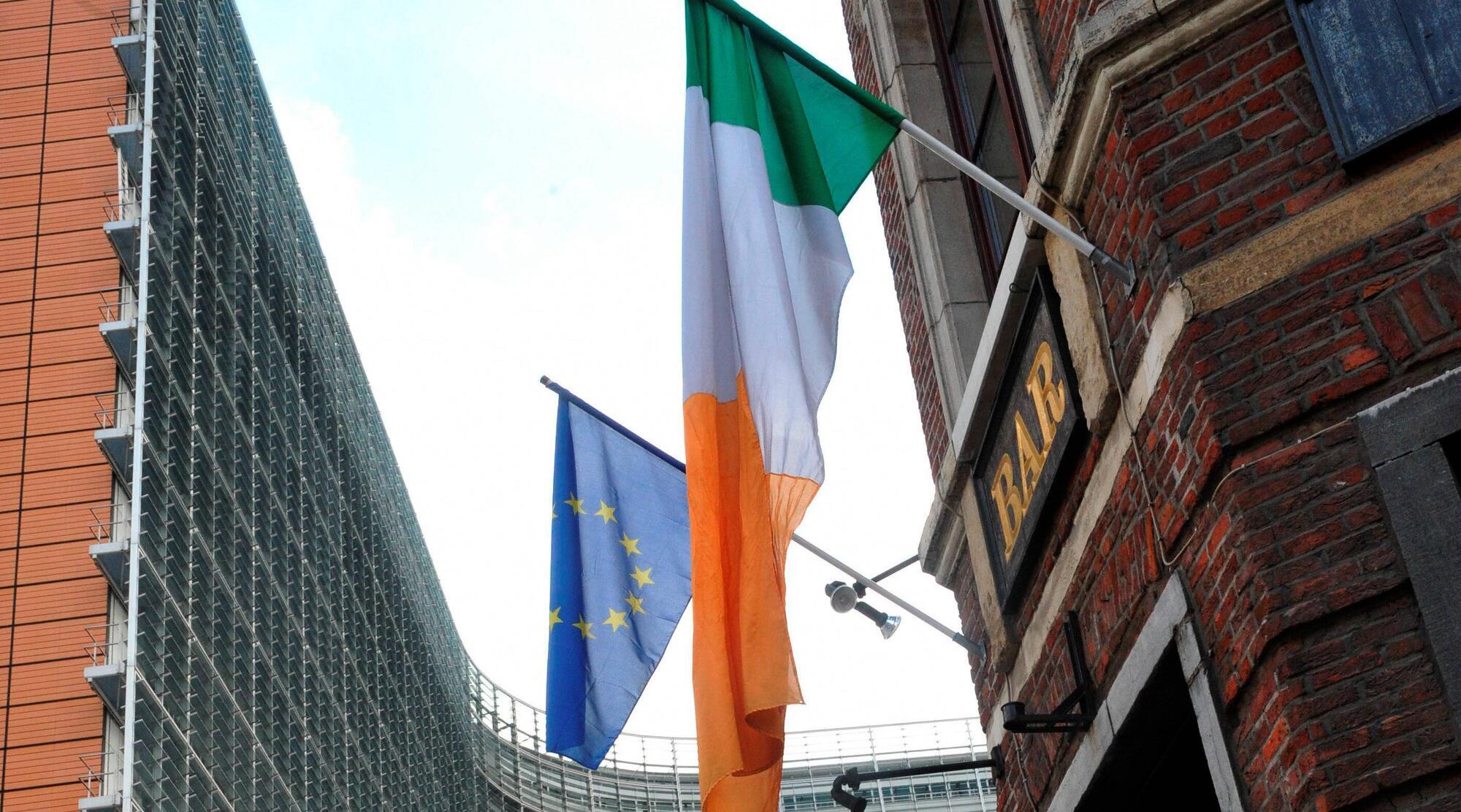
EU and Irish flags in Brussels. In contrast to the poor living conditions that drove waves of people out of Ireland in the 1950s and 60s, today 97% of us say that we are happy we live here. We must be thankful to our European neighbours for helping us achieve that. Picture: Dominique Faget/AFP/Getty Images
The first of January marks the 50th anniversary of Ireland’s accession to the European Economic Community (EEC), the forerunner of today’s EU. It was one of the most important decisions ever taken by the Irish people and foundational to our subsequent success.
The accession itself occurred 50 years after the formation of the Free State. The promised benefits of an independent Ireland had not been experienced by the population at large.
The number of people in employment was precisely what it had been in the 1920s at less than 1.2m.
National income per person remained only two-thirds that of the UK. And education levels were very low with free secondary-level education having only been introduced in 1966, 20 years after the UK had done so.
With two-thirds of our exports still going to Britain, arguably little at all had been achieved by independence. The inflexion point in our national development was joining the EEC.
Ireland first applied to join in 1963 but French president General Charles de Gaulle made it clear that France did not want Britain as a member, and Ireland was not in a position to proceed without its largest trading partner.
Ireland and the UK had to wait until his retirement to successfully conclude accession negotiations.
A referendum was held in May 1972 to decide on entry. The yes campaign posters promised “more jobs, better standard of living, guaranteed export markets, less emigration, better social welfare”.
Entry was opposed by the Labour Party, which feared that increased competition from European companies would result in job losses, and by Sinn Féin, concerned about the loss of sovereignty.

The vote was overwhelmingly in favour, with 83% of voters endorsing membership. Its positive impact was wildly underestimated, if anything. All of the campaigner’s promises were to be bountifully delivered on.
We gained access to the largest market in the world, enabling us to radically diversify our export markets. The union invested many billions of euros in modernising our infrastructure in the 1970s and 80s.
And the introduction of the single market in the 1990s enabled the IDA to promote the country as a single base of operations for companies that wanted to sell into continental Europe.
Our gross national product per capita is amongst the highest in the world.
Our goods and services exports are valued at nearly €400bn, and we are the largest exporter of beef in the northern hemisphere. We are now a country of net immigration. And our tax and welfare system is amongst the most equalising in developed nations.
The transformative benefits of membership have included many in the social arena too. Gender equality legislation was a requirement that delivered immediate benefits for mná na hÉireann.
It was the European Court of Human Rights that declared our criminalisation of homosexuality to be illegal in the 1980s, with subsequent EU equality legislation amongst the most comprehensive in the world.
Today, quality of life in Ireland is among the very highest in the world. The UN judges us the eighth best country on the planet in human development, for example.
Of course we have many challenges facing us — what country does not? — but we are now a wealthy, modern, liberal democratic state and EU membership has been integral to achieving that.
Our open economy is now a world-leader in attracting inward investment and job creation. It has also proven itself a magnate for the skilled professionals that we lack indigenously.
The 2022 census showed that we added 1m people to our population in less than two decades — making us one of the fastest growing countries in Europe.
Half of this is attributable to significant reductions in our death rate as we win battles against disease and live longer than any previous generation. Half was due to net immigration.
As we head into our second century of independence, it is critical that we retain the open disposition that has proved so critical to our success.
While population growth will pose us challenges in housing, healthcare, and carbon emission reduction, it will underpin the continued economic growth we need to finance the solutions to these.
We have reason to be optimistic. EU research undertaken in Ireland this year found that 89% of us think positively about free trade and 75% are positive about globalisation.
80% of us are satisfied with how democracy works in the EU and 86% say we are optimistic about the future of the EU.
That makes us the most optimistic nation in all of Europe about the union’s future.
We recognise how beneficial membership has been for us. In contrast to the poor living conditions that drove waves of emigration in the 1950s and 60s, today 97% of us say that we are happy we live here.
We must be thankful to our European neighbours for helping us achieve that.
- Mark Henry is the author of . See his website for more.
CONNECT WITH US TODAY



Be the first to know the latest news and updates