Emily O'Reilly: Scandal should prompt overhaul of EU anti-corruption framework
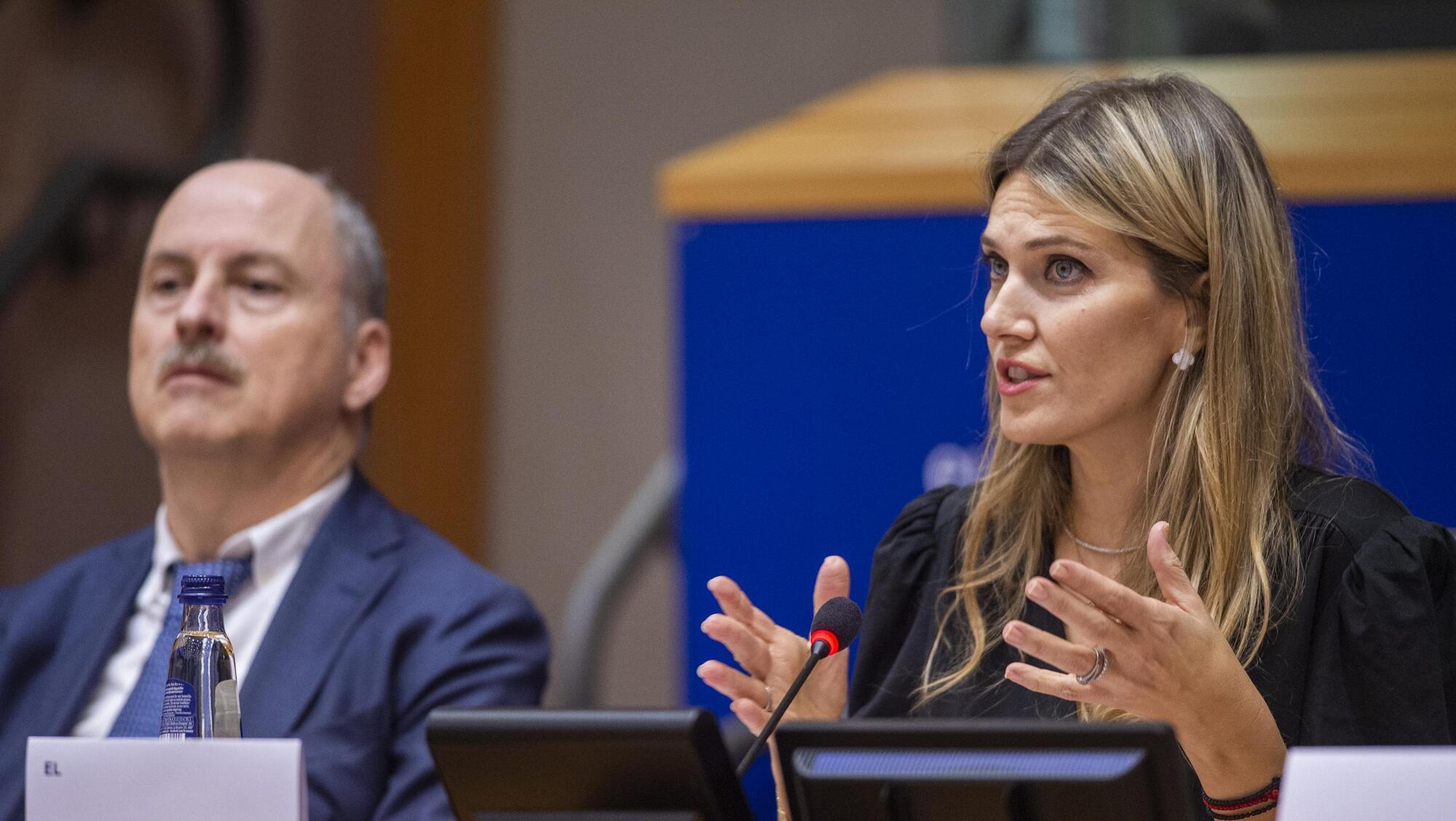
Greek politician and European Parliament Vice-President Eva Kaili, right, speaks during the European Book Prize award ceremony in Brussels. Kaili and three others were charged in connection with an investigation into suspected corruption linked to Qatar.
The corruption scandal engulfing the European Parliament is an example — albeit an extreme one — of what happens when a strong anti-corruption and ethics system is seen as an optional extra rather than an integral part of a public institution.
The damage it is doing to the credibility of the European Parliament, and to the institutional EU more widely, is immense.
By now the contours of the story are well-known — an apparent web of corruption, bribery, and influence-peddling in the EU’s only directly-elected institution, allegedly bankrolled by a Gulf state to the tune of — so far as we know at this stage — €1.5m.
Images from the Belgian police of actual bags full of cash have an almost comedic quality, but no one in the European Parliament — bar some members of the far-right — is laughing.
Whether this comprises the entirety of the scandal or is just the tip of the iceberg is a subject of frenzied conversation in the corridors of Brussels and Strasbourg, as MEPs, media, and others rake over the embers of past legislative decisions for evidence of undue or corrupt influence.
Hungarian Prime Minister Viktor Orban, who has long been in the crosshairs of the European Parliament for alleged anti-democratic and corrupt behaviour in Hungary, took to Twitter to mock what he determined to be hypocrisy.
While the vast majority of elected MEPs behave ethically and in the public interest, a weak and porous system of accountability can allow those who are not — whether MEPs or their staff — to act with impunity.
The scandal has shattered complacency, exposing long-apparent flaws in the Parliament’s anti-corruption and ethics framework. These include allowing MEPs to have second jobs, some of which risk conflicts of interest; the absence of rules about what jobs they can take up post-mandate; and the fact that their meetings with representatives from foreign countries are not required to be registered and made public.
It is also notable that it is the Belgian police taking the lead in this investigation and not the EU’s own anti-corruption systems. “Belgian justice is doing what, at first sight, the European Parliament hasn’t done,’ the Belgian prime minister remarked.
The shock and horror provoked by this scandal was predictable but it beggars belief that there could be such apparent institutional blindness to the size and value of the EU as a target for corruption.
The EU is a global trading power, a global regulatory power, and a global political power; it has the capacity to not only make or break entire industrial sectors, but also to enhance or sully the reputation of countless states around the world, many of whom actively seek the type of PR shine that the EU can bestow.
Foreign powers are also clearly paying close attention, and trying influencing our law-making. It is no coincidence that of the 10 top lobbying spenders in the EU, six of them are US firms, as highlighted by the large-scale lobbying around recent EU laws regulating tech firms. There is speculation now about what the Gulf state may have sought to influence, such as visa liberalisation for its citizens or possibly the aviation deal concluded with the EU last year.
While this scandal is particularly egregious, there have been numerous other attempts to sway European and national lawmakers, albeit without the bags of cash. Recent revelations about the tactics used by US company Uber to try to access markets in Europe provided EU regulators with a masterclass of what they are up against.
The methods reportedly ranged from backroom meetings with high-level politicians, the use of ‘stealth technology’ to block scrutiny, paying academics for flattering analyses of their product, and the actual flouting of certain laws.
While some of those methods are new, the lobbying playbook has remained largely unchanged over the years that is, lobbyists doing whatever it takes to exercise influence through a network of informal and formal contacts, at both the political and expert levels, and throughout the entire decision-making process.
As Ombudsman, I have drawn attention to the damaging effect of so-called ’revolving doors’, when politicians and senior public officials bring their expertise and contacts to new jobs in the private sector, a form of insider lobbying. I have also supported the need for an independent ethics body with teeth to monitor EU politicians. This latter idea was proposed by the European Commission President in 2019, but it continues to go round the institutional circles with little apparent appetite — until now — to see it through.
Any new EU ethics body, must have real powers and must have a mandate over not only MEPs and Commissioners, but also over national ministers and ambassadors who wield the most significant but often most opaque power in Brussels.
As European Ombudsman, I have heard more talk about the importance of fighting corruption and boosting ethical standards in the last few days than I have in my entire nine years in office. We shall see if this fine rhetoric delivers real results.
CONNECT WITH US TODAY



Be the first to know the latest news and updates