Not fit for purpose: Cop27 made a down-payment on disaster
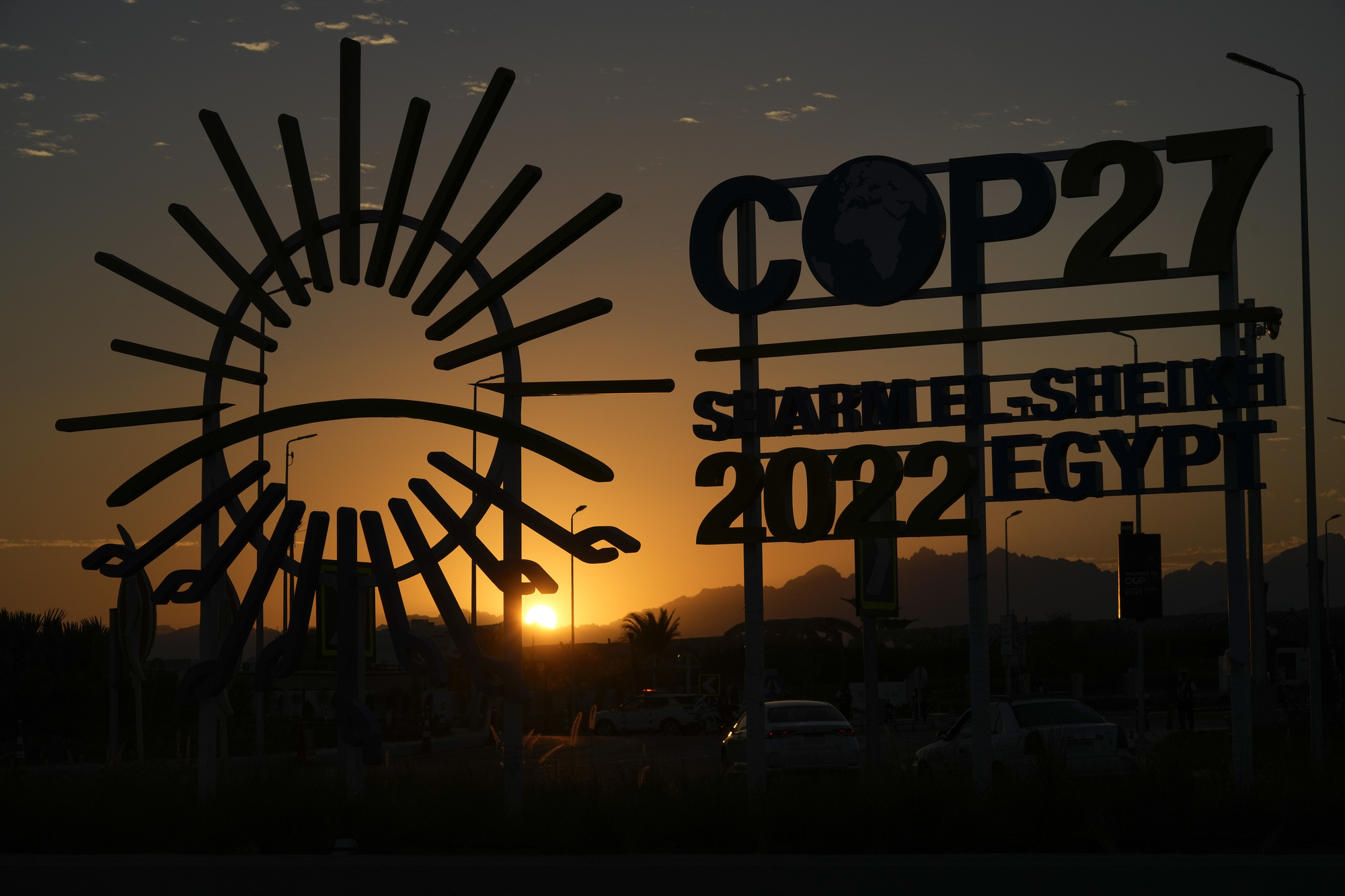
The sunsets behind the Cop27 logo outside the venue of the summit in Sharm el-Sheikh, Egypt. Picture: AP Photo/Peter Dejong
In the end, Cop27 in Sharm el-Sheikh at least ended up making modest progress on loss and damage — high-emissions nations agreeing to pay those countries bearing the brunt of climate mayhem that they had little to do with bringing about.
But, yet again, there was no commitment to cutting the emissions accelerating this crisis, without which this agreement is nothing more — as one delegate commented — than a “down-payment on disaster”.
No seasoned observers are of the opinion that the world is any nearer to tackling the climate emergency.
Indeed, the real legacy of Cop27 could well be exposing the climate summit for what it has become, a bloated travelling circus that sets up once a year, and from which little but words ever emerge.

It really does beggar belief, that in the course of 27 Cops, there has never been a formal agreement to reduce the world’s fossil fuel use.
Not only has the elephant been in the room all this time, but over the last quarter of a century it has taken on gargantuan proportions — and still its presence goes unheeded.
It is no surprise, then, that from Cop1 in Berlin in 1995, to Egypt this year, emissions have continued to head remorselessly upwards.
Expectations were never especially high since Glasgow’s Cop26. Even so, Cop27 has to be a new low — held in a country cowed by a malicious dictatorship, the world’s biggest plastic polluter on board as a sponsor and hosting more than 600 fossil fuel representatives and many others who are there to prevent, rather than promote progress and action.
I would never question the sincerity of those working within the UN Framework Convention on Climate Change (UNFCCC), established way back in 1992, nor those embedded in the Cop climate apparatus, who I know are desperate to find a solution to our predicament.
I do, however, seriously wonder whether an annual extravaganza in the full glare of the world’s media is the way to do this.
In all honesty, it is becoming increasingly difficult to view these events as anything other than photo opportunities for presidents and prime ministers.
And there is another huge and growing problem too. The all-encompassing nature of the annual Cop climate conference provides one enormous open goal for fossil fuel representatives; an unprecedented opportunity to kettle ministers and heads of state from every corner of the planet, but particularly the majority world, to browbeat them into handing over their untouched fossil fuel reserves for exploitation.
At Cop27, the sharks were circling around African nations, desperate to persuade them of the urgent need for a “dash for gas” and looking for a very large piece of the action.
In retrospect, it does seem that the whole idea of annual climate carnivals was probably not the best means of promoting serious action on global heating, but their hijacking by the fossil fuel sector, and failure, year on year, to do the job they were set up to do, surely means that Cop is no longer fit for purpose.
I don’t claim to be an expert in negotiation policy and procedure. I can, however, spot when something clearly isn’t working and needs a serious reboot.
But if the annual Cop climate conferences go then what would replace them? What is needed is an apparatus less cumbersome and more manageable — something leaner and meaner that zeros in on the most critical aspects of the climate crisis, that does its work largely hidden from the glare of the media, and which presents a less obvious honey pot to the busy bees of the fossil fuel sector.
One way forward, then, could be to establish a number of smaller bodies, each addressing one of the key issues — notably energy, agriculture, deforestation, transport, loss and damage, and perhaps others.

Such bodies would operate full-time, liaising with one another and perhaps coming together a few times a year.
Ideally, they would be made up of representatives from both developed and majority-world countries. In direct contact with representatives of national governments, part of their remit would be to negotiate agreements that are workable, legally binding, and which actually do the job — whether reversing deforestation, cutting methane emissions, or drawing down coal usage.
As and when all terms and conditions are agreed, these could be validated and signed off by world leaders as a matter of course and without the need for the ballyhoo of a global conference.
Back in the 1970s the economist and early environmentalist, EF Schumacher, wrote that in respect of economics, small is beautiful. It is a phrase that today could equally well apply to our international negotiating efforts to bring global heating to heel. After the abject failure of Cop27 it’s worth a try, surely.

CLIMATE & SUSTAINABILITY HUB
CONNECT WITH US TODAY



Be the first to know the latest news and updates