Rise in EU carbon emissions continues amid post-Covid rebound
Rise in EU carbon emissions continues amid post-Covid rebound

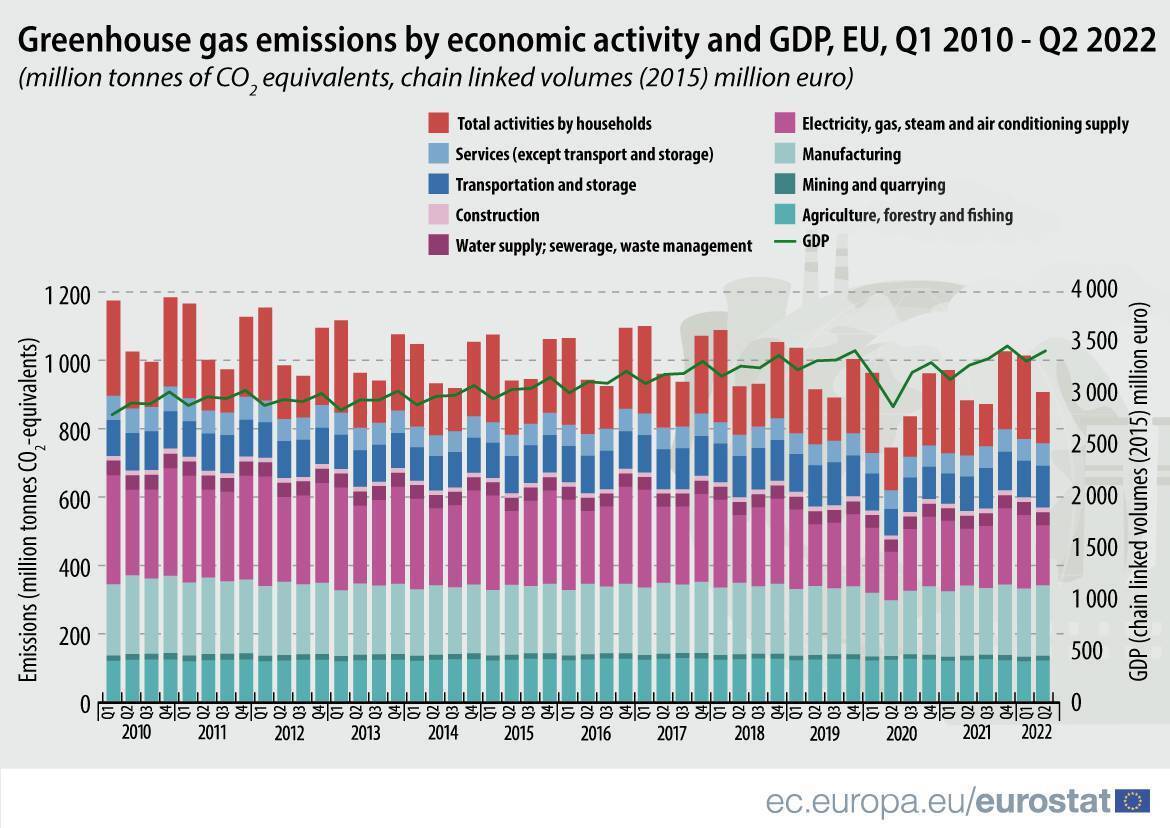
Greenhouse gas emissions by economic activity and GDP in the EU, Q1 2010 to Q2 2022.

A rise in greenhouse gas emissions by EU member states is largely being blamed on a post-Covid economic rebound as countries' GDP bounced back from the impacts of the pandemic.

Emissions rose by 3% in the second quarter of the year compared to the same period in 2021.

The rise comes at a critical time in the battle against climate change, amid warnings that global climate targets and reductions in emissions are being missed.

Greenhouse gas emissions amounted to 905m tonnes of CO2 equivalents in spring this year, according to Eurostat, the statistical hub for the European Commission.

However, emissions remain below pre-pandemic levels of 914m tonnes of CO2 in the second quarter of 2019, and levels have been steadily decreasing in the last decade.

Manufacturing (23%), electricity and gas supply (19%), households (17%), transportation and storage (14%), and agriculture (13%) were those sectors blamed for being the greatest emitters. 

Transport and storage recorded the largest hike in emissions compared to the previous year, surging 22%, while households and agriculture fell by 8% and 1% respectively.

Senior research fellow at University College Cork’s MaREI environmental institute Paul Deane said the data is “disappointing but not surprising”.

“We are seeing similar trends in Ireland with preliminary data showing Ireland’s greenhouse gas emissions are increasing at a time when they need to be decreasing,” he said. 

Similar to Europe, strong economic bounce-back from Covid has led to more driving and more emissions while increased coal burning to generate electricity is driving up emissions in Ireland."

Mr Deane said emission trends are going in the wrong direction and "are at odds with our political ambition and climate needs”. 

Cop27, the annual global climate summit, has put pressure on the world’s largest carbon emitters to detail their decarbonisation plans and contribute financially to countries disproportionately affected by climate change to which they did little to contribute.

Last week, Met Éireann confirmed the country saw its highest-ever minimum temperature for a November night. At Shannon Airport in Co Clare, the temperature did not fall below 15.5°C on Thursday. Daytime temperatures hit 17.5°C in west Mayo.

In recent weeks, parts of Ireland have experienced up to 2.5 times the average rainfall for this time of year and the World Meteorological Organization said weather patterns of up to 35°C in Spain were “hard to believe”.

An Environmental Protection Agency report recently found that local authorities in Ireland must step up their monitoring of air, noise, water, fuel, and farms, and the 8m tonnes of construction and demolition waste annually needs better enforcement.

x

CLIMATE & SUSTAINABILITY HUB

More in this section

Lunchtime News

Newsletter

Keep up with stories of the day with our lunchtime news wrap and important breaking news alerts.

Cookie Policy Privacy Policy Brand Safety FAQ Help Contact Us Terms and Conditions

© Examiner Echo Group Limited