Cianan Brennan: An Bord Pleanála following the whitewash playbook

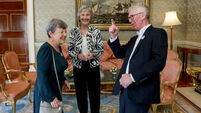
An Bord Pleanála chairman Dave Walsh recommended Paul Hyde's appointment as deputy chairman.
We’re fully six months into the scandal surrounding An Bord Pleanála, and it feels very much like the whitewash playbook is being followed step by step.
That may sound like a strange thing to say, given it has emerged that the former deputy chairman of the planning authority Paul Hyde is facing criminal charges of giving false declarations of interest to ABP.
But there are lots of ways of looking at it. Fundamentally, the controversy serves as a validation of the reporting across the media, notably on website and in this newspaper, which exposed the questionable nature of Mr Hyde’s declarations and some of the decisions he has been party to in recent years.
It’s hard to dismiss something as a non-story when it leads to a criminal investigation.
Mr Hyde, however, will have a day in court over this.
Nevertheless, while Mr Hyde's role in the ABP story has progressed since he stood aside from his role in May — having at all times denied any impropriety on his part — other elements of the saga have been brushed aside by those in authority.

At least two of them, the chairman Dave Walsh — who recommended Mr Hyde's appointment as deputy chairman and on whose watch the whole shambles unfolded — and Michelle Fagan, whose name was inextricably linked with the decisions made by Mr Hyde over the past five years, seem to have avoided further official scrutiny.
Ms Fagan has been signing off on applications ever since Mr Hyde first stepped back from his role. Last week she gave the order to refuse the construction of a house and garage in Clogherhead, Co Louth.
The statement put out by ABP in reaction to the publication of a first report by the State’s planning regulator last week is telling.
That report — broadly seen as being the least controversial of the three probes commissioned as a result of the scandal — recommended “major reform” of the organisation, but stopped short of pointing any fingers.
What did the board focus upon?
That the report “contains no specific criticisms of the board’s practices but rather is aimed at further strengthening the robustness and documentation of its systems and procedures to restore and enhance the board’s reputation and standing within the planning system”.
The statement continues, adding that “the chairperson acknowledged the huge amount of work done to date to address many of the issues raised”.
You would be forgiven for thinking that the chairman had had nothing to do with any of the decisions — notably with regard to strategic housing developments, four of which have been quashed by the courts in the last five days alone — handed down by ABP in recent times.
Consider some of what has been revealed regarding the other board members — consistently overruling their own planning inspectors (in one case to approve an application brought by an ex-employee of the board member); making decisions on applications next to their own homes on a regular basis; when this was pointed out, altering the geographic locations from which they were recused from voting upon; voting on 26 planning applications as a two-team board in one afternoon.
At the very least, such behaviour deserves further scrutiny.
The probe of Mr Hyde by senior counsel Remy Farrell was limited entirely to three facets of his own decision-making and his declarations of interest. The rest of the board has gotten a free pass despite voting alongside, and mostly in agreement with, Mr Hyde for eight years.
Yet all that remains to come is an internal review of ABP carried out by itself, and set to be delivered to Mr Walsh.

And the minister? Well, earlier this year Darragh O’Brien introduced legislation that will, among other things, make it increasingly difficult in the future to take a judicial review for a planning decision in the courts.
Mr O’Brien has taken a long look at the madness exploding out of the ABP offices and concluded that increased legal oversight is a bad thing, actually.
He even said as much the other day: “I don’t believe planning decisions should be made in the courts, it’s not the right place for them.”
“We have a housing crisis that is resolvable and solvable, we need people to stop objecting, frankly,” he said.
That does not mean that we are necessarily back where we started — it means the Government hopes that we are.
Time will tell whether it’s right or not. If it is, it is a triumph for cynicism over transparency.