Putin's nuclear threat evokes memories of the Cuban missile crisis
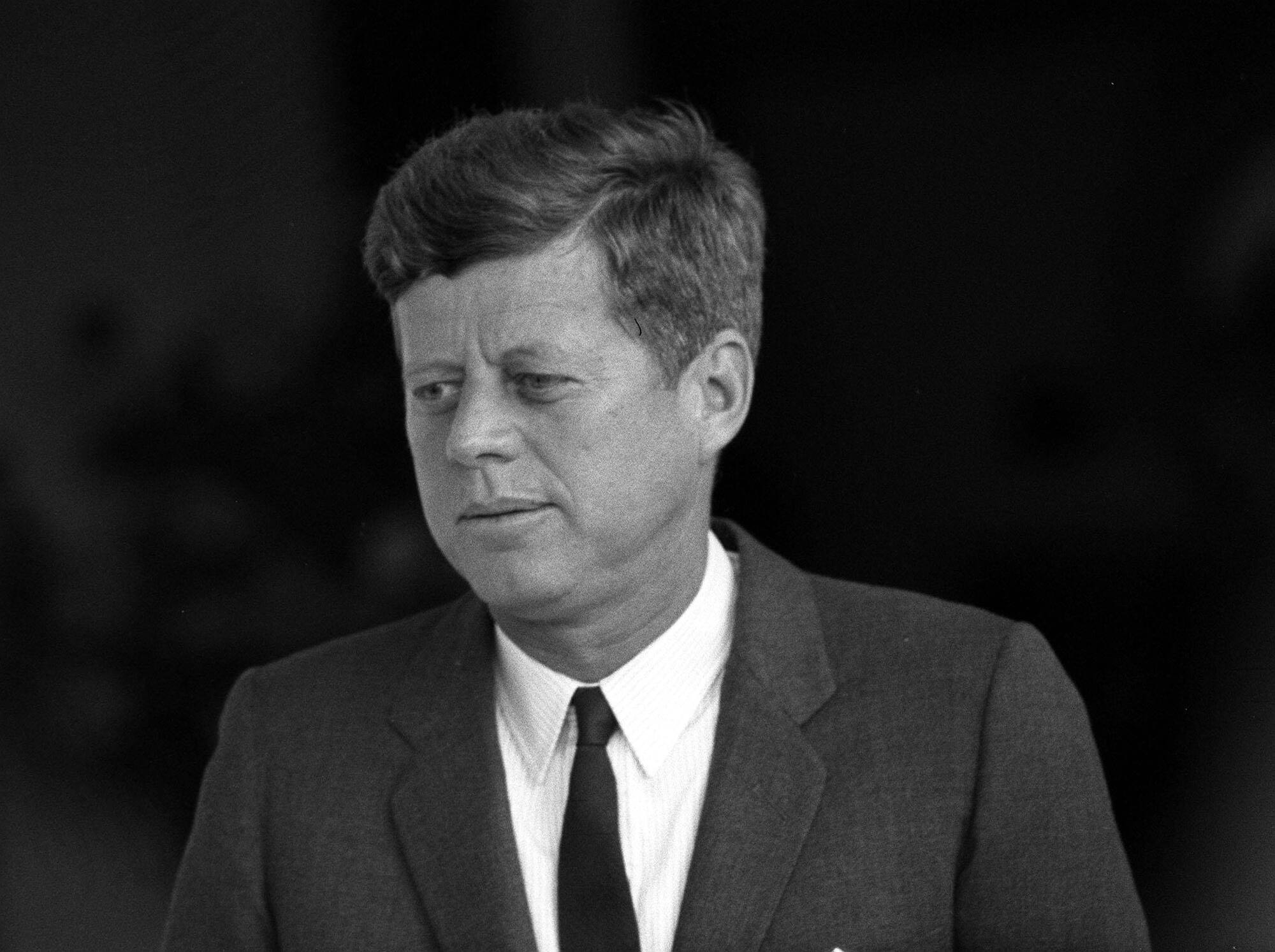
John F Kennedy, US president during the Cuban missile crisis. Picture: PA Wire
Russian president Vladimir Putin, as a noted practitioner of martial arts, knows the importance of timing when making a move against an opponent.
In ratcheting up threats to use tactical nuclear weapons in Ukraine, just before the 60th anniversary of the Cuban missile crisis, he is clearly playing on the world’s fear of a nuclear conflagration.
This coming week, with the war in Ukraine on our minds, the older generation everywhere will relive the dramatic days from October 16 to October 29, 1962, when mankind stood at the edge of the nuclear abyss.
The crisis began with the revelation that Soviet ballistic missiles were discovered in Cuba, within striking distance of major US cities.
President John F Kennedy revealed the evidence from aerial photography and threatened to attack and destroy them. He imposed a naval blockade on Cuba.

The crisis ended when the Soviet leader, Nikita Khrushchev, backed down and agreed to remove the missiles from Cuba. The word in the media was that “Kennedy stared Khrushchev down and Khrushchev blinked first”.
At the time it was hailed as a great victory for Kennedy, and a humiliation for Khrushchev. However, months later, it was revealed that Kennedy privately agreed to withdraw US nuclear missiles from Turkey as a quid pro quo for the Soviet withdrawal of missiles from Cuba.
Putin, a keen student of history, must be thinking about this right now.
It is ironic that Khrushchev was born 11km from the Ukraine border in the west Russian town of Kalinova. He went on to be first secretary of the Ukrainian Communist Party and was appointed by Stalin as leader of Ukraine. When Khrushchev came to power in Moscow, he later gifted Crimea to Ukraine in 1954.
The escalation towards a possible nuclear conflict in Ukraine continues, with the Russian Duma and upper house confirming Putin’s annexation of the four partially occupied territorial oblasts (regions) of Ukraine.
The four oblasts of Luhansk, Donetsk, Zaporizhzhia, and Kherson represent about 17% of Ukraine’s national territory. Under Russian Law, these territories now become part of Russia, and Putin has the obligation to defend them, using, if necessary, all means at his disposal, including nuclear weapons. Putin has now got legal cover under Russian law.
In the past week, public calls have been made by several senior Russian leaders, not just Putin but also ex-president Dimitry Medvedev and Chechen president Ramzan Kadyrov, who explicitly called for Moscow to consider using tactical nuclear weapons right now.

President Volodymyr Zelenskyy’s response to the annexation and the threats was to call for Ukraine’s application to join Nato to be accelerated. Once in Nato, Ukraine would then have the mutual defence protection of Nato.
However, the White House has poured cold water on Zelenskyy’s request. The problem is that Nato is a rules-based organisation, and it has a rule that it cannot agree to accept an applicant nation which has borders in dispute.
In the meantime, the overstretched Russian forces continue to be pushed back in Donbas with previously captured cities, such as Izyum in the Luhansk Oblast, and Lyman, just inside the Border of Donetsk Oblast, being retaken by the Ukrainians.
As this article is being written, the Russians are falling back to new defensive lines, hoping to create a firewall to stop the Ukrainian advance. The loss of these locations also greatly complicates the Russian logistics MSRs (main supply routes), making it more difficult to block or counterattack the Ukrainian advance.
Moreover, most Russian units have been reduced to half their strength.
A month ago, defence analysts had been considering the use of tactical nuclear weapons (TNWs) by the Russians as being increasingly possible, but more likely next year if the Russians suffer further military setbacks.
Now we have to seriously factor in the possibility of a nuclear war in Ukraine in the immediate future. Russia desperately needs time to mobilise, train, equip, and deploy its 300,000 reservists currently being called up. The quickest way would be to use their preponderance of TNWs to break up the Ukrainian advances in the south and east.
When the Cuban missile crisis took place, I was a cadet in the military college. Our training course was accelerated, and in July 1963 we were hastily commissioned and sent to our units.
Nuclear, biological and chemical warfare (NBC) courses had top priority. NBC training was being conducted throughout the Defence Forces, in preparation for the next crisis, under the darkening shadow of a possible Third World War. The fact that it did not happen was due to both the US and the USSR having a ‘no first-strike policy’ with nuclear weapons, and efforts by the UN.
The UN’s Nuclear Non-Proliferation Treaty of 1958, which was proposed by Irish resolutions, delayed the spread of nuclear weapons to other nations for years. UN peacekeeping missions helped to stop regional and proxy wars from widening into a world war.
In making a tribute to the UN, I often point out that “without the UN, the survivors of an apocalyptic World War Three, would by now be staggering around the nuclear wastelands trying to avoid World War Four”.
The new Russian nuclear doctrine has modified the old Soviet doctrine, allowing for a first-strike option. The precedent used is that Pakistan’s doctrine now allows a nuclear first strike against India, if India uses overwhelming conventional forces against Pakistan. Faced with the threat of overwhelming Soviet conventional forces in Europe in the early 70s, experts also began to talk up the feasibility of conducting a limited nuclear war using just tactical nuclear weapons.
In 1975, one year after the French Army’s TNW, the Pluton, became operational, I took part in a battlefield exercise with the French Army, where the attack scenario began with a simulated Pluton strike on an enemy battalion position.
The simulation was very realistic, with a 300m high mushroom, a blast wave that rocked our armoured vehicles and a wall of flame 1km wide. The Pluton had an explosive yield of 15 kilotons, approximately the same as the atomic bombs that destroyed Hiroshima and Nagasaki in 1945.
For me, this ‘Pluton thing’ was both tactical and strategic. I did not agree then that a limited nuclear war was possible.
But times have changed. Modern TNWs can be adapted to provide very low yields, and not necessarily escalate to the use of strategic nuclear weapons. Moreover, conventional bombs such as the US GBU-43 B MOABs ('mother of all bombs') can provide a similar comparable yield to the small TNWs.
Russia has 2,000 TNWs, and the US only about 230. President Joe Biden has threatened an ‘overwhelming response’ if Putin uses his TNWs.
I have often noticed that both Putin and Biden have one thing in common: they can stare into the TV cameras and the bright lights, for long periods, without blinking. The question now is — who is going to blink first?