Leo Enright: Ireland's long and eminent role in space discovery
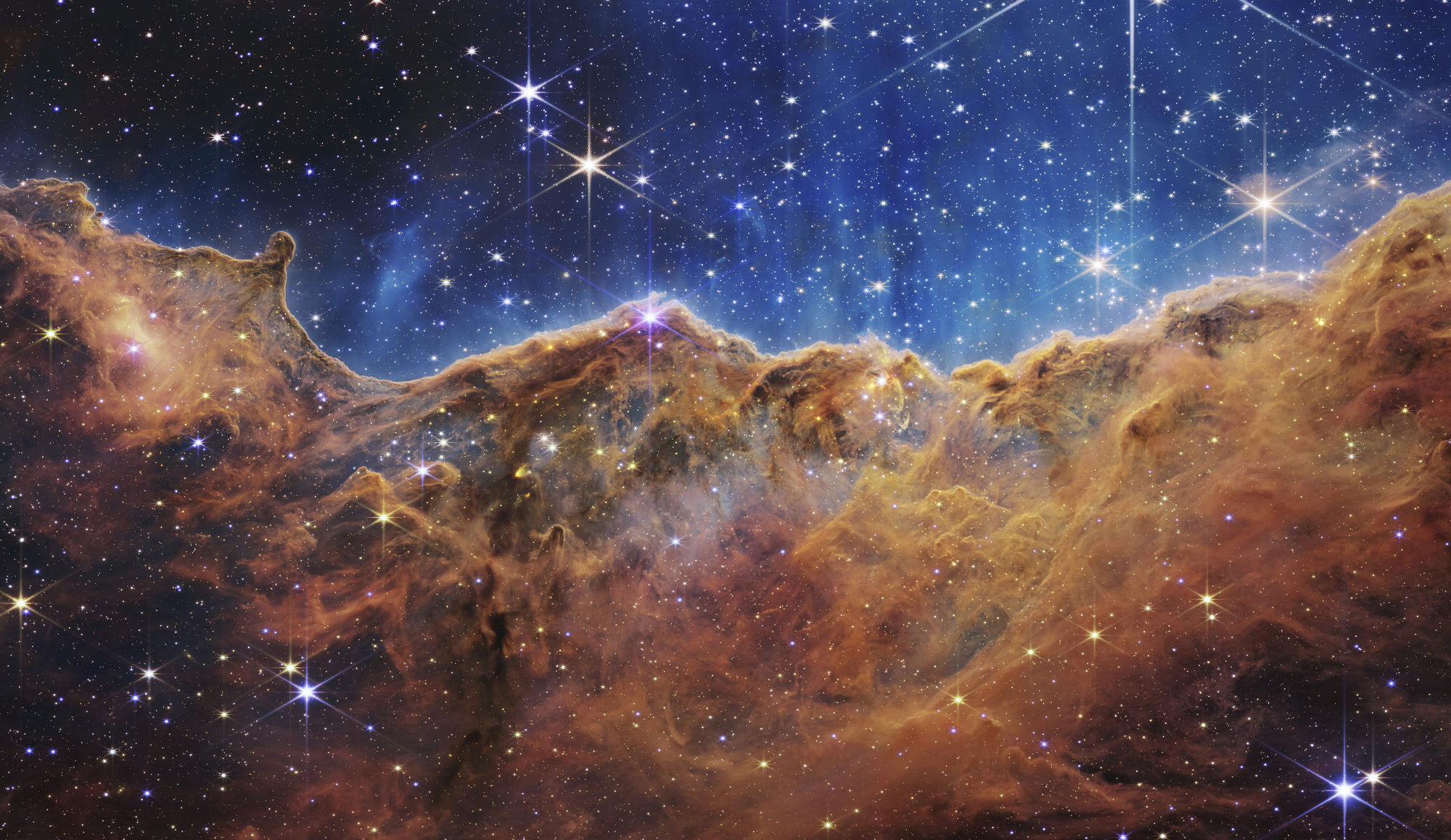
The edge of a nearby, young, star-forming region NGC 3324 in the Carina Nebula. Captured in infrared light by the Near-Infrared Camera (NIRCam) on the James Webb Space Telescope, this image reveals previously obscured areas of star birth, according to NASA. Photo: NASA, ESA, CSA, and STScI
You might need to go back 150 years, and to Birr in County Offaly, to find a moment in astronomy as dramatic as the one which happened this week.Â
Back then, Ireland was a world leader in the exploration of space and time, and the third Earl of Rosse had just built the most powerful telescope on Earth.

âThe Leviathan of Parsonstownâ held that record for more than 70 years - much longer than its great successor the Hubble space telescope - and scientists flocked to the Irish Midlands for an opportunity to gaze through the eyepiece of that wondrous instrument.Â
âFirst lightâ was the moment when starlight first struck the huge mirror and was reflected, greatly magnified, into the eyepiece; it was a moment that revolutionised our view of the cosmos. What the third Earl, William Parsons, saw was jaw-dropping - the mysterious (nebulous) blobs that were seen in earlier telescopes suddenly popped into focus and revealed themselves to be something entirely new.Â
We now call these objects galaxies, each one an island in the cosmos containing as many as a billion billion stars, and they were first seen up close from amongst the raised bogs of central Ireland.
Astronomers are now hoping for a similar moment of stunning revelation after âfirst lightâ for the James Webb Space Telescope (JWST). âWe don't know that we don't know yet,â said Amber Straughn, deputy project scientist for JWST at NASA. âEvery time we learn things that completely surprise us, that cause us to change our fundamental understanding of how the universe worksâ.
Just as the Webb telescope is a direct descendant of âThe Leviathanâ, so too Ireland's astrophysicists of today follow in a long tradition of cosmic discovery. For example, around the time of âfirst lightâ at Birr, William Rowan Hamilton at Dunsink in Dublin, was publishing his new form of algebra called quaternions. Today's space voyages rely on those same quaternions to navigate the Solar System.Â
In the 1880s, when Albert Einstein was still in short pants, the Irish physicist George FitzGerald was developing his own theory of relativity, and further important work was done in the 1960s by the brilliant Belfast physicist John Stewart Bell, who would surely have won a Nobel Prize had he not died tragically young.
Yet while Ireland has played a long and eminent role in humanity's exploration of the cosmos, it is not what is described in treaties as âa launching stateâ - one that actually owns or launches its own satellites. But that is about to change, and the fast pace of developments in space technology here has forced the Government to scramble to keep up with the soaring ambitions of Ireland's space scientists and entrepreneurs.
As Minister of State Damien English explained to the DĂĄil, UCD's plans to launch Ireland's first satellite (EIRSAT-1) suddenly triggered aspects of the UN Outer Space Treaty of 1969 and the Liability Treaty of 1972 that no Irish civil servant could have foreseen 50 years ago when we first signed it.Â
âThis is an unusual case,â he explained. âThe treaty introduces principles of responsibility for States launching objects into space, and we must address this lacuna in our domestic law."
The Government motion was broadly supported by opposition speakers, with Catherine Murphy of the Social Democrats remarking that if the Romans had launched a satellite into an 800-mile (1,300 km) orbit, it would only be crashing to Earth about now.Â
âWe are never going to be putting as many satellites into orbit as the US, China or Russia, but that doesn't mean we don't have a responsibility to legislate for the handful that we may launch,â she said.

The Educational Irish Research Satellite1, or EIRSAT-1, is in the final phase of testing before launch. It was built by graduate students, postdoctoral researchers and staff from the UCD Centre for Space Research with support from the European Space Agency (ESA) education officeâs âFly Your Satellite!â programme, and its main instrument is a gamma-ray detector to look for some of the most violent explosions in the universe.Â
The satellite will also demonstrate heat protection coatings developed by the Irish company ENBIO, who have already provided the large sunshield for Europe's âŹ1.5bn Solar Orbiter mission. A third experiment will test a UCD-developed system to control the movement of satellites in orbit.
EIRSAT-1 is awaiting launch aboard an ESA rocket, possibly as early as the end of this year. It may be placed directly into orbit, or may stop off at the International Space Station before being cast-off from that orbiting laboratory.
But EIRSAT-1 will not be the first piece of Irish hardware blasted into space.Â
The first Irish experiment to be landed on the Moon was brought there by Apollo astronauts in 1972, while the spectacular live television pictures of the separation of JWST from its Ariane launcher on Christmas Day was captured by a camera system developed by Dublin-based company Réaltra. Those images gave engineers their first hints that JWST would perform much better than expected, for maybe 25 or 30 years.

Irelandâs space activity is enabled primarily through its longstanding membership of both ESA and the EU, which funds Irish commercial and research activity. The vast majority of Irelandâs âŹ24.8m annual contribution to ESA, goes to industrial contracts to Irish companies on a âfair geographical returnâ basis called juste retour.Â
It has been estimated that the direct return on Irelandâs space investment is about âŹ3 to every âŹ1 invested. When considering the additional economic activity reported by businesses as arising from their engagement in ESA contracts, the return on investment had been put at âŹ7 to âŹ1.
The global space sector is reckoned to be worth about $350bn a year, and Irelandâs plan for getting a piece of that pie is outlined in the National Space Strategy for Enterprise, issued in 2019. Enterprise Ireland is in charge of promoting the country's space industry and it lists 34 businesses in its âspace industry directoryâ, while around 80 have secured contracts with the European Space Agency over the past decade.Â
Unfortunately, under ESA's âfair geographical returnâ juste retour, the vast bulk of ESA contracts go to the countries that pay the most into its budget. This means that Irish companies must find investment from elsewhere if they want to grow and expand into space.
But Ireland's scientists often struggle for funding too, precisely because of the focus on commercial gain from space projects. Emma Whelan of Maynooth University will be studying how stars form within the beautiful nebulae that were revealed by JWST this week.Â
âUnder current funding models, it is a real challenge to get consistent funding,â she says. âYou need to show how it may create jobs and that it has industrial applications, whereas the value of pure research lies in the potential for discovery and the stimulation of further innovation.Â
Emma has several PhD students working with her. âSome of the brightest students in Ireland today are studying astrophysics, which is not as surprising as it might seem. Many of our students donât actually go on to work in astronomy â the big technology companies canât get enough of them because they are so flexible and can work on any problem.â
One idea for marketing Ireland agressively as a place to invest in the new space economy is to turn Shannon Airport into a spaceport. The idea was raised by Independent TD Cathal Berry, and it is not as wild as it might seem. âRockets can land on barges now, so it is an opportunity if we want to exploit it,â he said.
The idea of establishing a west-coast spaceport has already been implemented â in Cornwall. The first satellite made in Wales is set to be launched into space later this year from Spaceport Cornwall â better-known to Irish travellers as Newquay Airport.Â
On September 8 next, a specially-adapted Boeing 747 will take off from the same runway used by holiday jets; it will carry a rocket under its wing to an altitude of 35,000ft. over the Celtic Sea, where it will release the rocket to blast onwards into orbit. It will be the first satellite launch from Europe.Â

The UK Government gave ÂŁ7.35m to Richard Branson's Virgin Orbit for launch support equipment and mission planning activities at Spaceport Cornwall and Virgin Orbit itself will contribute ÂŁ2.5m.
Shannon Airport's runway is longer than Spaceport Cornwall's, but using it for aircraft-assisted rocket launches would require even more regulatory steps beyond ratifying the 60-year-old Outer Space Treaty. These would include the proper regulation of rockets within Irish airspace and specific safety waivers if someone wanted to fly joyriding tourists to see the Cliffs of Moher from space.
But the Irish Government has been here before. In 1972 a young American entrepreneur proposed creating a commercial launch site on Inis na BrĂł, one of the Blasket Islands.Â

This was decades before private spaceports became a reality, but his plan was to use the Blaskets' unique position, jutting out into the Atlantic, to launch commercial satellites into polar orbits, travelling north-to-south over the poles. That man was named Gary Hudson â one of the legendary founders of the commercial space movement that ultimately led to Elon Musk, Jeff Bezos and Richard Branson.
The idea was firmly rejected by officials in Dublin as wildly impractical. Presumably they thought Ireland had no tradition of space exploration.
Read More
- Leo Enright is a broadcaster and space commentator