TP O'Mahony: Whatever its aberrations, Catholicism kept society together
The decay of the Church as the main structuring force of Irish society saw the growth of a selfish individualism that stands in the way of reform today, writes TP O'Mahony
TP O'Mahony: Whatever its aberrations, Catholicism kept society together

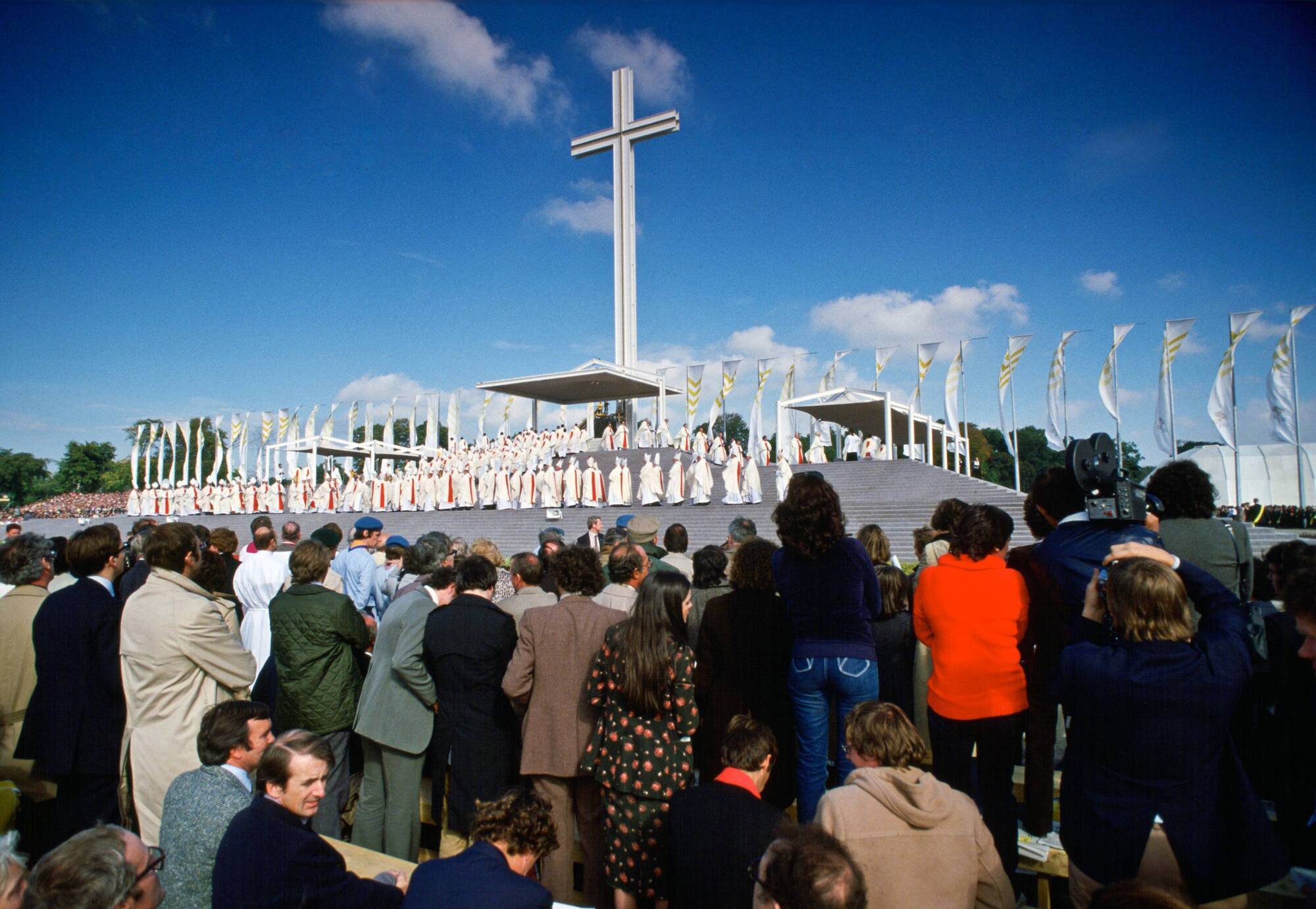
Knock, 1979: Pope John Paul II's visit to Ireland was a very different event than it would be today. Picture: Tim Graham/Getty Images

STANDS Ireland where it did? The Shakespearean idiom is borrowed from Macbeth, with Macduff’s question (about Scotland in the play) eliciting this response from Ross, his fellow knight: “Alas, poor country, almost afraid to know thyself.”

Is this where we’re at? Who are we now? In the Ireland of the 1950s, when I was growing up, these questions were much easier to answer. It was an Ireland at the centre of which stood three great institutions: The Catholic Church, the Gaelic Athletic Association, and the Irish Press.

The contours of our world, our worldview, our sense of who we were, and our moral code were all largely shaped and determined by reference to these central institutions, the pillars of our society.

Since the foundation of the Free State in 1922, it was Catholicism most of all that was the main structuring force of Irish society. Its decay and the consequences of this have yet to play out in the 21st century, but what is already evident is a society adrift, cut loose from its moorings and, in some important respects, floundering.

Even in pre-independence Ireland our sense of collective identity was fixed, certainly since the time of Daniel O’Connell’s campaign for Catholic Emancipation which came to fruition in 1829.

We were bound together by faith and fatherland; and in the new Free State we were consciously white and Catholic and our sense of fatherland — and the related sense of “Irishness” — was located very definitely within the territory of the 26 counties. 

Belfast was as remote and alien as Saigon.

In Croke Park on All-Ireland Final day, the 80,000 spectators sang (with gusto) ‘Faith of Our Fathers’ before ‘Amhrán na bhFiann’. Our flag was the Tricolour, but the orange segment was as foreign to us as the red of the hammer-and-sickle (the flag of the old Soviet Union).

As for the white middle segment, signifying unity, we felt closer to the Irish in Birmingham and Boston than we did to the unionists of the North.

“There is such a disconnect, because people from Dublin, from down South generally, they don’t spend any time up here, in places like the north coast, unless it’s for rugby or golf.”

This was said by former Irish rugby international Andrew Trimble in 2022 in an interview in the  Irish Times. But this was much more the case in the 1950s.

IRA campaign 

In the meantime, of course, and mainly because the Provisional IRA’s murderous campaign, the Tricolour has become for many unionists a hated sectarian symbol, which is why in any consideration of or conversation or debate about a united Ireland flags and anthems and symbols will invariably be stumbling blocks.

Unlike Northern Ireland, where it was openly proclaimed that it was a “Protestant state for a Protestant people”, this claim on behalf of Catholics was never made for the Free State or, later, the Republic.

“It is true,” wrote Conor Cruise O’Brien, “and interesting considering the overwhelming Catholic majority, that the Irish State has never officially proclaimed itself to be a Catholic State.”

As to why this didn’t happen, it could be said that it was just so manifestly obvious that it never needed to be formally declared.

The feeling engendered by a lot of the commentary on and from the 1950s was that life in Ireland was unremittingly awful, but were things that bad?

The sheer awfulness of the picture painted makes one wonder how we ever came through it all relatively unscathed. It’s as though we were permanently trapped in the Ireland of Angela’s Ashes.

 Mary Lou McDonald could be Ireland's first female taoiseach. But will Sinn Féin usher in a era or is our society too fractured?
 Mary Lou McDonald could be Ireland's first female taoiseach. But will Sinn Féin usher in a era or is our society too fractured?

Yes, of course there were constraints. Economically things were bleak. For thousands of young people, the only option was the emigrant ship. And for the political establishment emigration was a crucial safety valve.

My generation also fell victim to a purity culture that was so repressive that we had, in time, to free ourselves of a calcified sense of sexuality.

The absence of contraceptives meant many marriages were left sexually impoverished. The absence of divorce meant there was no way out of an emotionally or erotically shrivelled relationship.

The version of Catholicism that won out in Ireland determined that the faith would be otherworldly, private, individualistic, and focused on the next life rather than the lives people were living. Irish Catholicism never developed a “social gospel”.

What is Ireland’s sense of itself in the 21st century? Confronting the dark recesses of its past, marbled by various scandals, and making proper redress, is still a very incomplete process. Can we say this was part of an Ireland that is now past?

The elections on May 5 in Northern Ireland were a further boost for Sinn Féin. In the Republic, the polls are indicating that Mary Lou McDonald could make history by becoming our first female Taoiseach, but that’s by no means set in stone.

Despite the hope that the partial solidarity displayed during the pandemic would take hold, it is still the case that individualism and selfishness are hard-wired into our culture.

The greed that characterised and fed the Celtic Tiger showed that from the government on down we were happy to embrace neoliberalism with the alacrity of the most ardent Thatcherite.

Boom followed by bust

Boom was followed by bust, and Ireland will start the painful process of repaying the €40bn-plus EU part of its international bailout in 2023.

Our increasing dependence of multinationals has been highlighted by the Irish Fiscal Advisory Council.

This dependence on multinationals is extremely precarious — as one of the lessons of globalisation has shown elsewhere.

It is repeatedly said that Ireland is a wealthy country, but the sources of that wealth cannot be taken for granted. The greater reality is inequality and the fact that wealth in Ireland is very unevenly distributed.

Michael Collins in 1922 warned of the new need for the new State to avoid 'destitution or poverty at the one end and an excess of riches at the other'. Picture: Topical Press Agency/Getty Images

Back in 1922, Michael Collins warned of the need in the new State to avoid “destitution or poverty at one end and at the other an excess of riches”.

One hundred years on how have we met that test?

Irish society today is a very fractured one. It is also a more ethnically and culturally diverse society, and a more secular one. 

So as the de-Catholicising of society proceeds, what values does the Ireland of the 21st century embody?

Whatever its aberrations, Catholicism provided the social cement that held the basic elements of society together.

Now that it is in disarray. The decay of Catholicism as the main structuring force of Irish society saw the growth of a selfish individualism and a conservatism (outside of the socio-moral sphere) that today stand in the way of reform.

And even if the Fine Gael-Fianna Fáil dominance (during which corruption was widespread, as Elaine Byrne has shown in her book Political Corruption in Ireland 1922-2010) of the political landscape is coming to an end, it is by no means certain a Sinn Féin-led government will usher in a new era.

That party’s rhetoric about a “socialist republic” has been sidelined of late.

And now, having emerged from one pandemic, we are plagued, according to a new report from the Health Research Board, by a cocaine epidemic — the use of the drug is now ubiquitous across age groups, social classes and regions.

As we seek to explain ourselves to ourselves what does this tell us, given that cocaine is today as much a rural drug as an urban one?

So do we know who we are in 2022? Or are we hoping that in a future united Ireland a new version of “Irishness” will be fashioned?

More in this section

Revoiced

Newsletter

Sign up to the best reads of the week from irishexaminer.com selected just for you.

Cookie Policy Privacy Policy Brand Safety FAQ Help Contact Us Terms and Conditions

© Examiner Echo Group Limited