Simon Coveney: 'I had seen the horrors but I was not prepared for the beauty of Bucha'
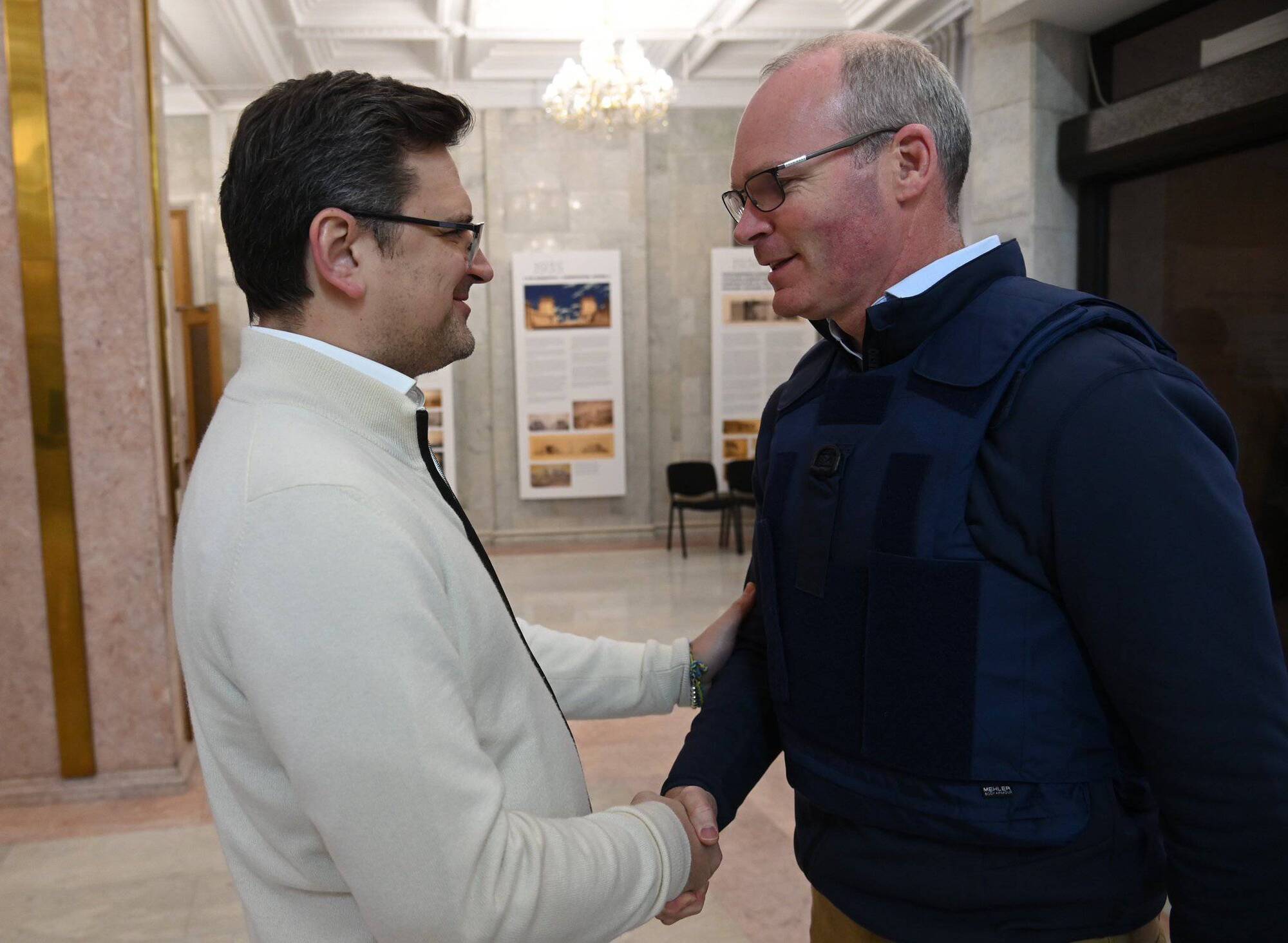
Foreign Affairs and Defence Minister Simon Coveney meets Ukraine's foreign affairs minister Dmytro Kuleba.
I stood above a trench of a mass grave where the bodies of 56 civilians had been found in Bucha, Ukraine.
A mass grave, in Europe, in 2022.
Seven weeks ago, this grave did not exist, the souls who were dumped in it were living their lives in a quiet suburb of Kyiv. We drove through Irpin and Bucha to get to the proud and eye-catching gold dome of the Church of Saint Andrew, behind which at least three trenches of mass graves have been found, including the one open in front of me.

Along the route through Bucha, civilian homes, shops and infrastructure had been burnt, severely damaged or totally destroyed by relentless shelling. The unmistakable stench of fire that had been drenched by water was everywhere.
Every checkpoint we passed on the way out of central Kyiv had soldiers with boxes of homemade Molotov cocktails and stacks of tyres to burn to thwart tanks. The skeletons of destroyed tanks and military vehicles were everywhere.
Like many of you, I had seen the horrors of Bucha on media and social media. However, what I was not prepared for was the beauty of the place.
We arrived at sundown on an idyllic early summer evening. The air was still, the sun was low on the horizon, highlighting miles of rich pasture and agricultural land.
The apartment buildings are tall, laid out in grids that allow for mature parks in the squares between them, filled with towering pines and children’s playgrounds. The standalone houses of Bucha had space for a smallholding and orchards.
It was not hard to see why, in peacetime, this would be such an attractive place to raise a family, close to central Kyiv, but with space and the beauty of the countryside.

After the church grounds, we pulled off the road to what looked like a scrap or breakers yard for old cars. However, this was a field that had been taken over to clear the highways and roads of shelled and destroyed cars and buses.
Even at a distance, it was obvious that this wasn’t a graveyard for military vehicles, but a graveyard for modest and common family cars. The occupants had been either injured or killed as they tried to flee.
They had no armour but had tried to appeal to the humanity of the invading soldiers with Russian words like “children” “civilian” and “stop” scrawled in red or white paint on the front and sides of their vehicles. It didn’t protect them.
Humanity is absent from many of the acts committed in Ukraine, from rape and murder to the cruelty of civilians returning to their land and homes to find fields and family cars mined to explode.
These are war crimes that demand accountability. It’s important to document and carefully gather evidence for the trials that must follow. That is why I committed €3m this week to fund the International Criminal Court to build the legal case necessary to successfully prosecute these crimes. The ICC has already begun detailed work on the ground in Bucha.

My trip to Ukraine was not only to see these horrors but to meet with my counterparts in foreign affairs and defence.
I was invited two weeks ago by foreign affairs minister Dmytro Kuleba. He warmly welcomed me to the door of the same foreign ministry I visited eight months ago, in peacetime.
This time, however, the windows were boarded up and entry was only possible by moving through a maze of sandbags stacked from floor to ceiling. Our meeting had to be relocated to ground-floor level on the insistence of security, as air raid sirens rang out across Kyiv all morning in response to missiles fired into Ukraine from Russia.
Minister Kuleba thanked Ireland for what we continue to do on a humanitarian, military and political level, but asked me to make further representations at EU and UN Security Council level, which I will do.

My defence counterpart Oleksii Reznikov told me that full control of the Chernobyl nuclear power plant had been restored on the day of my visit.
Both ministers’ intelligence, calmness under pressure and absolute resolve was so impressive.
One of the most in-depth discussions I had was a briefing with the Ukrainian lead negotiators from the peace talks with Russia in Istanbul about progress and barriers in those negotiations. What is clear is that an agreed basis for a peace agreement is possible.
However, negotiating in the heat of war and atrocities, without a ceasefire, while your country is partially and brutally occupied is not easy. War hardens positions and makes compromise tough to carve out, yet Ukraine continues to negotiate in good faith.
I have fears for what may unfold in the days and weeks ahead in eastern Ukraine, in the Donbas region where more than 130,000 Russian troops are massing for a renewed assault on a brave but outnumbered Ukrainian army.
Nobody should underestimate Ukraine’s ability to resist and survive. They are remarkable people: brave, proud and resourceful. They deserve our support, respect and solidarity.
They will have it, as we work to end the madness of this war and in the journey to rebuild in its aftermath.
- Simon Coveney is a Fine Gael TD for Cork South-Central and Minister for Foreign Affairs and Defence
CONNECT WITH US TODAY



Be the first to know the latest news and updates