How will rousing Dáil speeches help Ukraine and five-year-old Anastasiia?
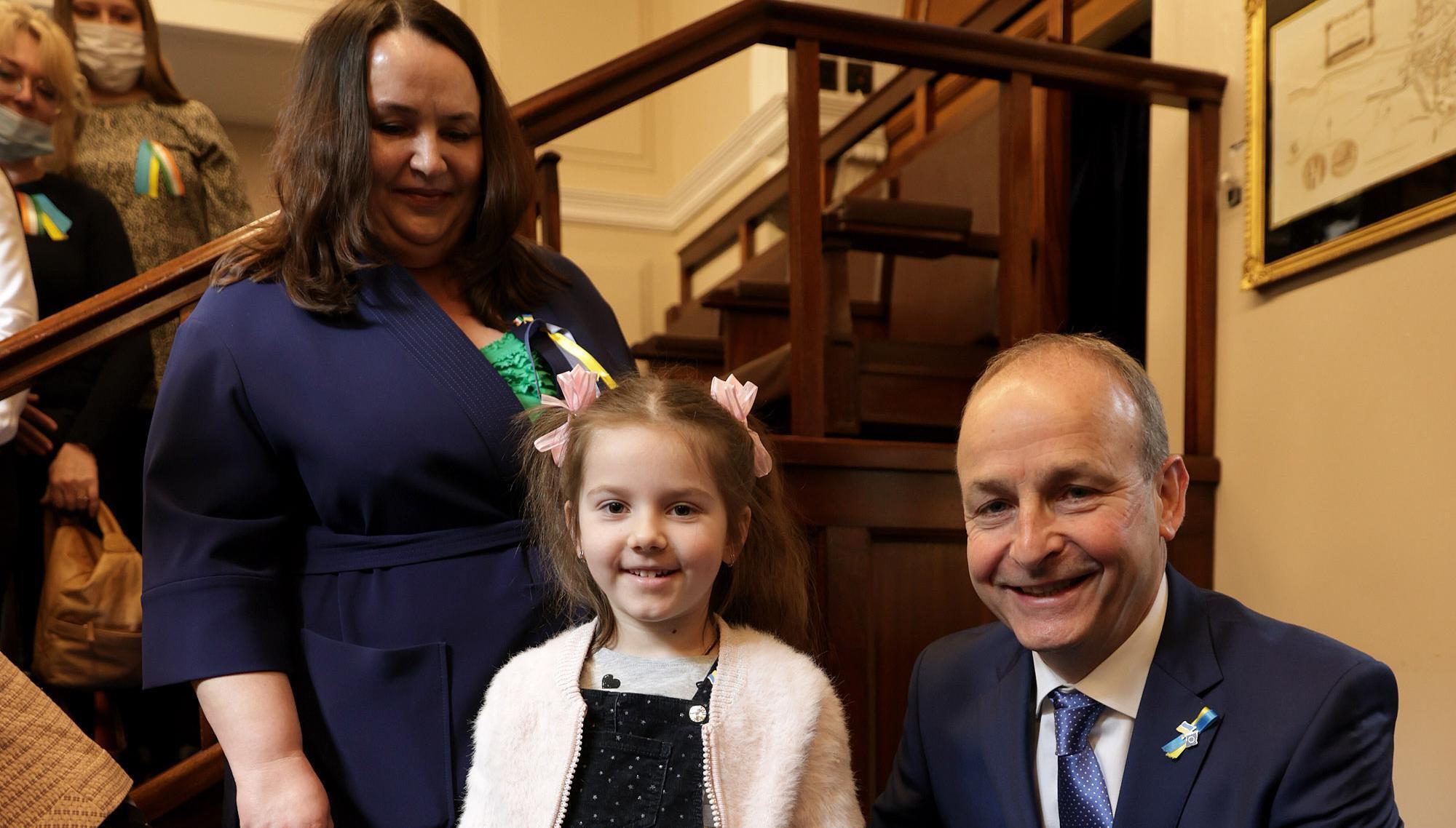
Ukrainian ambassador to Ireland Larysa Gerasko; Anastasiia Semonova, 5, daughter of Yana Semenova; and Taoiseach Micheál Martin at Leinster House after the address by Volodymyr Zelenskyy. Picture: Maxwells
The image of little Anastasiia Semenova receiving a round of applause from a packed Dáil chamber was a poignant moment.
It came at the end of a political debate following an historic address by her president, Volodymyr Zelenskyy, to the Joint Houses of the Oireachtas.
What the five-year-old, and, moreover, her mother, Yana Semenova, thought of all rousing speeches and expressions of solidarity from politicians over the preceding hour is unclear.
Anastasiia’s mother looked tired, understandably so, given she and her daughter had travelled — without the girl’s father — 4,000km from the Ukrainian capital Kyiv to Dublin.

The cathaoirleach of the Seanad, Mark Daly, welcomed them to the chamber, pointing out they had to leave Ukraine under Russian artillery fire.
Her husband and Anastasiia’s dad, like thousands of others, is in a defence unit in Ukraine fighting to keep it free and independent for his daughter’s future,” the Seanad’s chairman said.
"In recent days there is evidence of war crimes in Bucha.”
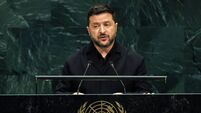
That reality was brought home in a forceful address by President Zelenskyy.
Watch LIVE coverage now of the Joint Sitting of Dáil & Seanad Éireann as the President of Ukraine, Volodymyr Zelenskyy, addresses both Houses - view on Twitter, Facebook & on the #OireachtasTV channel #seeforyourselfhttps://t.co/q7cBqPIhjo https://t.co/tIhXupzTv9
— Houses of the Oireachtas - Tithe an Oireachtais (@OireachtasNews) April 6, 2022
He said 167 children had been killed in the 42 days of the war.
On top of the missiles and bombs targeting civilian infrastructure, including hospitals, schools, and churches, he said hunger was being used “as a weapon” against ordinary people and as an “instrument of domination” — words that will strike deep in the Irish psyche.
And there was more that resonated — Russia was acting like a “21st-century colonial empire” and its army was a “colonising army”, aimed at subduing a neighbouring country and destroying its identity.
He said he was grateful to Ireland for supporting sanctions against Russia as well as humanitarian and financial support, but urged it to “please show more leadership” and convince other EU countries of the need for more sanctions.

He mentioned how Ireland’s neutrality did not mean it was neutral to the disaster that has befallen Ukraine.
But he did not mention Ireland’s decision not to provide military aid to Ukraine.
That is despite repeated calls from him and other Ukrainian leaders for EU countries to provide more weapons so they can defend themselves, including anti-tank and anti-aircraft weapons.
When, on March 24, President Zelenskyy addressed the parliament of Sweden — also militarily neutral and non-aligned — he said: “Sweden has made a historic decision to provide Ukraine with the necessary weapons. We thank you for that!”
Speaking on RTÉ’s earlier in the day, Ukrainian MP Inna Sovsun urged Ireland to help her country “fight back” and to “give weapons to the Ukrainian army”.
She said they were not asking Ireland to “come and fight in this war”, but to supply them with some weapons.
She pointed out that neutrality did not go too well for Ukraine in 2014 when Russia annexed Crimea.
The first six speakers in the Oireachtas debate — Taoiseach Micheál Martin, Tánaiste Leo Varadkar, Green Party leader Eamon Ryan, Sinn Féin leader Mary Lou McDonald, Labour leader Ivana Bacik, and Social Democrats co-leader Catherine Murphy — gave rousing speeches, with genuine emotion and expressions of solidarity.

All condemned the despotism and war crimes of Vladimir Putin — indeed, many called or suggested he be removed from power. Some called for the Russian ambassador to Ireland to be expelled.
Pretty much all said Ireland "stands by you", and there were powerful words of "light overcoming dark" and "life overcoming death" and convictions that "Ukraine will prevail".
Poets and international statesmen were quoted.
But only two Irish politicians touched on the issue of military intervention or military assistance, albeit from completely different perspectives.
After condemning Russia’s “barbaric invasion” and “horrific” crimes against humanity, Richard Boyd Barrett said he felt duty-bound to attack those in government who, he said, were using the Ukrainian crisis to drop neutrality, back Nato, or move the country into a military alliance.
In a passionate speech, he denounced “all warmongers”, including those in Nato — aware, no doubt, that Ukrainian leaders have sought more military assistance from Nato.
Ukrainian ambassador to Ireland Larysa Gerasko seemed unimpressed as he eased up.
Independent TD, and former soldier, Cathal Berry was more direct on military aid.
He singled out the Finnish and Swedish ambassadors present (Finland, like Sweden, is military neutral) who had provided thousands of protective and defensive anti-tank and anti-aircraft weapons.
He said Russia did not want a diplomatic solution, at least at the moment, but wanted “a military solution”.
He said the provision of non-lethal military aid — such as meals, fuel, and body armour — by Ireland to the Ukrainian army was welcome, but said there were hundreds of anti-tank rockets in the Defence Forces that could be transferred.
He urged the Taoiseach to send these protective defensive weapons to Ukraine to help efforts to “stop the Russian advance and drag them to the table and alter the course of history”.
Ms Gerasko clapped as he finished.
Independent TD Marian Harkin thanked the people of Ukraine for “their defence of liberal democracy” — something, she said, too many people took for granted.
"There could not be a greater contrast.
“When this session ends, we will go back to our offices and our lives, while members of the Ukrainian parliament and the Ukrainian people stare down the face of Russian aggression and terror.”
People like Anastasiia’s dad.