How a Syrian war criminal was brought to justice — in Germany
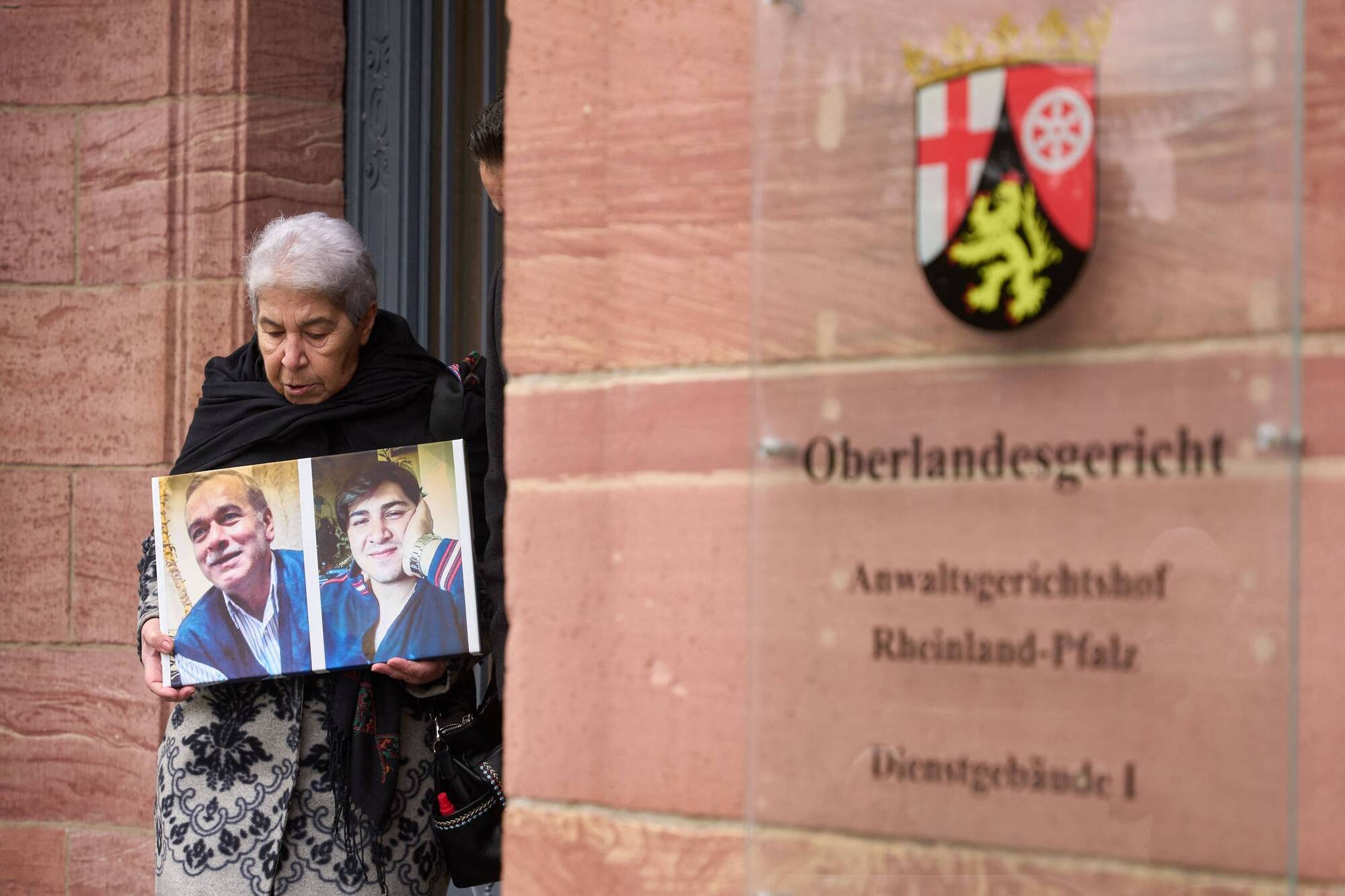
Syrian Fadwa Mahmoud holds a photo of her son and partner as she leaves the courthouse in Koblenz, Germany, on January 13, 2022, where former Syrian intelligence officer Anwar Raslan was sentenced to life in jail for crimes against humanity in the first global trial over state-sponsored torture in Syria. Picture: Thomas Frey/ Pool/ AFP via Getty Images)
On the night of July 20, 2021, Ruham Hawash lay awake unsure of where she was, mistaking her hotel bed in Koblenz, Germany, for the cramped and filthy cell in Damascus where, in 2012, she was detained and brutalised.
The next day, in a German court, she would see and testify against the Syrian colonel who oversaw her torture.
The trial was history-making. Two Syrian state security officers had been arrested and charged in Germany for crimes against humanity, including torture, murder, and sexual assault. It was the first time anyone from the Syrian regime would be tried for its crimes.
In Arabic, they are called the mukhabarat, four security bodies that have for decades carried out the Syrian regime’s surveillance and repression of its people.
Without them, the regime, under both the current ruler, Bashar al-Assad, and his father, Hafez, before him, would never have been able to maintain its rule over more than half a century.
In that time, they have crushed any dissent and opposition from several generations of Syrians. The two defendants — like Hawash herself, and over half a million other Syrians — had sought refuge in Germany. Both men readily admitted to working for the mukhabarat, as if their defections would absolve them of their pasts.
But if they thought they would disappear into the flood of Syrians arriving in Europe, cleansed and free to start new lives, they failed to account for two things.
First, their fellow Syrian exiles were determined that those responsible for the unraveling of Syria would not enjoy absolute impunity. Second, they landed in a nation that had grappled with its own legacy of war crimes and was now increasingly committed to pursuing war criminals operating far beyond Germany’s borders.
In the days leading up to her testimony, Hawash, 34, agonised over her decision to participate. Much had changed since 2019, when she decided not only to be a witness in the German state’s case but also to join it as a named plaintiff.
When the trial started amid the pandemic in April 2020, the international news media covered it, and some Syrian proponents of the trial promised that Syrians would finally have justice. But attendance quickly dwindled, partly because Koblenz is far from where many Syrian activists now live in Berlin, but also because the court didn’t provide access to the in-court Arabic translation for the public, leading some Syrians to wonder who the trial was for.
Although Hawash knew it was possible for the Syrian regime to harm her in Germany, where she would soon become a citizen, what she feared more was what the memories might do to her.
Two close girlfriends — Syrians who, like her, were active in the uprising against the regime and now lived in Berlin — accompanied her to Koblenz.
She wanted people in the courtroom who knew her from Syria, who would relate to what she would say and know that she wasn’t making it up.
Over the last decade, more than 500,000 Syrians have been killed and more than half the country’s population has been displaced, both within and outside Syria’s borders. What began in 2011 as a popular and peaceful movement calling for the regime — in power undemocratically since 1970 — to reform and to end its corruption has turned into a brutal civil and proxy war.
Throughout, the Syrian people have been victims of and witnesses to countless crimes against humanity. While armed opponents of the regime, such as ISIS, also committed such offenses — more often capturing the world’s horrified if fleeting attention — the Syrian regime, backed by Russia and Iran, has, by far, perpetrated most of the violence.
To stay in power, al-Assad has unleashed conventional and chemical weapons, aerial bombardment, siege, starvation, and expulsion, mostly against civilians. This destruction remains nakedly visible across the country. But behind the closed doors of its opaque detention system, the regime has also carried out the much more hidden but no less lethal violence of mass disappearances, mass torture, and mass executions.
When some atrocities have garnered international scrutiny, the regime has either denied its involvement, claimed that the victims are actually terrorists, or accused their enemies of staging these attacks. But the regime’s culpability has been well documented, not only by civilians, journalists, activists, and human rights organisations — both Syrian and international — but also by the regime itself.
Perhaps most famous are the pictures taken by a former Syrian military police forensic photographer, code-named Caesar, who defected in 2013. The images he smuggled out show at least 6,627 dead Syrians, an estimated two-thirds of whom died from torture between May 2011 and August 2013, either in detention or after their transfer to a military hospital. (Another third are Syrian military casualties from battles with armed opponents.) The corpses are, remarkably, tagged with the number of the mukhabarat facility where they died.
In addition, two organisations, the Syria Justice and Accountability Centre and the Commission for International Justice and Accountability, have become repositories for verified regime documents that reveal its own policies and directives since 2011.
What the documents described came as no surprise to the Syria Justice and Accountability Centre’s executive director Mohammad al Abdallah. He still remembers the daily “morning warning” his mother would give before he went to school in Syria, to not repeat out loud anything he heard the adults say at home.
Otherwise, she said, “people will come and take Baba” — his father — “and we won’t see him again”. Later, as an adult, al Abdallah would experience firsthand what it meant to be taken.
What did shock him, though, was how unconcerned the authors were that such documents could ever be used against them. “You’d expect them to try to hide things,” he says.
“But no, they still signed with their names, rank, and in their own handwriting. They believed 100% they could write what they want and behave the way they want.”
While Syria is far from Germany, thousands of potential witnesses and victims — and, undoubtedly, perpetrators as well — now find themselves together in Germany.
Among them are key Syrian human rights lawyers and activists who lost no time — even in the pain and discombobulation of displacement and exile — in trying to stop further offences in Syria, as well as seeking some morsel of justice for victims and accountability for the perpetrators.
They have found willing partners in German civil society and the German federal public prosecutor general’s office, which handles cases relating to international war crimes.
When it comes to its own war crimes, Germany has made a point of prosecuting Nazi perpetrators no matter how long it takes or how old the accused become.
That commitment has nonetheless been an evolution, and before the country was unified, one that differed between East and West. While the former East Germany repudiated its Nazi past and would embrace the Nuremberg Trials, West Germany was much more hostile to the idea, seeing them as “victors’ justice”.
On the day of her testimony last summer, Hawash wore a mustard-coloured blouse, black pants, and a black blazer, an outfit she chose specifically because there was nothing special about it.
Around her neck was the custom-made gold peace pendant she had worn every day since 2007. Her usually close-cropped hair needed a trim, but she had chosen to wait until after she testified. You get your hair fixed for happy occasions.
She walked in the sunshine to the courthouse, which faces Koblenz’s small memorial to the Nazis’ victims. A sightseeing train drives tourists past it. She had managed to put aside questions of whether her testimony mattered to the trial. With millions of Syrians being denied any justice as a people, many individual Syrians had discounted their right, let alone acknowledged any need, to find some justice for themselves.
Her attorneys, Patrick Kroker and Sebastian Scharmer, waited to escort her through security, the former in blue high-top Chucks, the latter in black Doc Martens.
As she entered the courtroom, Hawash couldn’t help reflecting on how surreal it all felt: “Here I am in Germany, joining my government in prosecuting someone who tortured me in Syria.”
Then she saw him. Raslan was standing in the courtroom, chatting with people around him, as if nothing were out of the ordinary. She noticed his clean clothes — a pair of jeans and a grey sweatshirt, its Polo logo visible.
She saw that he was neither blindfolded nor bound, as she had been during her interrogations. He had clearly not been beaten either. She tensed up, thinking, 'at any minute, he could do something to me'. But as she walked past one of her friends who was already seated in the gallery, Hawash saw her smile and reach toward her, grazing her fingertips. With that light touch, she felt anchored.

When Hawash took her seat at the witness table in front of the judges, with Kroker by her side, she kept her eyes on Kerber. Raslan was only a few feet away, and when she removed her mask, he studied her. Hawash had decided to testify in German because she didn’t want to recreate the dynamics that defined her and Raslan in Syria — where she was a victim, and he had power.
She was adamant: “I am not a victim today.” Speaking in German also allowed her, not the translator, to choose her words.
Kerber began by prompting Hawash to introduce herself and state what happened to her. Hawash took a long drink of water and avoided looking at Raslan, focusing on Kerber, as if it were a one-on-one conversation.
At a regime checkpoint outside Damascus, she told the court, the mukhabarat confiscated her ID and possessions. If she wanted them back, they said, she must turn herself in at Branch 251. Without an ID in Syria, life is impossible. She agonised and even went into hiding, she said, terrified of entering the notorious facility. Finally, she had no choice but to go. She didn’t mention torture. Only that at some point, the interrogation was no longer “friendly”.
Eventually she was let go, she said, without her ID. She was issued a one-way travel permit and told to leave Syria and never come back.
The judges’ questioning then began, aimed at soliciting specifics regarding dates and times, about torture and whether she was sexually assaulted. As they had done with other witnesses, they referred to Hawash’s statement to the police given the year before. Hawash bristled; did they doubt her?
Reluctantly, she recounted how her investigator became impatient with her, telling her he could better refresh her memory in another room. She was then bound, blindfolded, and taken underground — she could tell from the dank smell.
But she was generally allowed to see, and what she saw were implements of torture and walls filthy with dirt and blood. She testified to being beaten — sometimes seated, sometimes standing with her arms bound above her head and suspended from the ceiling — on her head, neck, ears, and face.
Under judges’ questioning, she specified that her torturers applied electric devices to her knees and fingertips, then her shoulders and chest. She recalled how she had no sense of time: “I didn’t know if it was day or night.” Yes, she answered the judges, she could hear others crying and screaming.
After an hour, Hawash asked for a break, and the court went into a 15-minute recess. Seeing that Hawash had nearly finished her bottle of water, Kerber asked a court aide to bring a new one.
When Hawash returned, she felt ready again. She had thought about it, and she realised that she didn’t see others who were tortured as weak. She answered all the remaining questions, from the prosecutors, defense counsel, and her own lawyers. In less than an hour, Kerber thanked her. It was over.
Before court was dismissed, Kerber added 10 counts of murder to Raslan’s charges, based on testimony presented the previous month. As Kerber read out the names of the witnesses, Hawash was astounded to recognise many of them. How small is the world, she thought. It turned and turned, and those who felt we had no power — you wanted to silence us. Those of us who survived, we are the ones judging you.
On January 1, the day the verdict would be announced, spectators who wanted a coveted seat in the courtroom began lining up at 3am outside the courthouse doors, which wouldn’t open until 8am.
In the darkness, with temperatures below freezing, people camped out with snacks and thermoses of hot coffee, happily sharing with strangers. Syrians had come from across Germany, Europe, and beyond. There were several joyful reunions.
But any sense of excitement or satisfaction with what was expected to be a guilty verdict was tempered by frustration over just how small the day’s justice would be and how blatantly ongoing the Syrian regime’s impunity is.
The Syrians held vigil as camera crews filmed them. Two women pushed a window open from still-dark offices across the way and leaned out to take a picture. It was the court clerk and one of the judges, their faces illuminated by the light of their cellphones.
Once the doors opened, only a few were able to enter. After security checks, it would take another two hours to seat everyone in the small gallery. When Raslan was brought in, in handcuffs, people stood to see him.
“What a sight!” someone said in Arabic. “U’bal m’almak,” Mahmoud said. May your boss be next. Mazen Darwish, one of the Syrian lawyers who helped bring the case to fruition, sighed: “I wish it were in Damascus. How different it would be.”

As the judges climbed the dais, everyone quietened down, waiting for Kerber to signal they could sit. Hawash was seated at the front with the other joint plaintiffs. Her hair was freshly cut in a high fade.
The judges took their seats. Kerber held in her hands the judgment that she would read out loud, pausing regularly to allow the Arabic interpreters to translate. It would take more than five hours, with a few 10-minute breaks and none for lunch. She announced the verdict and sentence first.
Finding in the form of killing, torture, serious deprivation of liberty, rape and sexual assault in combination with murder in 27 cases, the court sentenced him to life imprisonment.
But the court allowed that the sentence could be suspended on probation after 15 years, taking into consideration that, among other things, Raslan had defected. He did not appear to react.
Hawash didn’t particularly care how much prison time Raslan received. What was important to her were the broader findings about the nature of the regime, she says, which she believes will lay the groundwork for the road ahead, no matter how long it takes.
But her composure crumbled later in the afternoon when, in Kerber’s summation of the testimony, the judge recounted the specifics of the plaintiffs’ detentions, by name.
She cried silently as Kerber described the conditions of Hawash’s torture in German, which were even more excruciating to her as the interpreter repeated them in Arabic.
Sitting in the German courtroom where this victory was won, Hawash suffered flashbacks to her Syrian cell. In comparison to the day she testified, she felt even more exposed in the now-packed courtroom. She again feared being seen as weak.
But she knew now that she was not. It had been almost two years since she joined the case. “I can leave it here,” she said. “I can start something new.”
All she wanted now was to walk out of the building and call her parents. Syria’s unraveling had flung her family far apart, but she was always thinking of them, especially that day. She wanted to hear her parents’ voices and tell them, “it’s done”.
- A longer version of this article originally appeared in 'The New York Times'.