Dorcha Lee: Coveney shows how to walk the international diplomacy tightrope
What had all the makings of a disaster ended up as a very good week forthe Foreign Affairs and Defence Minister, writes Dorcha Lee
Dorcha Lee: Coveney shows how to walk the international diplomacy tightrope

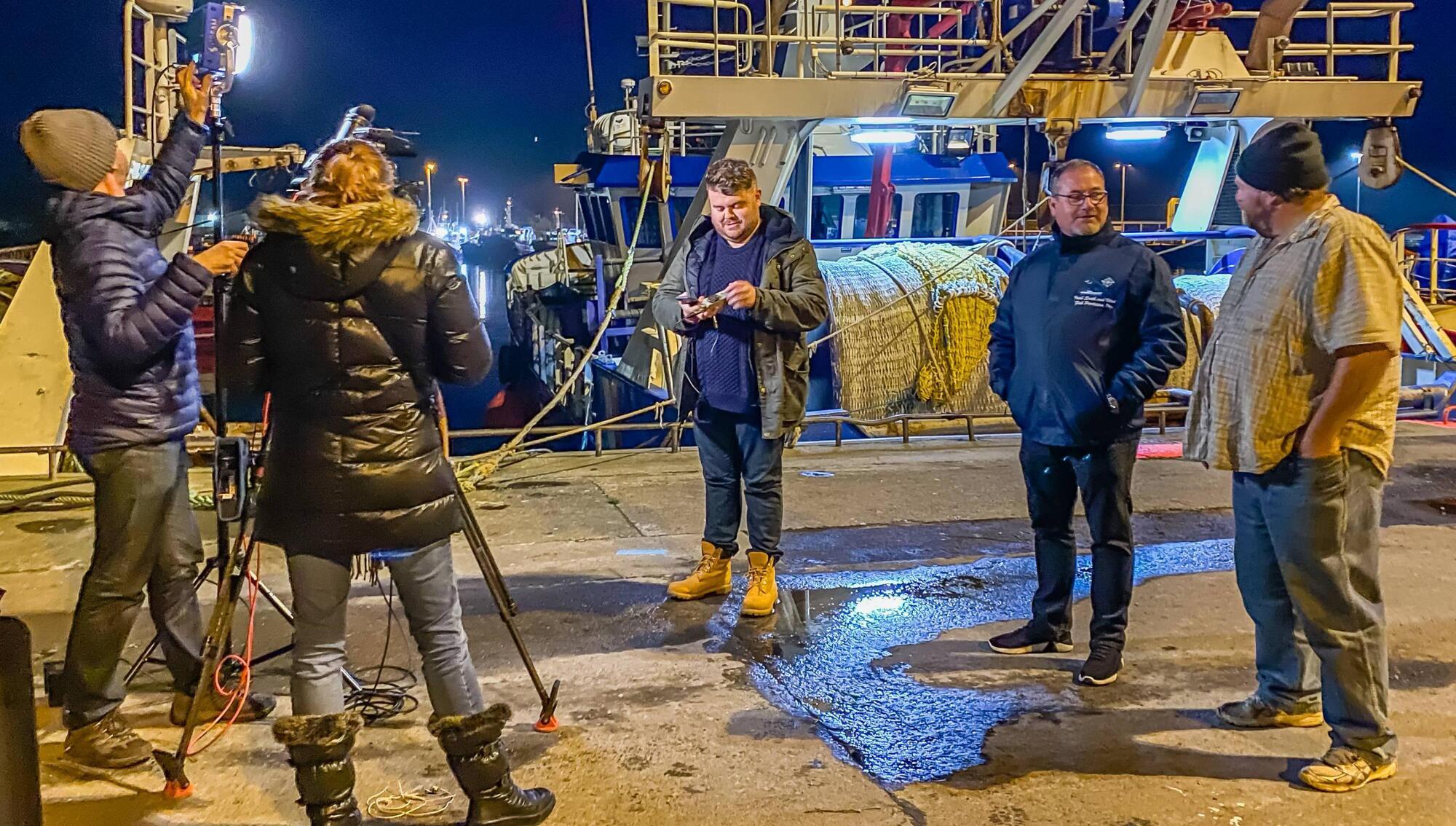
Donie O’Sullivan of CNN interviews Patrick Murphy of Irish South and West Fish Producers Organisation Patrick Murphy and fisherman Alan Carleton as Russia announces the relocation of exercises outside Ireland’s EEZ. Picture: Anne Marie Cronin

Former British prime minister Harold Wilson famously said “a week was a long time in politics” and former taoiseach Albert Reynolds ruefully remarked that it’s “the little things that get you down”.

For Minister for Foreign Affairs and Defence Simon Coveney, both sayings must have crossed his mind last week. Under pressure for an independent inquiry into a gathering at Iveagh House, which appeared to have violated Covid rules, he risked being compared to British prime minister Boris Johnston with his booze ups in No 10 Downing Street.

It must truly have been a heart-stopping moment for the minister to see the familiar face of one of his senior, and highly regarded, diplomats, taking a selfie of the Iveagh House event.

His next shock would have been to see the photograph of the chief of staff with the Russian ambassador, within hours after the Russians announced their plan to conduct naval exercises in the Irish exclusive economic zone (EEZ). The occasion was a pre-arranged unofficial meeting, part of a long-standing and approved practice in fostering good relations with the diplomatic corps. Despite the scary optics, the minister is probably now very glad that the meeting with the chief and the ambassador went ahead.

Then, out of the blue, one of his Cabinet colleagues, the minister for the environment, with the very best of intentions, proposed building a housing scheme on Cathal Brugha Barracks. This absolutely key military installation is essential as a backup to the gardaí for the security of Government Buildings, the southern part of Dublin Port, almost all the embassies and diplomatic residencies and dozens of other vital facilities. Finally, the Women of Honour Group rejected his proposals for a review into allegations of bullying, misogyny and violence in the Defence Forces. Without knowing the details of these events, my gut feeling is that, in each case, there was a failure of communications.

Diplomatic success

However, by week’s end, two diplomatic successes brought the sun out of the clouds again. The release by the Chinese of Richard O’Halloran after three years in detention was a major diplomatic achievement. It showed the effectiveness of the Department of Foreign Affairs in playing its cards right, in a difficult context of growing tensions over human rights issues in China and calls to boycott the Winter Olympics.

The second success was in diverting the Russian fleet exercises out of the Irish EEZ. The current narrative is that the fishermen and the Russian ambassador achieved this result. No question but the ambassador greatly helped, but I would suggest a more plausible reason. The international rule of thumb, in the conduct of foreign and defence policies, is to stay on message and above all not to have any contradictions. I have noticed that in the case of the Russian Federation, there may be some slippage.

The Russian defence minister, General Sergey Shoygu, seems to have the ear of president Vladimir Putin more than his foreign minister, Sergey Lavrov. The decision by Gen Shoygu to release the plan for worldwide naval exercises, including in the Irish EEZ, created a problem for Lavrov. The official concern of the Russians, in the present crisis, is to keep Ukraine and Georgia out of Nato, in other words, that Ukraine, in particular, would become some form of neutral/non-aligned state This message would, arguably, be undermined if the exercises went ahead in the Irish EEZ, the waters of a stated neutral country. It would show that Russia disrespects the neutrality status of a country and actually wants to control/occupy Ukraine.

However, the catalyst for a successful outcome was Mr Coveney’s direct appeal to Gen Shoygu, as one defence minister to another. It shows that having one minister in charge of defence and foreign affairs can work out very well.

One interesting lesson from this whole affair, which was highlighted by Independent TD Cathal Berry, and others, is that the Russians chose the Irish EEZ, not so much because we are a neutral country but because we are effectively undefended. This latter problem will be the subject of a debate shortly when the Commission on the Defence Forces report is published.

In the meantime, the people of Skibbereen can relax. One hundred and four years after the Skibbereen Eagle’s famous headline attacked the emperor of Russia, a Russian fleet with enough firepower to reduce this beautiful Co Cork town to rubble, will not be coming.

To paraphrase that old ballad, there will be no Russian ‘Revenge for Skibbereen’ Thankfully, the Russians have other fish to fry.
Colonel Dorcha Lee (retired) is a defence analyst

x

More in this section

Revoiced

Newsletter

Sign up to the best reads of the week from irishexaminer.com selected just for you.

Cookie Policy Privacy Policy Brand Safety FAQ Help Contact Us Terms and Conditions

© Examiner Echo Group Limited