Dorcha Lee: The ball is at Putin’s feet and there is no referee to blow the whistle
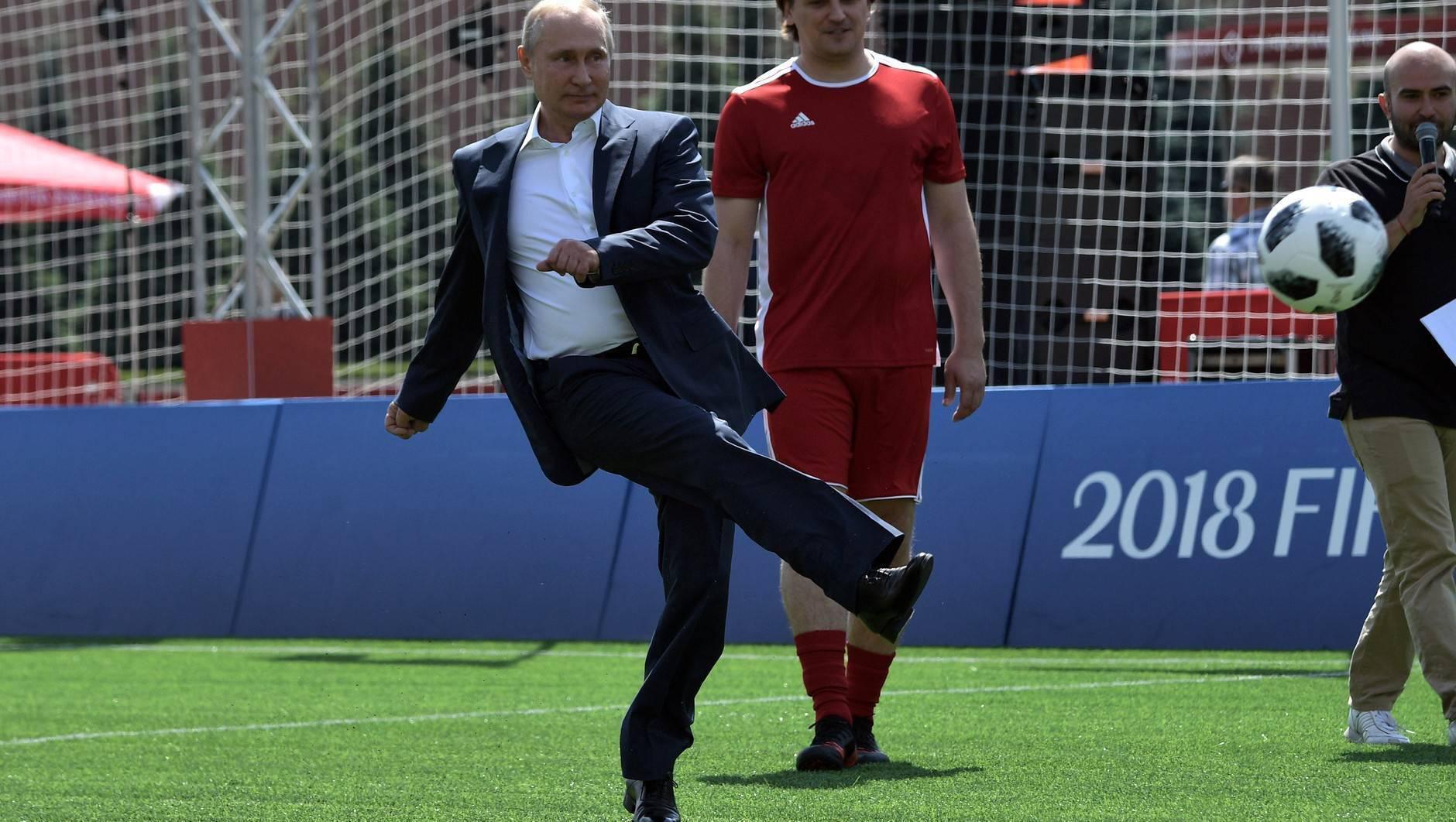
Vladimir Putin takes aim during a visit to the 2018 World Cup Football Park in Red Square. The goal of taking Ukraine is wide open for the Russian president, who undoubtedly senses the weakness in western powers’ resolve.
WINTER has finally arrived in the Donbas region of Eastern Ukraine. As temperatures dropped to below freezing last week, the soft muddy ground has begun to freeze.
It is expected to drop next Friday to a daytime high of -6C and a night-time low of -10C. By the time the Winter Olympic Games begin in Beijing, on February 4, the ground in eastern Ukraine should be sufficiently frozen to allow for rapid movement of armour.
The estimated 100,000 Russian forces, massed in assembly areas on the Ukrainian border, and in southeastern Belarus, can be doubled in size by divisions from bases located deeper in Russia. The US and Nato have made it publicly clear they will not intervene militarily if Russian forces move further into Ukraine.
Each interview with senior US and Nato officials — such as US secretary of state Antony Blinken, US deputy secretary of state Wendy Sherman, and Nato secretary general Jens Stoltenberg — includes unspecified “dire consequences” and “economic and financial sanctions”, but total silence on direct military consequences, and certainly no Nato boots on the ground.
In his recent press conference, US President Joe Biden expressed his own belief that Russian President Vladimir Putin will take some form of military action against Ukraine, and indicated that minor military actions by the Russians would not provoke a heavy response.
In fairness to the US, it has grown tired of being the world’s policeman. Its priority is the "tilt towards Asia", to counter the rise of China.
In recent years, the Obama administration failed to respond decisively when the Assad regime ignored Obama’s red line on bombing Syrian civilians with gas canisters. Donald Trump repeatedly undermined Nato by cosying up to Putin.
Last year, the Biden administration’s botched withdrawal from Afghanistan left thousands of former US Afghan employees at the mercy of the Taliban.
Putin undoubtedly sensed the inherent weakness in successive US administrations’ resolve to handle crises. Uncle Sam has lost his mojo. Russia can also take comfort from calls for appeasement in western media, including Irish, to turn Ukraine into some form of neutral state.
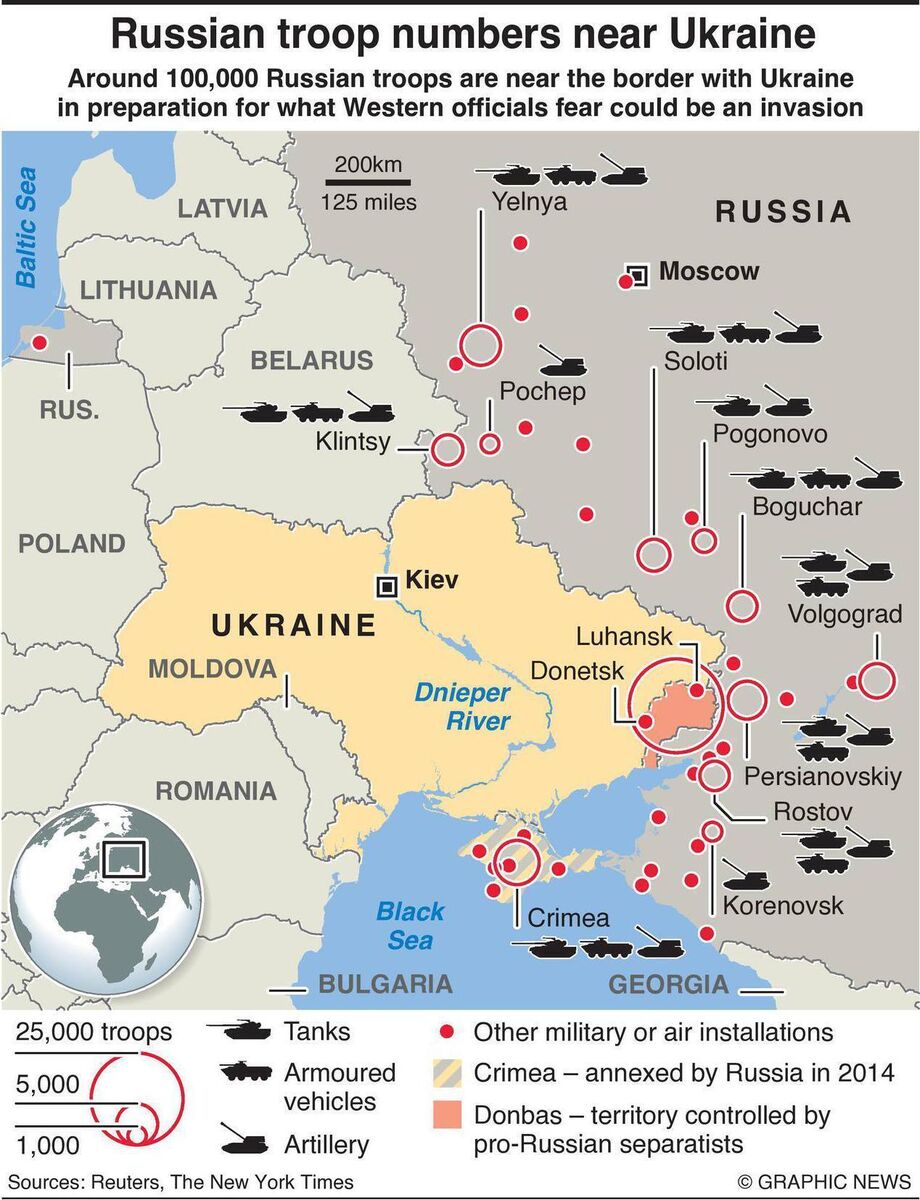
Putin has two broad military options — a limited invasion to extend his control over eastern Ukraine, or a wider intervention to seize Kiev and topple the Ukrainian government. For his military commanders, the main consideration will be the Dnieper river, which divides the country in two.
It is truly a formidable river, 1,000km long, so wide that it can be described as an almost continuous chain of lakes. It is a natural defence line and any attacking force would be channelled towards only a handful of bridges.
A limited invasion could be envisioned, initially with three simultaneous armoured advances, preceded by Spetsnaz (special forces) to capture key objectives.
The first advance could be in the south, from Crimea, to seize the Kherson area and unblock the flow of water into the North Crimean Canal, blocked by the Ukrainians in 2014 in retaliation for the Russian invasion of Donbas and Crimea. This could be combined with a diversionary naval attack on Odessa.
In my opinion, the greatest risk of confrontation between Nato and Russian forces will be in Crimean waters, which the international community still recognises as Ukrainian waters.
The second axis of a limited invasion scenario could be from Luhansk and Donetsk in Donbas, to seize Dnipro and Zaporizhzhia, and their bridges over the Dnieper.
The third advance would be from Belgorod in Russia to Kharkiv and Poltava to secure the northern flank of the force moving to Dnipro.
Belarusian forces may participate in the Russian intervention. If Putin wants to go all out and effect a regime change in Kiev, a fifth (Russo-Belarusian) advance south, from Mazyr in Belarus, continuing west of Chernobyl and down to Zhytomyr, could pivot east to attack Kiev from the west.
Combined with a sixth advance by Russian ‘peacekeeping’ forces in Transnistria (eastern Moldova), towards Vinnytsia and Zhytomyr, this could trap the bulk of the Ukrainian army in a pincer movement and bring the war to an end.
The ball is presently at Putin’s feet, and there is no referee to blow the whistle.
- Defence analyst Dorcha Lee is a retired Irish army colonel.
CONNECT WITH US TODAY



Be the first to know the latest news and updates