Niamh Hourigan: Population growth opens a new chapter in the story of Irish society
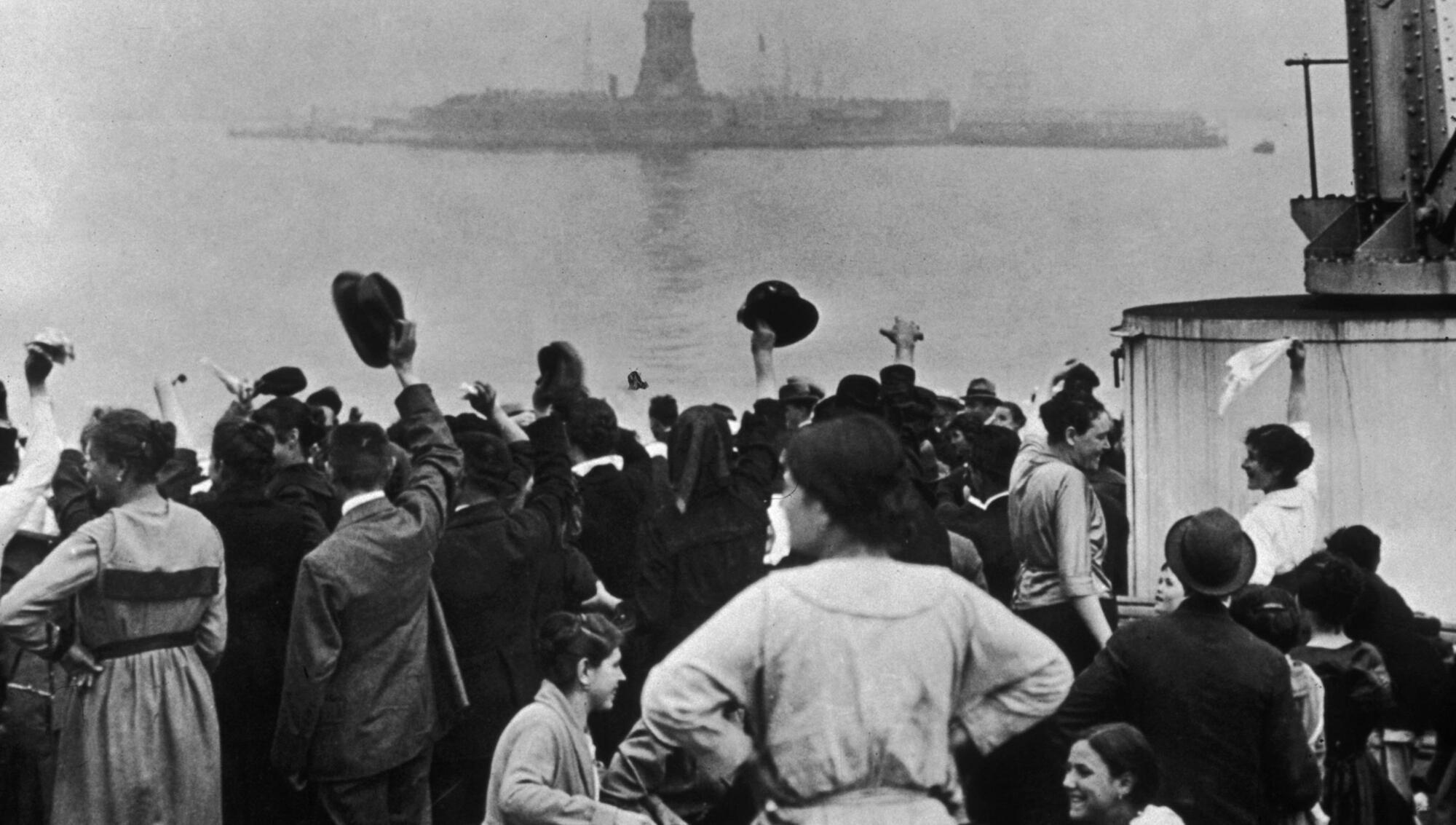
Population figures — and the stories of people such as these emigrants getting their first glimpse of the Statue of Liberty in New York — have long been a shorthand for a much larger story about Irish history. Picture: Edwin Levick/Getty
The release of CSO figures this week shows that the population of the Republic of Ireland has crossed the symbolic 5m threshold.
Since the mid 19th century, population figures have always represented a shorthand for telling a much larger story about Irish society — a story of famine, a story of emigration, and often a story of rural decline.
Rarely have these figures told a good news story but this week was different. The CSO figures show that the population of the Republic has returned to the level where it hovered in 1851. From that point onwards, the population was largely in decline, a decline which underpinned a much wider social and economic malaise as well as a certain despair.
This despair is most evident at the nadir moment of 1958-59. The waves of emigrants that left Ireland throughout the 1950s left behind a country denuded of its youth and demoralised in its vision. As Maynooth professor Denis Meehan commented in 1960: "In purely physical terms the population cannot dwindle any further, the bottom of the curve must come somewhere, there is literally nowhere to fall from."
From that low point, we have journeyed to this week’s 2021 figures which show that the population of the Republic has increased by 2.19m since the early 1960s — undoubtedly a good news story.
There have of course been waves of emigration from Ireland since the 1960s, most notably in the late 1980s and immediately after the banking crisis in 2010. However, the long-term trajectory over this period has been upward, and it’s a trajectory that has emerged as a result of strategies by generations of policy planners, activists, and indeed politicians.
The critical importance of choosing public policies which would support population growth was articulated most clearly by Sean Lemass during that nadir moment at the beginning of the 1960s when he said:
The strategies that resulted from this publicly-stated commitment to population growth have not come without cost. Our continued dependence on foreign direct investment means that we are extraordinarily exposed to the tumults of global capitalism. In our facilitation of global corporate tax avoidance, the state has veered perilously close to tax haven status for multinationals.
Despite these costs, many would argue that this approach did ultimately support population growth and was worth the risk. Burgeoning towns, cities, and rural communities are very much at the heart of what Lemass envisaged back in the early 1960s.
However, much of the population growth in the Republic since he articulated his vision has been uneven. Rural communities have continued to experience population decline while the infrastructure of the cities and towns bursts at the seams.
A positive element within this week’s figures was the weakening of population growth in Dublin. Part of this trend may be a Covid effect which we are only just starting to understand. Remote working has undoubtedly enabled many people to move out of cramped conditions in the capital — a trend which continues to be visible in Europe and North America.
Migration patterns may also be impacting on the regional distribution of the population. Of the 65,000 people who arrived to live in Ireland during the 2020-21 period examined, nearly half were returning Irish citizens, the highest level of return migration since 2007.
For those who spent lockdown in small, cramped, but valuable apartments in European, North American, and British cities, the appeal of Dublin with its massive housing shortage and creaking infrastructure may be limited. Whereas the appeal of regional cities, county towns, and rural communities would appear to be significant if current trends in these property markets are to be believed.
Returners are good news for Ireland. They bring new skills, new perspectives with an already developed understanding of Irish society. There is some evidence that Irish emigrants of the late 1980s who returned in the early 1990s played an important role in the early stages of the Celtic Tiger boom — particularly in terms of the IT sector.
But of course, the success of their return to Ireland depends on the capacity of government to deliver public services that support their lives here and the lives of those already living in the State.
Population growth is only a good news story if government policy makes it so. If more people in the Republic means more people competing for very limited housing, over-burdened healthcare, and over-crowded schools, then a growing population becomes a source of societal strain.
However, by managing it correctly and building on the huge opportunity it offers, population growth can become a blessing that will benefit generations of Irish citizens to come.
• Prof Niamh Hourigan is a sociologist and vice president of academic affairs at Mary Immaculate College, Limerick