Bill Emmott: Herd immunity is closer than you think
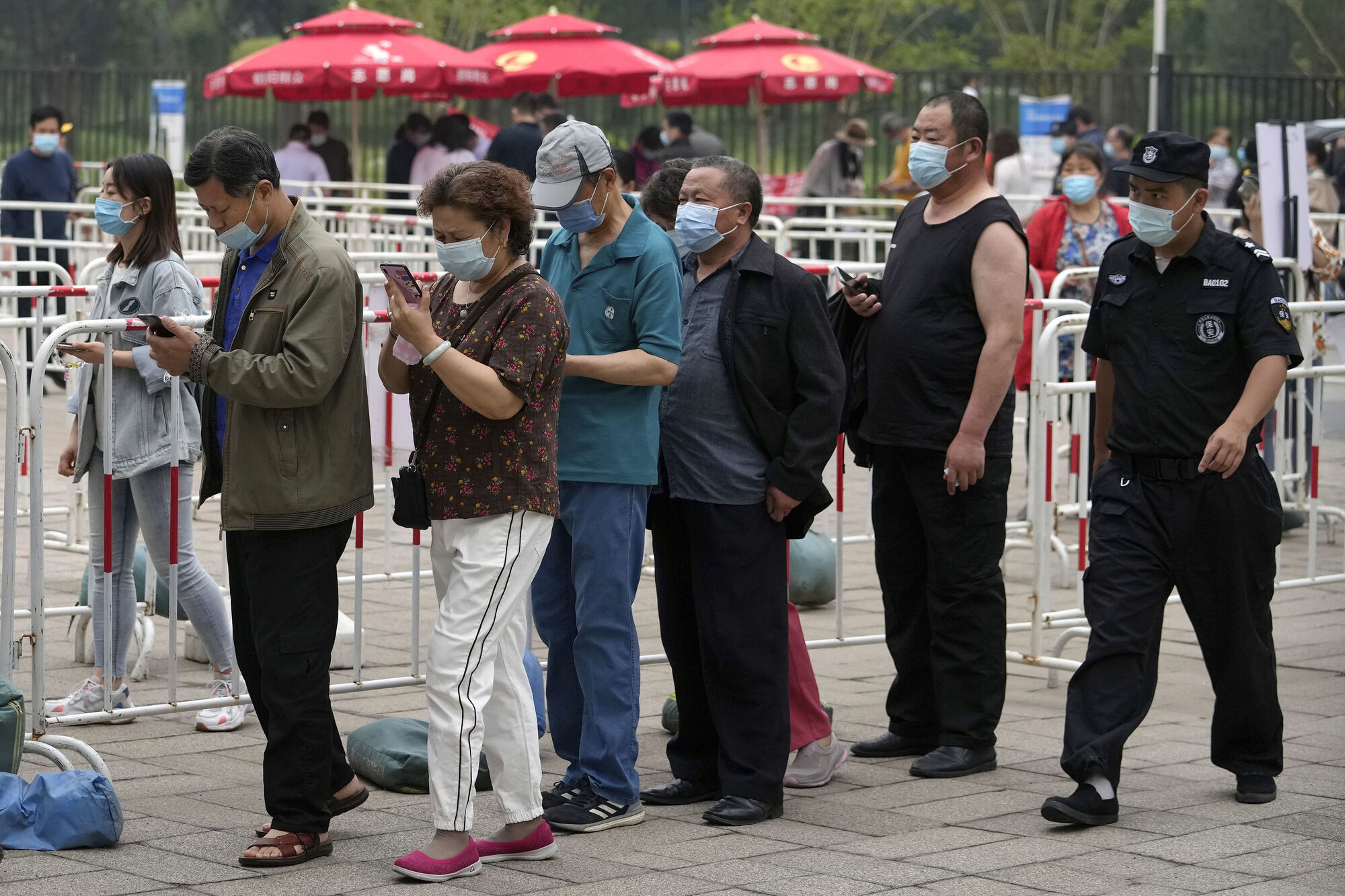
Residents line up to receive the Sinopharm Covid-19 vaccine at a vaccination center in the Central Business District in Beijing recently. After a slow start, China is now administering shots at a staggering pace. Photo: AP/Andy Wong
When will the world have vaccinated 80% of all adults, the level presumed by scientists to produce herd immunity against Covid-19?
Most people’s answer is 2023 or 2024, which suggests deep pessimism about the progress of vaccinations outside the rich world. That is also why pledges at the recent G7 summit to donate one billion doses to poor countries during this year and in 2022 look to some like generous game-changers.
But despair is the wrong sentiment and self-congratulation by the G7 is the wrong reaction.
The first step toward effective action is to convince oneself that a problem is solvable. To that end, the Global Commission for Post-Pandemic Policy, an independent, non-partisan group of 34 high-level doers and thinkers from around the globe, has done the maths to come up with a global vaccine countdown.
Surprisingly, we found that the challenge is much more manageable than we imagined, and on a timetable much faster than that assumed by the G7 governments.
The arithmetic is simple, but first you have to decide whether to regard China, the world’s most populous country, as an inspiration or an exception.
According to Our World in Data, China now accounts for 17m-20m of the 33m-36m doses being administered worldwide every day. With China included, the countdown reaches zero in just over 200 days; without China, the time increases to 370 days.
That is an important difference, but it amounts to reaching the finish line in July 2022, rather than in January. Even if a higher threshold of 90% becomes necessary, owing to the lower efficacy of Chinese vaccines, we are still nearly there.
Let’s look at the numbers. The world’s population is 7.9bn, an estimated 5.85bn of whom are adults (74%). If the goal is an immunisation rate of 80%, 4.7 billion will need shots, which on a two-dose vaccine regimen means 9.4 billion doses.
As of June 11, 2021, Our World in Data reports that more than 2.3bn doses have already been administered worldwide, leaving just over 7bn doses. Divide that by a mid-range daily figure (34m) and you get roughly 211 days — January 2022.
Yes, 7bn is a very large number. But look at what is happening: Every day, China is administering 17m-20m doses; India is administering just over 3m; and even Africa is administering nearly 900,000 — a 37% increase since the start of the month.
Moreover, these numbers are still rising in most countries. Though not every middle-income country will be able to match China’s pace, that at least should be the motivating goal.
Until recently, the main constraint and source of frustration was the limited supply of vaccines. But production is rising sharply, with the global monthly output of vaccines approved by at least one major regulatory body increasing from 420m doses in April to 822m doses in May.
China’s two vaccine makers, Sinovac and Sinopharm, accounted for more than half of this total (nearly tripling output from 164m doses in April to 454m in May).
Output of Pfizer-BioNTech and Oxford-AstraZeneca vaccine doses in the EU doubled, from 69m to 140m, while the number of Pfizer-BioNTech, Moderna, and Johnson & Johnson doses in the US rose from 71m to 105m. The only disappointing production figures were in India, where output slipped from 76m doses in April to 62.6m in May.
In the coming months, the key constraint will no longer be supply shortages but rather financing and logistical challenges, particularly in poorer countries with limited infrastructure and healthcare coverage.
These hurdles can be lowered if rich countries release their production more quickly for others to buy, and if more bilateral and multilateral aid funding is made available to support public-health systems and vaccine purchases.
Make no mistake: China will likely play a large and perhaps leading role in this process. As the world’s biggest producer of Covid-19 vaccines (albeit of a less sophisticated variety than the Western ones), China will have immunised its own population by September or thereabouts, giving it abundant spare production capacity to supply the world (along with funding).
That is why the Western pledges at the G7, welcome as they are, are in reality somewhat behind the curve. The G7 countries are offering their billion doses on a timetable convenient to them, divided between late 2021 and 2022, but actual demand from poor and middle-income countries is coming much sooner than that.
This means that China is being given a huge market and diplomatic opportunity of stepping into the breach with perhaps 500m doses every month during the last four months of 2021.
#China is #vaccinating at a blistering pace. Can other nations match its #COVID #vaccine rollout?
— Global Commission for Post-Pandemic Policy (GCPPP) (@GCPPPorg) June 13, 2021
Via @SmritiMallapaty @Nature https://t.co/00LeGGjQaC
If that happens, the surprisingly short timescale indicated by our vaccine countdown can actually be shortened further. Rural parts of Africa and unstable parts of Latin America will face the biggest challenges, but these can be overcome with aid from rich-country governments, including China’s, and from big philanthropic foundations.
Mass vaccination campaigns in the developing world are nothing new. Success depends on generosity, political will, and a belief that the solution is both necessary and achievable.
With new variants emerging rapidly and new outbreaks in places that had seemed to have the virus under control, Covid-19 remains a global problem.
We should know by now that it demands a global solution. The recent increase in supplies and the Global Commission’s vaccine countdown indicate that what we need is well within reach.
- Bill Emmott, a former editor-in-chief of , is co-director of the Global Commission for Post-Pandemic Policy.

CONNECT WITH US TODAY



Be the first to know the latest news and updates