Cork students and the 'absolute horror' that is the scramble for accommodation
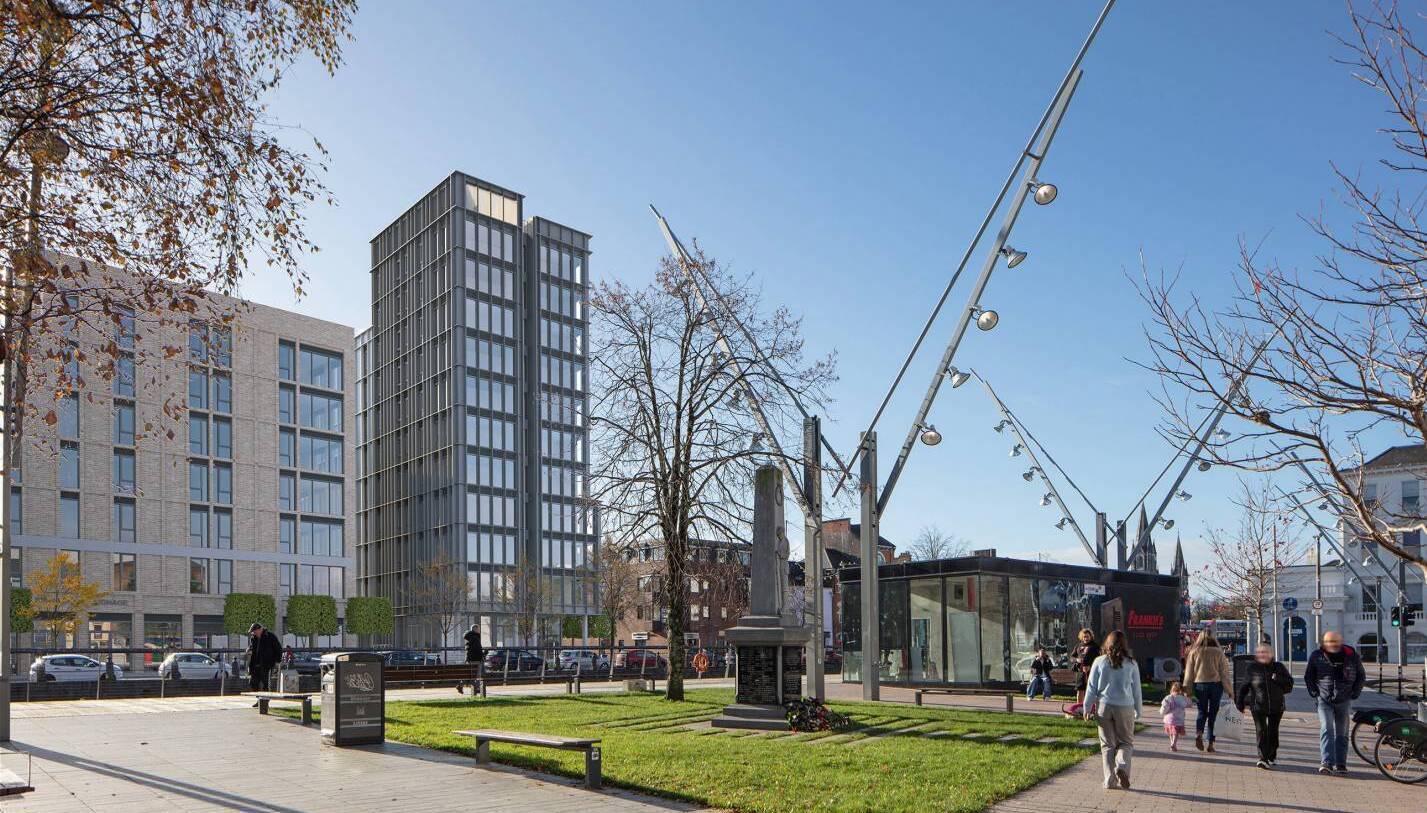
BAM was granted planning permission last month for a 495-bed student apartment scheme on Sullivan’s Quay in Cork. A number of such developments are in the pipeline, but experts predict the shortage will affect students for some years yet.
The scramble for student accommodation is back on as more than 200,000 full-time students prepare to attend colleges across the country.
Every September is now characterised by a mad dash of students seeking to find a roof over their heads in a marketplace that is increasingly void of supply.
In 2025, there were around 69,000 students scrapping for 43,000 beds, according to the Department of Higher Education.
This year, in University College Cork, there are around 1,540 beds available in official college accommodation, compared to 6,732 applicants.
Students’ union representatives say they’re hearing from a plethora of students on the brink of despair.
“It’s just gotten so much worse in terms of the desperation that students are coming in with,” says Caoimhe Brinkley, the welfare officer of UCC Students’ Union.
“Whether it’s over an email or whether it’s in person, you can just sense the absolute horror that they’re facing.”

Ms Brinkley says students are being caught in the crossfire of scams and disreputable landlords, with some students putting down deposits for accommodation that doesn’t actually exist.
Students who are looking for accommodation typically size up three options: Purpose-built accommodation provided by colleges; private rentals; and rooms in owner-occupied homes, or ‘digs’ as they’re colloquially known.
Read More
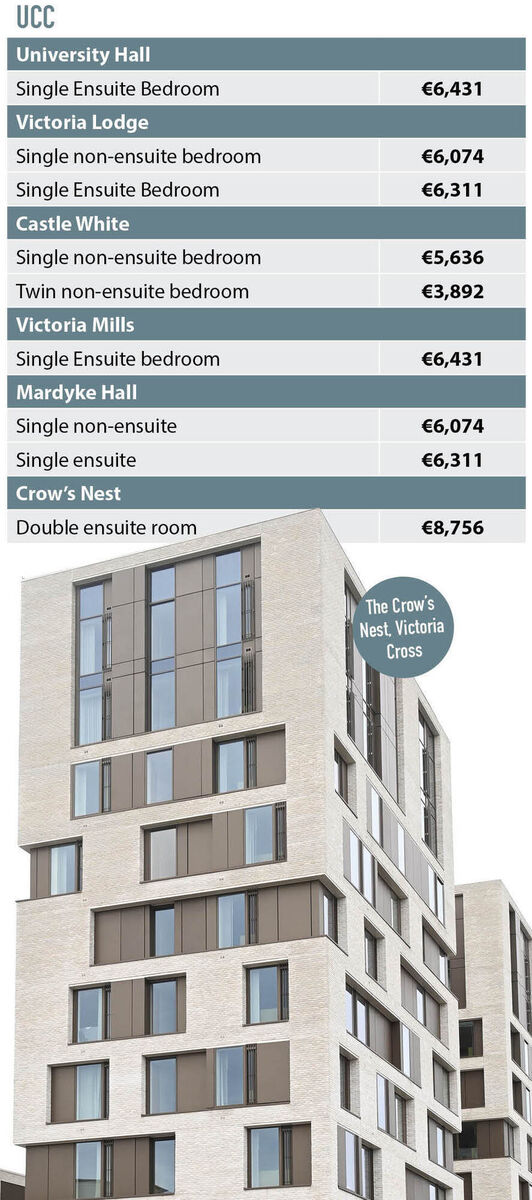
Options range across the six student accommodation sites that UCC owns, from older, cheaper options in University Hall, Victoria Lodge, Castle White, Victoria Mills, and Mardyke Halls, to new state-of-the-art modernistic buildings such as the Crow’s Nest at Victoria Cross.
Prices can run as low as €3,892 for the academic year to stay in a non-ensuite twin room to upwards of €8,500 for a double ensuite (both excluding utilities).
The question of who gets on-campus accommodation is based on a lottery system.
“If you’re from Spain or from Donegal, the lottery system is the same,” says Gary Mulcahy, chairman of UCC’s Student Life body, which oversees UCC’s accommodation operations.
“What we tend to do is to try to fit whatever the student wishes… Sometimes the only option is digs, but for the most part, most of our first-time students are looking for that purpose-built student accommodation option, and the digs really can be the last resort for probably 70%-80% of our students.”
The window for incoming first-year students to find accommodation is tight. CAO results for college placements were released on August 26. Many will begin their studies today.
More than 2,800 first-year students have accepted places at Munster Technological University Cork, with numbers yet to be fully confirmed as offers and placements are still being delegated through the CAO process.
Deirdre Falvey, accommodation officer for MTU Cork, says around half of incoming first-years will live in private accommodation, mostly in digs.
The marketplace for digs has become “huge”, she says.
Initiatives such as the rent-a-room scheme allow homeowners to rent a room to students and earn up to €14,000 tax-free, and have become a fulcrum of Government policy in seeking to address the shortfall of student beds.
The Department of Further and Higher Education envisages an additional 10,000 beds for students being unlocked through digs — the arrangement currently accounts for around 5,000.
Ms Falvey stresses that while digs have proved to be successful in the interim, the long-term solution needs to stem from accommodation built by colleges at affordable prices.
“There’s always the hope that we will be able to build our own eventually, but that all depends on the Government.
“If you told me this a couple of years ago, that we’d be where we are today, that all students would be back in digs, back like what it was like in the ’80s and the 90s, I’d be laughing at you.”
Increasingly, the private sector has represented a larger cohort of the overall student housing stock.
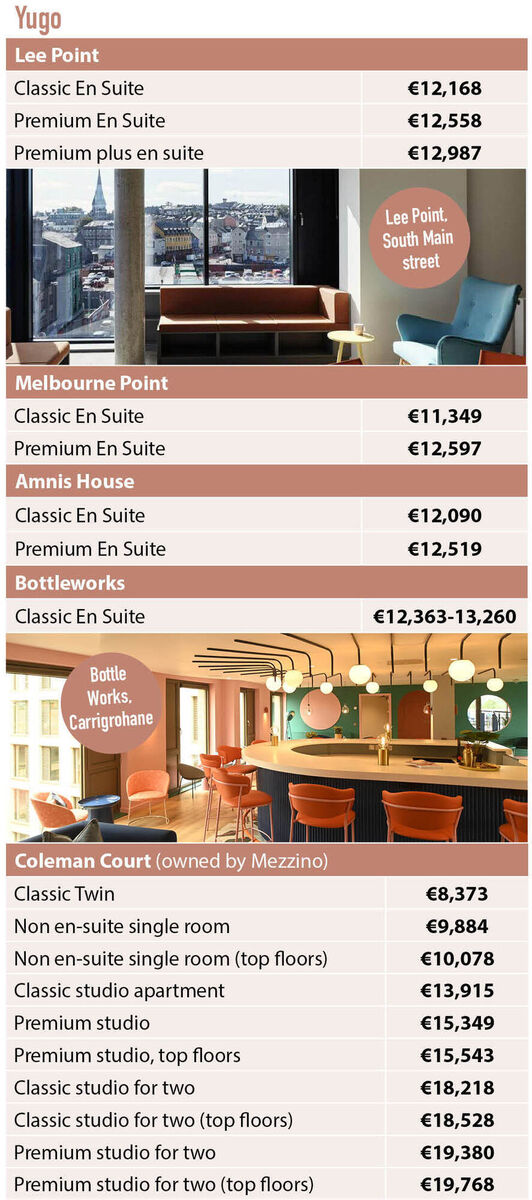
Yugo — a purpose-built student accommodation specialist — now has a housing stock of 1,575 beds spread across four sites. In its latest financial filings, Yugo carried over profits of €956,000 into 2026.
Compared to UCC’s older purpose-built student accommodation stock, Yugo’s offering can be considered far more boutique — and the market positioning is reflected in the price.
A classic en-suite room in one of Yugo’s residences, Bottleworks on the Carrigrohane Rd, can cost up to €1,360 per month without utilities for the academic year, around twice the price of accommodation in UCC.
Most developers of Yugo’s ilk offer facilities that would be hard to come by in traditional student accommodation, from rooftop terraces, communal gaming, and movie rooms, to indoor gyms.
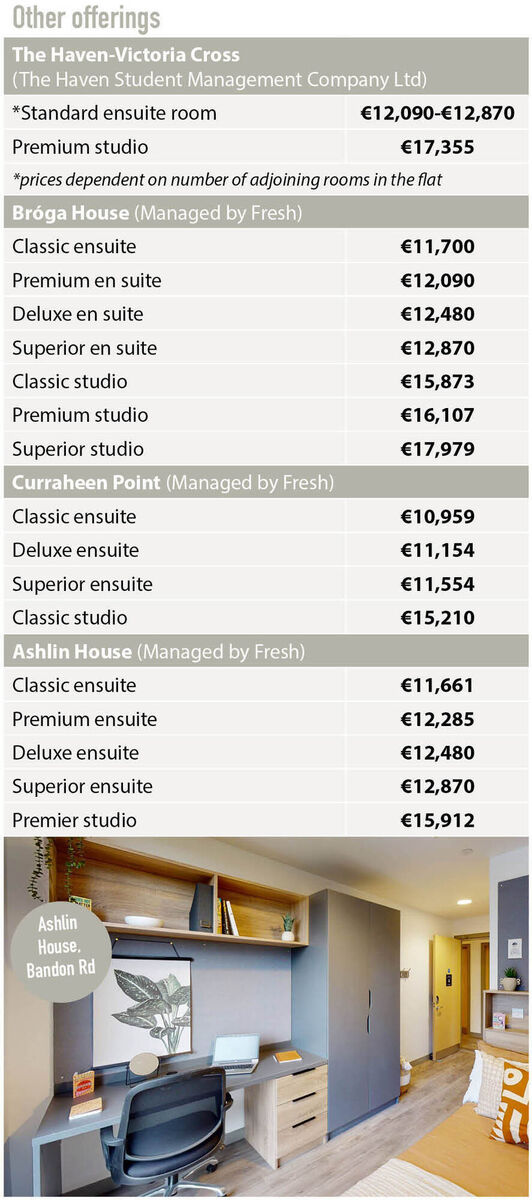
Other operators such as UK property management firm Fresh control a stock of around 870 beds in Cork, having taken over four student accommodation sites formerly controlled by Round Hill Capital.
Again, the offerings are distinctly more premium — a 25-37 square metre studio in the company’s Bróga House on Washington St commands prices of nearly €18,000 for the academic year, or just shy of €2,000 a month.
According to UCC Student Pad, which acts as a monitored marketplace for students to find private accommodation, offers for digs can range from as cheap as €390 a month around Barrack St for a Monday-Friday stay, to €800 per month on the Western Rd for the same five-day offer.
Opinions on private providers are split. Ms Brinkley says some of the offers are exploitative in nature and only appeal to students with “the big bucks”. Ms Falvey adds that they offer genuine relief to students that can afford the steep prices.
For some gearing up for the academic year, the traditional means of accommodation aren’t an option. Ruairí Smith, 19, is preparing for his second year of studying government and political science at UCC. He currently spends three nights a week living in the same hostel where he spent his first year.
He spends the remainder of his week back home in East Clare.

“It’s been difficult. There are moments where you’re like ‘oh fuck, will I make it to next week?’ ”
Mr Smith says he exists outside of the periphery for Susi grants (the financial support body for higher education students), but that paying a landlord €800-€900 to live in a spare room is “unfeasible”.
He says he can’t obtain a steady job in Cork because of his living situation, and he can’t escape his living situation as he’s unable to obtain a job.
“It makes it hard to find work in Cork because employers want someone who stays seven days a week, but suddenly you can’t because you’re only able to afford X amount of nights,” he says.
“Students are missing out on their community, on an authentic experience they get through college, like our parents had.
“You’re stuck in between two places, but you can’t establish a life in either one because you just don’t have the time to split between them.”
He says UCC’s manner of delegating student beds, which does not factor in students’ socioeconomic background, is “equal but not equitable”.
He also criticised Susi’s means of ascertaining needs based on a means test, saying it does not always accurately reflect a parent’s ability to support a child through secondary education.
Nainesh Parikh is enrolling in a master’s programme in UCC beginning this year. The programme has cost him €20,070, which was partially reduced by a scholarship grant.
He says one of the few places that he has been able to find has been an unfurnished twin room for €600 a month, excluding utilities.
“There was an apartment in the city centre where the owner has given the entire apartment on a 10-year lease to an agent or an agency, and the agency is now operating the apartment and putting up the bunk beds and everything in each room and charging this high,” he says.
“You have no choice. You have to buy this… The accommodation shortage crisis is huge, not only in Cork, Dublin, or anywhere else, and the supply is less, and students are more.”
Like Ruairí, he is staying in a hostel, with his studies set to begin this week. Unlike Ruairí, he is unable to return home on the weekend.
For the week when his master’s degree begins, Nainesh plans to sleep on a friend’s couch. After that, he is not sure where he will go.

The student housing accommodation strategy, launched in March 2026, identified a need to bring another 42,000 beds to the market in the space of a decade.
Digs are a fulcrum of the strategy, as well as public-private partnerships, in which private developers will build on university-owned land.
In a statement to the Irish Examiner, the Department of Higher Education said the first round of partnership developments would soon be rolled out to Cork, Dublin, and Galway, with a formal tender process expected to begin in 2027. Industry bodies are less optimistic about the department’s goal.
Construction consultancy firm Mitchell McDermott forecasted that just 422 additional student beds would be developed in 2026, the lowest number in 20 years.
Company director Paul Mitchell says the high costs of construction meant it was almost impossible for large-scale residential developments to claw back money on rent that few students can afford.
“A lot of schemes that are trying to trade at the moment, people are just struggling to make them work,” Mr Mitchell says. “If you have a regional scheme where the investment yields are much poorer, you can’t get the scheme to stack up.
“One of the larger student accommodation operators was sceptical about public-private partnerships because there has been a lot of regulatory change… You want us to go and invest tens of millions on a site that is not ours? What happens if they revoke the license? What happens if the rules of the game change and we’re fully invested?”
A body of student accommodation developers is now calling for Vat on new builds to be completely cut, to facilitate development.
More than 14,000 beds with planning permission have yet to proceed to construction. When the issue invariably rears its head again next September, issues could be even more perverse.
Read More

CONNECT WITH US TODAY



Be the first to know the latest news and updates