Helping women take the plunge into local and national politics
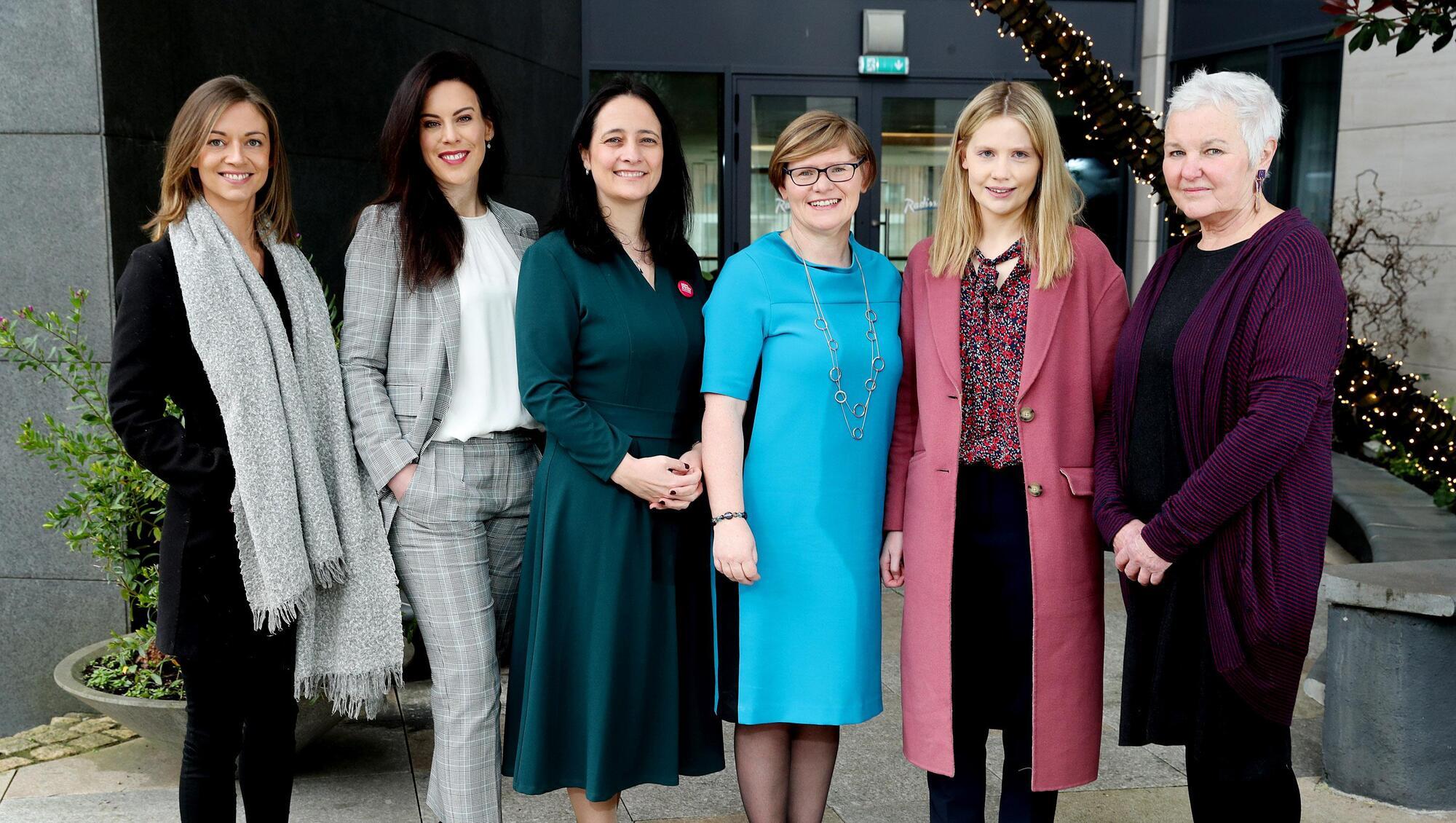
Holly Cairns, Social Democrats; Jennifer Carroll Mac Neill, Fine Gael; Catherine Martin, Green Party; Orla O’Connor, National Women's Council of Ireland director; Claire Kerrane, Sinn Féin; and Bríd Smith, People Before Profit. at an event last year to celebrate newly elected women TDs. Picture: Maxwell Photography
It’s the photograph that gets to you first. Then the numbers sink in. You turn over a page of your newspaper or stop mid scroll. There they are. All the men.
And the stark reality of how many men and how few women are in politics swims glaringly into view. What needs to happen to see HER elected?
Most of our TDs, both men and women, make their way to the Dáil via local government. By our reckoning, only 25 of the TDs elected in February did not have council experience behind them and all bar three of the Cabinet first cut their teeth in politics in our county or city council chambers.
The 2019 local elections saw 226 women councillors elected, the highest number since the beginning of the State. However, this is just 24% of the overall number of councillors in the country.
While councils in Dublin and neighbouring counties are seeing growing numbers of women councillors, it is a very different vista in rural Ireland.
Gender quotas are not in place for local government elections, but the Citizens' Assembly recently recommended the introduction of gender quotas for party candidates at general, local, Seanad and European elections by the end of next year. This is required because of the evident disinclination of political parties to select and support women candidates.
Of the 112 candidates selected by the three larger parties (Fianna Fáil, Fine Gael and Sinn Féin) in the counties of Donegal, Leitrim, Sligo, Roscommon and Longford in the 2019 local elections, just 20 of them were women. Voters in three local election areas in the region had no women on the ballot papers; Lifford-Stranorlar in Donegal, Ballymote-Tubbercurry in Sligo, and Athlone in Roscommon.
The lack of female councillors has multiple repercussions, not least of all the fact that decisions are being taken that affect the daily lives of citizens in a county in myriad ways. Time and time again we see that women bring a different perspective to these decisions and how they are made.
The lack of representation in the local political sphere is all the more concerning when you take into account the fact that women are often the bedrock of many community initiatives responding to inequalities and barriers that exist in our society. Why are they not choosing politics as a way of tackling the issues that propelled them into community activism in the first place?
Concern about the lack of women in councils in rural Ireland led women activists in community groups across the Midlands and North West to establish See Her Elected (She) in 2019.
We connect with women in their homes and their communities through our online SheSchool, which delivers political knowledge about how local government works, what the job of a councillor is really like, and the opportunities to get involved in council decision-making offered by public participation networks and local government committees. This is supplemented with practical advice from women who have run for local office and managed campaigns.
Initially, the ambition of She was to bring women together who were interested in politics and were curious about how politics worked, and facilitate their growing political education and engagement.
We have succeeded in this and She has welcomed women from all backgrounds and beliefs.
We will continue to bring more women into She through our very accessible Introduction to Politics, following which they can decide their level of continuing engagement, from an ongoing interest in politics to planning for the 2024 and 2029 local elections.
She's Practical Guide to Running for Election is being jointly authored by women with considerable practical experience of doing just that. This phase will run in parallel with our ongoing political education.
It will bring together women in the same or adjacent counties who want to be part of a campaign team for a woman candidate and/or who want to be a candidate in 2024.
It will be very practical, bringing women through what they need to do, month by month, between autumn 2021 and the 2024 elections, as well as addressing needs that they themselves identify, such as public speaking training and interview techniques.
Those with family and/or party connections are reluctant to assert themselves as a potential candidate, preferring to wait to be asked — a fact backed up by research commissioned by the National Women’s Council.
We are asking women right now, three years out from the next local elections, to think about being that candidate or being part of a campaign team for a woman candidate. Local government is much much more than just a pipeline to national politics. It is the level of government closest to us and the decisions made in council chambers affect where we live, work, socialise and relax.
Women, through their greater undertaking of (unpaid) domestic and caring duties, are particularly affected by decisions taken and services provided by councils as they go about their day-to-day lives.
The proximity of local government to the lives of women makes their perspective and knowledge an essential enhancement of the local political system. That perspective and knowledge is equally and urgently required in national politics. This is why it is time to See Her Elected.
- Dr Michelle Maher is the programme manager for See Her Elected. For more information check out www.seeherelected.ie.
- See Her Elected is a partnership project between Longford Women’s Link and 50/50 North West. It is funded by the Department of Housing, Local Government and Heritage, and all our resources are freely available to everyone.
CONNECT WITH US TODAY



Be the first to know the latest news and updates