Cork doctor had crucial role in combating smallpox
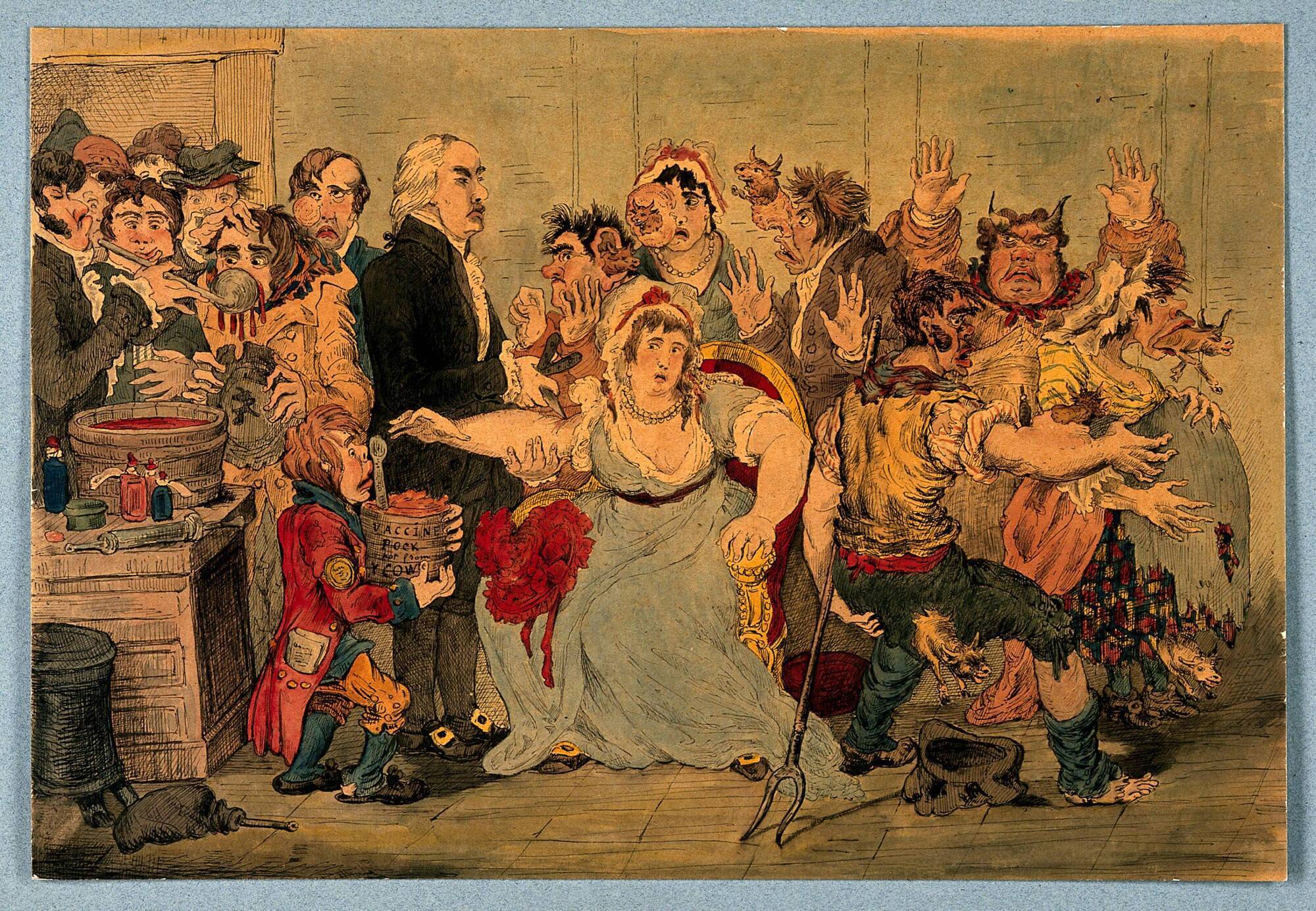
Edward Jenner vaccinating patients in the Smallpox and Inoculation Hospital at St Pancras in London. Jenner had noticed that farm workers who contracted a mild pox disease from livestock, usually from milking infected cows, were subsequently immune to natural and inoculated smallpox. Watercolour after J Gillray, 1802: Wellcome Collection
Smallpox or variola is the only human disease to have been eradicated by vaccination, the last natural case occurring in 1977.
For centuries, this acute highly infectious viral disease was feared and loathed in Ireland and elsewhere because of its disfiguring effects and relatively high mortality rate, often around 20%. Except in the rarest instances, there were only two ways in which smallpox infection could end – in death or with long-term protection against recurrence.
It was known that smallpox could be prevented by variolation – the inoculation or artificial infection of healthy people with smallpox matter in the hope of producing a mild case of the disease and immunity from future contagion.
The practice, which originated in China, was introduced to Britain in 1721 and to Ireland a few years later. Variolation was generally accomplished by obtaining fluid from pustules of an active case of smallpox and scratching it into the skin.
Inoculation with the material of smallpox posed a serious public health threat: the process afforded protection to the recipient, but exposed the general population to the possibility of contracting fully virulent smallpox.
The identification and promulgation of vaccination (from vacca, Latin for cow) in the late 1790s by Edward Jenner, an English west country doctor, was a significant advance.
Jenner noticed that farm workers who contracted a mild pox disease from livestock, usually from milking infected cows, were subsequently immune to natural and inoculated smallpox.
The technique employed in vaccination and variolation was identical, but vaccination conveyed cowpox rather than smallpox. The substitution of cowpox matter for the smallpox virus proved to be safer and more effective and vaccination spread quickly.
John Milner Barry, a Cork medical practitioner who was born in 1768 at Kilgobbin near Bandon, was among the first in Ireland to recognise the importance of the new procedure, describing it as Jenner’s ‘fortunate discovery’.
According to Barry, smallpox was a 'dreadful malady', a devastating and pestilential scourge that affected the poor disproportionately. He contended that the prevalence of smallpox throughout Europe testified to the inefficacy of variolation as a prophylactic, and he believed that the disease could only be extirpated by variolating the entire population, which he considered impracticable.
Barry obtained sufficient doses of cowpox infection from these children to vaccinate others in the city and its environs. Shortly afterwards, he received a second vaccine thread from London and passed it to a colleague, Dr Sugrue, who vaccinated children in the city’s northside.
Barry estimated that he and Sugrue vaccinated some 330 children in the next couple of months. He claimed that the infection was very mild in all cases and that none of the children experienced any adverse reaction, though some did complain of sore arms, which he attributed to the size of the incision produced by the thread.
Although Barry is generally credited with introducing vaccination to Ireland, the procedure was performed at the Dispensary for Infant Poor in Dublin from its establishment in March 1800.
The popular awareness in the west of England of the prophylactic power of cowpox, which informed Jenner’s vaccination experimentation, pertained in eighteenth-century rural Ireland also.
In a pamphlet published in Cork in 1800, Barry observed that for the previous half century and more country people were familiar with cowpox, which they termed ‘shinach’, from the Irish word sine, meaning teat (of an animal); they recognised the mildness of the cowpox infection and its ability to provide immunity from smallpox.
A Church of Ireland clergyman in the parish of Moviddy in east Muskerry informed Barry that ‘shinach’ was well known in the locality and had long been deemed a preventive of smallpox.
Barry had encountered several individuals who as children had been deliberately exposed to cowpox infection.
Cowpox appears to have been endemic in mid- and west Cork in the middle decades of the 18th century and, according to one of Barry's informants, whose account was substantiated by his octogenarian grandmother, country people exposed themselves deliberately to the disease, such was the general belief that those who contracted cowpox were ever after protected from the more virulent smallpox.
Barry concluded that popular belief in the anti-variolous power of cowpox was as old as the disease itself.
In addition to its significance as a medical text, Barry’s pamphlet on vaccination contains the case histories and oral testimony of many country people, which shed light on popular beliefs and practices in 18th-century County Cork.
A particularly striking example was Barry’s incidental observation that women alone milked cows, that men dissociated themselves from the work, considering it a disgrace to engage in any rural occupation in which women were employed.

We might reasonably deduce from this social reality that women – at least those involved in dairying – were generally more immune to smallpox and its consequences than men.
Barry, an early Irish vaccination convert, was generous in his acknowledgement of Jenner’s pioneering work, claiming that he was "destined to enjoy that enviable species of immortality which belongs exclusively to the great benefactors of mankind".
Barry, too, secured public acknowledgement, though of a more modest and localised variety, but for his attempts to suppress fever, that other great affliction of the age, rather than smallpox.
Two years after Barry’s death from apoplexy on 16 May, 1822, a monument was erected in the grounds of the fever hospital, 'in respectful and affectionate remembrance of Doctor John Milner Barry'.
According to the inscription, the hospital had been "the means of preventing the pernicious contagion of typhus fever from diffusing itself widely in the populous city of Cork".
- Laurence Geary, School of History UCC
CONNECT WITH US TODAY



Be the first to know the latest news and updates