Probing the legality of imposing hotel quarantining
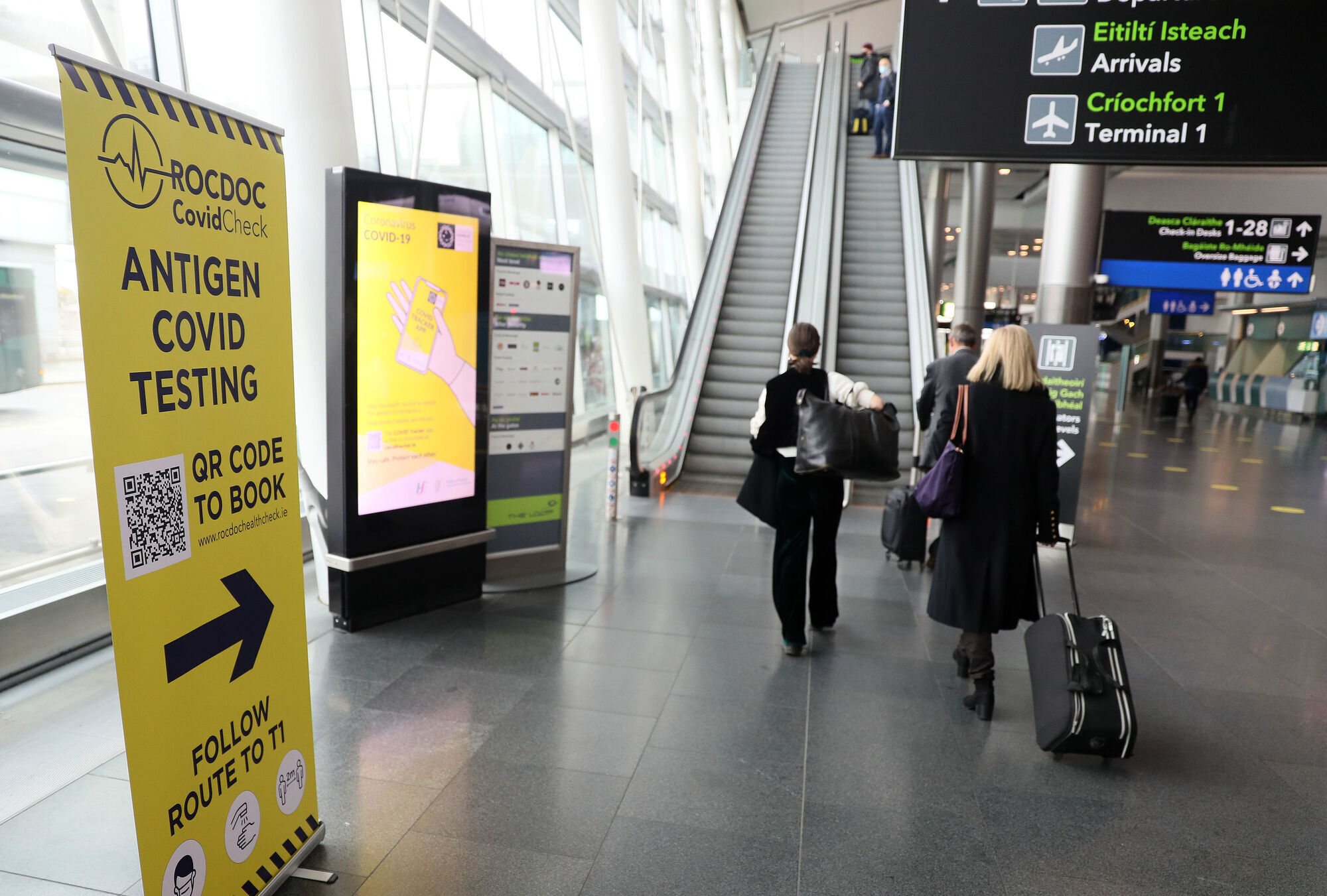
Signs for antigen covid testing at Terminal 2 at Dublin Airport. Picture: Brian Lawless/PA
During Leaders’ Questions in the Dáil, the leader of the opposition Mary Lou McDonald suggested to the Taoiseach that a system of mandatory hotel quarantine is “necessary” and “a no-brainer.”
The Taoiseach responded that there are “compelling legal reasons” why it is not possible to introduce such a system, related to the constitutional protection of personal liberties and freedoms.
Is it the case that mandatory hotel quarantine might be unconstitutional?
Such a system has been successfully introduced in other jurisdictions with similar legal traditions to our own, including Australia and New Zealand.
Of course, we have a different Constitution to theirs, but on its face, there is nothing in the text of the document that would preclude the introduction of mandatory hotel quarantine.
Article 40.4 states that “no citizen shall be deprived of his personal liberty save in accordance with law.”
While a 14-day mandatory quarantine in a hotel room might amount to a deprivation of liberty, this does not make it unconstitutional once it is “in accordance with law”.
The courts have said that this means “without stooping to methods which ignore the fundamental norms of the legal order postulated by the Constitution.”
Several other constitutional rights are also restricted by mandatory hotel quarantine, including the right to freedom of movement within the State and the freedom to work.
However, it is well established that no constitutional rights are absolute, and their exercise may be regulated by the Oireachtas when the common good requires this.
All legislation is presumed to be constitutional until the contrary is proven and the courts have stated that the decision of the Oireachtas should prevail unless it lacks “reasonable proportion” or is shown to be “so contrary to reason and fairness as to constitute an unjust attack”.
Can it really be said that mandatory hotel quarantine fails this test?
Mandatory hotel quarantine balances the rights of the traveller arriving in Ireland against the right to life of those who might die as a result of Covid-19 infections introduced into Ireland from abroad.
The courts have on many occasions held that the right to life ranks first in the hierarchy of constitutional rights.
The risk of the introduction of new variants is a particularly important factor here, due to the experience of the surge of Covid-19 cases in December and January after the introduction of the UK variant and the risk that new variants may undermine future efficacy of vaccination programmes.
More broadly, mandatory hotel quarantine aims at maximizing the effectiveness of the other Covid-19 restrictions and allowing for their relaxation in due course, in a manner seen in Australia and New Zealand.
As such, it can be linked to the protection of all the other rights of Irish residents which are currently impacted by Covid restrictions.
These rights include the right of freedom of movement within the State, the freedom to work, the right to free primary education and the right to freed practice of religion.
The impact of mandatory hotel quarantine is significantly less than the scale of the other interferences that it is designed to prevent.
No one will die.

The number of people who might be subjected to mandatory hotel quarantine is comparatively tiny compared to the entire population of Ireland, who are currently subjected to severe restrictions of their rights.
The period of time (14 days) is far shorter than the many months of lockdown imposed in both 2020 and again in 2021.
And perhaps most importantly, people can elect whether to travel to Ireland, and can simply avoid quarantine by not travelling.
This cannot be said of the nearly five million residents who have no way of avoiding the longstanding Covid restrictions.
In addition to having been successfully operated in legally similar jurisdictions, its introduction in Ireland has been recommended by multiple leading experts in public health or infectious diseases, including Prof Anthony Staines, Dr Tomás Ryan, Dr Niall Conroy and Prof Sam McConkey.
In light of all of this, is it credible to suggest that it is perfectly constitutional to leave children with special needs out of school for months on end, or to close down someone’s restaurant or pub, or to prevent religious people from attending churches almost indefinitely – but that a 14- day mandatory hotel quarantine lacks “reasonable proportion” or is “so contrary to reason and fairness as to constitute an unjust attack” on constitutional rights?
In assessing proportionality, the courts ask whether a law impairs rights as little as possible.
Any challenge to mandatory hotel quarantine would be met with the defence that 14 days is the minimum period that can ensure the prevention of the spread of the virus, since PCR tests can have a false negative rate up to 29%.
It is not workable to only apply mandatory hotel quarantine to countries where new variants have arisen, since those variants have already spread beyond those countries.
Finally, in the same way that other Covid restrictions have included limited exceptions for certain cases (such as the death of a family member or essential work), a mandatory hotel quarantine regime could do likewise.
If it only applied to people whose travel into Ireland was outside of such exceptions, it is difficult to imagine a court striking it down.
Any such challenge must be placed in the wider context of trends in Irish constitutional law.
Since the turn of the Millennium, in particular, the Irish courts have had a settled preference for deferring to the judgment of the Oireachtas and upholding laws in cases where complex or controversial judgments need to be made on social or economic policy.
This tendency would likely be particularly pronounced in the context of laws enacted in a time of crisis and informed by very specific medical and scientific expertise which is not shared by the judiciary.
All in all, my conclusion is that a law enacted by the Oireachtas imposing 14-day mandatory hotel quarantine on travellers arriving into Ireland would be highly likely to survive constitutional challenge, particularly if it included some narrowly drawn exceptions to cater for cases where the impact was most extreme (for example, in the event of the death of an immediate family member).
:: Professor Conor O’Mahony lectures in constitutional law at the School of Law at University College Cork.

CONNECT WITH US TODAY



Be the first to know the latest news and updates