Conor O'Mahony: Lifelong pain met with a wall of legal jumble
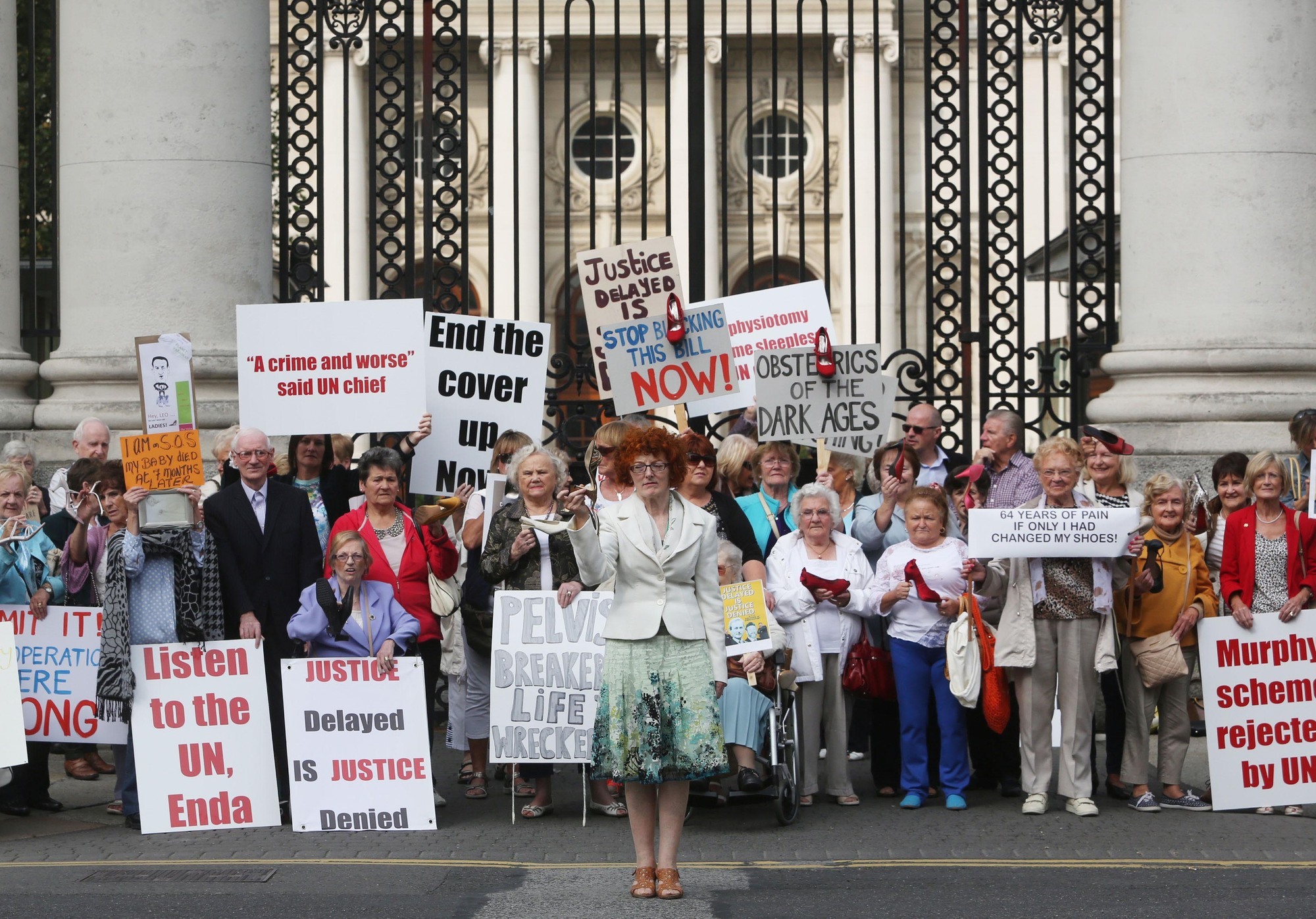
Survivors of symphysiotomies and their supporters protesting outside Department of An Taoiseach in 2014.The European Court of Human Rights has ruled as inadmissible three complaints by Irish women that symphysiotomies conducted in the 1960s without their consent violated their rights under the European Convention on Human Rights. Picture: Sam Boal/RollingNews.ie
Yesterday, the European Court of Human Rights ruled inadmissible three complaints by Irish women that symphysiotomies conducted in the 1960s without their consent violated their rights under the European Convention on Human Rights. The Court’s rulings focused largely on narrow technical issues. In many ways, they failed to address the fundamental question of whether conducting a controversial and outdated medical procedure on women without presenting them with alternatives and obtaining their express consent violated their human rights.
A symphysiotomy involves cutting into the fibres connecting the pubic bones to facilitate natural childbirth where it might not otherwise be possible. In most European countries, it was abandoned by the mid-Twentieth Century in favour of Caesarean sections (which were much safer). However, in Ireland, it continued to be used until the 1980s.
Many women who had the procedure experienced significant chronic health issues for years afterwards (including chronic pain, incontinence and psychological difficulties). Crucially, many women (including the three applicants) alleged that did not expressly consent to it and were not presented with the alternative of a C-section. Instead, having signed general consent forms, they were not even told that they were going to have a symphysiotomy, and did not realise until after the event.
Numerous international human rights bodies (including the UN Human Rights Committee and the UN Committee on the Elimination of Discrimination against Women) have expressed concern about the impact of symphysiotomies on Irish women, and called on Ireland to conduct a prompt, thorough and independent investigation of the issue and provide remedies to the victims. The UN committees were of the view that official reports produced in 2011 (by Prof Oonagh Walsh) and 2014 (by Judge Yvonne Murphy) did not discharge the State’s human rights obligations.
The three complaints to the European Court of Human Rights alleged that the manner in which the symphysiotomies were conducted violated the women’s right to physical integrity. It was further alleged that symphysiotomy amounted inhuman and degrading treatment; and that Ireland had failed to provide the applicants with an effective remedy in Irish law, or to conduct an effective and independent investigation into the practice of symphysiotomy.
In three separate judgments, the Court ruled that the cases were inadmissible because the women had either been afforded a fair chance to pursue their case in the Irish courts, or had failed to pursue remedies available to them in national law. Complex domestic litigation had prevented the women from pursuing their claim of absence of consent, due to the fact that the passage of time gave rise to a risk of unfairness in pursuing a claim against a doctor who may have died or who may not have been able to call witnesses in his defence. The European Court of Human Rights held that this was in line with the standards of a fair trial, and deferred to the findings of the Irish courts in rejecting the alternative claim pursued (namely, that the procedure was inherently unjustified).
The Court sought to bolster its findings on the adequacy of the domestic legal proceedings by reference to the various reports on symphysiotomy and the establishment of an ex gratia scheme, noting that Ireland had “not remained inactive in the face of the considerable controversy”. Although it had earlier referred to the findings of the UN Committees on the inadequacies of these measures, the Court ignored these views in its own reasoning.
The most striking feature of the judgments is how they treated the question of consent. The Court essentially accepted that the women had not provided fully informed consent to symphysiotomies, stating that it “has great sympathy with the plight of the applicant and the other women who only became cognisant of the fact that they had undergone a symphysiotomy several decades after the event”. However, other passages in the judgments treat the question of consent as undecided.
The Court conducted no proper analysis of whether it was acceptable to have women sign a general consent form, and later subjected to a highly invasive (and widely abandoned procedure) with no further discussion and no explanation of the availability of a safer alternative. Instead, this was glossed over by reference to the “attitudes of an earlier age, when medical paternalism was more widely accepted”.

In essence, the paternalistic medical culture of the time was deemed to justify a practice that would otherwise be viewed as an egregious rights violation. The Court did not consider whether this paternalistic culture was consistent with the human rights established by the European Convention in 1950. It might thus be suggested that the judgments entirely missed the point of the case.
Finally, one of the judgments held that the claim that symphysiotomy amounted to inhuman and degrading treatment was inadmissible because the applicant had not pursued this claim against the State in the Irish courts. While it is a well-established rule that domestic remedies must be exhausted before making an application to Strasbourg, it is equally well established that applicants need only exhaust domestic remedies that have a reasonable prospect of success.
The Court had previously held in the Louise O’Keeffe case that when the respondent State argues that an application should be inadmissible due to non-exhaustion, it must demonstrate, by reference to previous case law, how any such claim might succeed. However, yesterday’s judgment provided no indication of how a claim that symphysiotomy violated the right to freedom from inhuman and degrading treatment might have succeeded in the Irish Courts. It is notable in this regard that the European Convention on Human Rights did not become arguable in an Irish court until 2004 (meaning that Convention arguments relating to events occurring before this date had to proceed to Strasbourg).
This aspect of the judgment appears to suggest that applicants must have exhausted novel causes of action in addition to established ones before they can be deemed to have exhausted domestic remedies. But since the potential range of novel actions is essentially limitless, this reasoning poses an almost insurmountable barrier to admissibility.
The ruling of the European Court of Human Rights on the symphysiotomy cases is disappointing to individual victims and support groups active on this issue, who will feel that their lifelong suffering has been met with a wall of legal obfuscation in the Irish courts and in Strasbourg. More broadly, it is an example of a case where the core human rights issues at stake appear to have played second fiddle to procedural rules and technical arguments. It is questionable whether this approach best serves the protection of human rights.
CONNECT WITH US TODAY



Be the first to know the latest news and updates