The killing fields: TB cost farmer 20 years of hard work and his livelihood
Paddy Brosnan spent 20 years building a herd before TB saw his cattle shot, leaving him to clear up their remains and shattering his mental health and livelihood, writes Michael Clifford
The killing fields: TB cost farmer 20 years of hard work and his livelihood

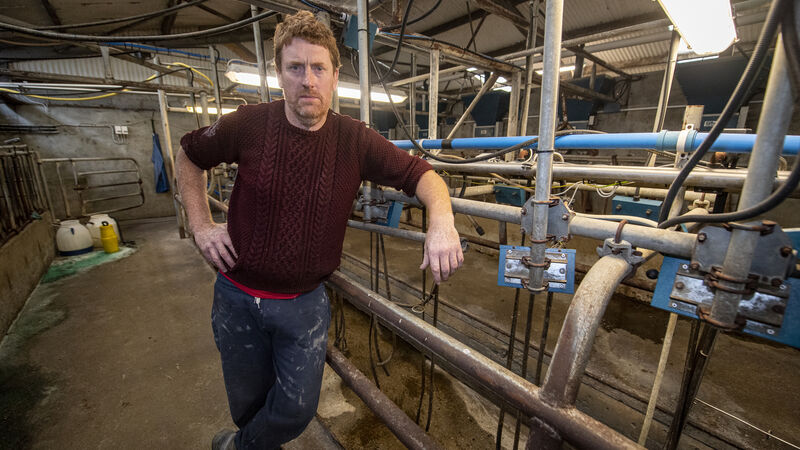
Paddy Brosnan, pictured in his milking parlour in his empty dairy complex. His dairy operation was run into the ground and is his dairy complex that now stands empty. Picture: Domnick Walsh © Eye Focus LTD

Bovine TB continues to be a problem in this country despite an eradication programme that has been operating since 1954. Out of around 100,000 herds in the state, between 400 and 500 have a chronic problem with TB on an annual basis.

All of the regulations, both national and at European level, suggest that reactor cows should be taken off a farm to be euthanised. Sources in the agri world confirm that there are rare occasions when it is done on-farm. 

This might occur, for instance, if the animals in question are calves and not heavy enough to make it economically viable for the department to have them taken to the factory for killing.

However, any instance in which a decision is taken to do the job on-site explicitly requires the consent of the owner. In such an instance the owner would generally be asked to leave for most if not all the day so as not to witness what can be a very difficult experience.

“When he returns everything should be done and cleaned up, leaving no sight of what had gone on,” according to one source. 

“All he will notice is the silence.” The Department has confirmed that the procedure “is followed by a thorough cleansing and disinfection of the area.” 

Paddy Brosnan claims that didn’t happen in his complex in December 2011. An account from the knackery service company which carried out the operation, seen by the Irish Examiner, makes no mention of cleaning the yard or disinfecting the shed where the killings occurred. It does detail how the truck and tools used were disinfected.

The official who dealt with Brosnan at that time is now retired. When contacted he said he had no comment to make.

One day in 2015, Brosnan’s wife Teresa saw a notice in the local paper for a visit to Tralee of the Ombudsman’s Office on an outreach exercise. Paddy attended at the event and explained what had occurred.

He says he was told that what he described was an incident of criminal damage and therefore a matter for the guards rather than the Ombudsman.

Some time later, he attended at a garda station intent on making a complaint. He says the garda, whom he had spoken to on the phone beforehand, told him flatly that he wouldn’t take a statement.

Brosnan subsequently made a complaint to GSOC which is currently under investigation. 

Last February, after the GSOC process had been initiated, he was contacted by gardaĂ­ to have a statement of complaint taken. Legally, the gardaĂ­ are now obliged to investigate the matter.

There is sympathy for Brosnan among the farming community in his local area. The farmer to whom he sold the TB infected cow made a point of telling the Irish Examiner that he bore him no ill will.

Another farmer, Mike Deenihan expressed sympathy at what had befallen Brosnan.

“It’s all wrong,” he said. “Paddy loved his animals. He would not go to bed until he was sick and sore unless they were looked after. He should never have been put through this.” 

Niall Counihan became familiar with Paddy Brosnan’s problems when he leased land to him a few years ago. Counihan was moved to offer any assistance he could in attempting to find a resolution.

“I met him at his worst, he was in a bad way over it all,” Counihan says. “He called to my door several times in a desperate state. I said do you want me to give you a hand in dealing with all this. He was grateful for that and that’s where we are today."

Sources in the department point to repeated attempts to find a resolution for Paddy Brosnan and the TB problem that brought his farming life to an end.

***************

Paddys operation was run into the ground and is his dairy complex that now stands empty of cattle .

The animals were shot in the head with a captive bolt. The bolt is a four-inch iron bar that enters the brain and stuns the animal, hopefully fatally. 

If the job is done as designed, in a controlled environment, the animal should literally collapse and, following some seconds of trashing around, expire. 

If it doesn’t go to plan the animal can begin lashing out in loud and terrified pain for a matter of minutes, before finally collapsing in death.

Fifteen cows, most of them weanlings between six and twelve-months-old, were dispatched in the front shed of Paddy Brosnan’s dairy complex in Lixnaw, north Kerry on 8 December 2011.

There were up to 200 cattle in the complex at the time, many of them with a clear view of the slaughter. They would have heard the captive bolt, smelt the blood, heard cows in a highly agitated state at the top end of the complex. The condemned animals were in the vicinity of the killing, observing those who were destroyed before them, waiting their turn.

The 15 cows – only one was under six months, the technical age limit of a calf - were infected with TB. Ordinarily, in this situation the process is to take the animals away to be put down in a controlled environment in a slaughterhouse. That process was not followed in the case of Paddy Brosnan’s cows.

“I objected to the shooting of cattle in my yard and the answer I got was that it was department policy and that’s the way they do business,” Mr Brosnan says.

“I was told to go away and come back in three hours. But that evening, when I came back after it was over and was handed a brush and a water hose to brush away the blood and brains of infected animals, it became clear to me that it was all wrong.” 

The killing in his yard was to have major consequences for him, his livelihood and his mental health. The effect it had on the other animals in the complex can only be guessed at. Nobody in the Department of Agriculture has ever provided an answer as to why the killing was done in this manner.

Paddy Brosnan inherited 50 acres and 70 cows in the townland of Ahabeg outside Lixnaw. A carpenter by trade, he worked in construction while building up a dairy herd over 20 years up until 2011.

“I spent most of those years getting up to milk cows before going to work in construction at 7am,” he says.

“I’d be up on the roof of a house saying to myself, I’ll stay at home when I have 50 cows and then I thought when I’d 100. I eventually stayed home full time farming in 2009 when I had about 220.” 

Over a period, he built a large complex adjoining the family home which incorporated sheds and milking facilities all under the one roof.

Along the way, he married Teresa and now has two teenage boys and girl. His family has witnessed close up the fall-out from the killing of the cows.

Bovine TB is an occupational hazard of farming. By the middle of the last century, Bovine TB represented a threat to human health in a major way.

An eradication scheme was started in 1954. Regular testing of herds is carried out. Farmers are familiar with the process when a positive test occurs. 

The infected animals, known as reactors, must be isolated from the herd. The rest of the herd is “restricted”, meaning cows can’t be sold until such time as the all-clear is given with two further tests (Among farmers this is known as being “locked up”). And the farmer’s holding must be well secured to ensure that none of the cattle stray and infect beyond the legal boundaries.

Any cows to be destroyed as a result of a positive test are valued, and the farmer compensated. The reactors are therefore passed into the control of the Department of Agriculture, Environment and Rural Affairs (DAERA). 

According to the department’s website “DAERA will remove reactors from your herd as soon as possible and take them to be slaughtered.” 

That didn’t happen on Paddy Brosnan’s farm in December 2011. In response to parliamentary questions, former Minister for Agriculture Michael Creed has stated that the Brosnan “had a TB breakdown in 2011 during which a number of calves were identified as reactors. The calves were euthanised on farm with his consent.” 

Paddy Brosnan says he didn’t give any consent. He says at the time he objected but was told it was “policy”. He was never given a specific reason why the animals were put down as they were.

He has never seen any document recording his consent. According to the department, “written consent is not required”.

At 5pm on the day in question, when he returned to the yard, he says the place had not been cleaned.

“I was handed a brush and a hose,” he says. He went about trying to clean the place in a highly emotional state. “There was blood and brains all over,” he says.

“My shed was actively producing milk that very day, with 800 litres of it going into the food chain while all that infected matter was there on the ground.

“It was in the shed, it was outside in the yard where they had the truck to take away the carcasses. And there were even signs of it out on the public road in front of the yard.” 

The following day, he says, he was still finding matter around the shed. 

“I was picking up little bits of brain from the floor. They were like Rice Krispies.” 

His description of the aftermath of the operation, if accurate, is at odds with the aftermath that would be ordinarily expected. The cattle should die quickly with a minimum of pain or spilt tissue. Sometimes, that doesn’t go according to plan.

The trauma

The episode left Brosnan traumatised, and within months he had a major TB problem with up to 50 animals testing positive for the disease.

Paddy Brosnan, Niall Counihan neighbour and Brother John Brosnan pictured in John’s empty dairy complex. Picture: Domnick Walsh © Eye Focus LTD

Plans were made for another cull in March 2012. He was visited by a different official than the person who organised the event in 2011. 

This time Brosnan felt compelled to tell the official explicitly that he didn’t want any more animals killed on his farm. The official told him to write to the department to that effect. He had not received that advice the previous December.

In a letter received by the department on 8 March 2012, he wrote: “I do not wish to have animals tagged for TB slaughtered on my holdings. Please make alternative arrangements for same.” 

Why it was necessary to write such a letter to prevent a recurrence of the earlier incident is curious? As shown above, the stated policy is to take away the animals.

Meanwhile, the TB continued to surface and the past wouldn’t leave Paddy Brosnan alone. He claims that much if not all of his TB problems in the years after 2011 can be traced to infection that followed the killing of the cows in his complex. That theory is not supported by the preponderance of evidence in relation to the spread of infection but it is possible.

His mental health suffered. He received treatment in Tralee. One referral from a counselling service to psychiatric services seen by the Irish Examiner described his condition as “query major depressive episode with PTSD symptomatology and concurrent suicidality.” 

In lay person’s terms this translates as suffering from post-traumatic stress disorder as a result of an episode while also experiencing real thoughts of suicide.

His brother John was one of those who saw him through the worst of it. 

“I’d ring and he’d be crying on the phone,” John Brosnan says. “One night I was around with him he was close to going over the edge. I had to take a (shotgun) cartridge off him.” 

A number of meetings were held with officials from the department with a view to achieving some resolution. An official from Teasgas was involved in one meeting. A high level officer in the department was dispatched down to Tralee from Dublin for another meeting with him.

There were efforts on the part of the department to assist him with his ongoing TB problems, but there was nothing that could be done about what had occurred in 2011.

He also consulted different solicitors who generally came to the conclusion that linking his TB problems with infection from the 2011 incident would also be legally difficult.

In April 2018, Brosnan sold seventy cows to another farmer in the area. A few weeks later, it was discovered that one of these animals was badly infected with TB. The purchasing farmer was “locked up” as a result. 

Ordinarily, Paddy Brosnan should have been locked up too in order to comply with rules of traceability. For some reason, he wasn’t.

The purchasing farmer, who doesn’t want to be identified, confirmed these details. 

“Paddy wasn’t locked up,” he says. “I was and that was only right. But I had bought that cow from Paddy and he should have been locked up too. He knows that himself. I don’t blame him, he didn’t know the animal had TB, but it is very surprising that he wasn’t locked up.” 

Paddy Brosnan says he believes that the failure to lock him up was connected to the fact that he had been making such an issue over the 2011 incident and his subsequent ongoing TB problem.

However, it has emerged that his contention – repeated in various forums – that he was not locked up on this occasion is inaccurate.

The backtrace should have been conducted within days but for some reason it took three months. Thereafter, Brosnan was locked up for eight weeks until his herd received a positive result from the test.

When asked about this omission in his narrative, he said: “That’s news to me.” 

His conspiracy theory about the department in this episode may well be attributable to his grievance that he has never received a proper explanation about the killing of the cows in his complex.

In 2019, the same old problem resurfaced in his herd again. He was, he says, at his wit’s end by then.

In February of this year, he had enough. He sold all of his herd and accepted that his dream of creating and expanding his holding into a large farming operation was finally dead. He has returned to working in construction.

The dairy complex adjoining his house now lies empty and silent.

“I spent 20 years of my life working in construction to put the whole thing together and now I have to turn my back on it,” Brosnan says.

“I created a state of the art complex that would be the envy of many dairy farmers. Dairy farming was in my family. I built it up from near scratch.

“Then there was nothing but trouble since that day they came into my yard. I was expected to live and work in that environment?

“That’s why I offloaded my herd for about a quarter of their value. I couldn’t do it anymore. I couldn’t have it on my conscience.”

In response to a number of questions the Department of Agriculture, Food and Marine (DAFM) said it does not comment publicly on individual cases.

From a general perspective, in TB breakdowns where calves are identified as reactors and are considered to be of no commercial value they may be put down on the farm with the consent of the herdowner and in full compliance with department guidelines.

“In accordance with those guidelines, written consent is not required. A decision to euthanise calves on farm would take account of the welfare of the animals in order to avoid the stress they may encounter during travel and at a knackery.

“It is usual that the procedure used for euthanasing calves is carried out on farm by a person from a knackery and it is not required that an official from DAFM be present. 

"The procedure is followed by a thorough cleansing and disinfection of the area. There is no scientific research that supports a theory that euthanising calves on farm could result in TB persisting in the environment. That is not how the disease is spread.

“The department’s policy on backtracing is that it is completed in respect of introduced animals that fail the tuberculin test or confirm with tuberculosis on slaughter. 

"DAFM’s Animal Health Computer System (AHCS) carries out the trace back automatically and the results are notified to the relevant veterinary inspector (VI).

“The VI makes a decision as to whether the herd of origin should be tested for TB taking into account the current status of the herd, the date of movement of the animal(s) that are the subject of the report and the date of herd tests subsequent to such movement.”

More in this section

Revoiced

Newsletter

Sign up to the best reads of the week from irishexaminer.com selected just for you.

Cookie Policy Privacy Policy Brand Safety FAQ Help Contact Us Terms and Conditions

© Examiner Echo Group Limited