Lack of novel ideas has left us hungry for more
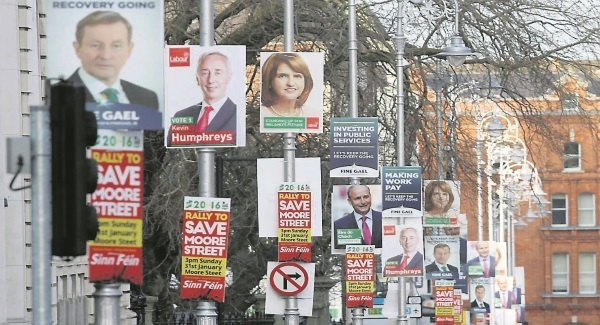
The essentials of the political process have not changed since Ó hEithir passed away more than a quarter of a century ago, which would make it eminently recognisable to him, if a little depressing for the rest of us.
Why? So many questions have been asked in the last three weeks that posing one more will either crystallise your experience neatly or make no difference whatsoever to you. What were you expecting from this election?
I ask partly because this is something most people forget to ask themselves, and partly because most people feel they already know the answer, but mostly because of the faint but distinct odour of disappointment that comes at the end of every campaign. Despite the reflexive disdain for politicians, which occasionally widens into a continental shelf of real contempt, people also expect something from the hustings, and when they don’t get it they’re unhappy.
What exactly is that? It’s like the old joke about the innocent girl who’s told that all men want one thing, only for her to ask if it’s always the same thing.
Here are the turnout figures and what the party leaders are saying https://t.co/LP1MyOyBUz pic.twitter.com/gMPjnVUh3F
— Irish Examiner (@irishexaminer) February 26, 2016
The temptation to say ‘answers’ is almost overwhelming, but you should resist, because election campaigns are always about confirmation, never revelation: Underlining what is already known about personalities, not unveiling new information on policies which should be shared.
Novelty is at a premium on the hustings. Always. The occasional flash of temper or gaffe doesn’t count, nor does the sparkle of a human interest story; those are reiteration, not innovation. The discovery that electoral candidates are prone to anger and stupidity, like the rest of us, was made when Aristotle was beginning his career, though it is unveiled as fresh fare every time someone puts their name forward.
For more election news, analysis and general banter join us HERE
No: Real novelty is a fresh strategy, a completely different set of tactics, an approach that has never been tried before.
And clearly that level of innovation has no place in an election campaign. In politics the tried and trusted is less of a prop and more of a pillar, supporting the entire structure. As a microcosm of the wider political process the weary and wearying approach to re-election couldn’t be more apt: Go out and knock on doors, put up posters, get coverage in the media on any platform that will have you.
It’s hard to blame a politician for that lack of imagination, because that is precisely the approach he or she has always seen succeeding. The fact that it’s also the approach that doesn’t succeed for the majority of candidates is neither here nor there for the professional politician; that qualifying adjective speaks to an understandable unwillingness to take chances on the method used to stay in one’s job.
Yet novelty or difference is what the electorate craves. Not a new party, which is almost a contradiction in terms (witness the two new parties which contested this election, both of which had reheated candidates from other, older parties). Perhaps that’s the best explanation for the disappointment mentioned above. The mass of participants — the electorate — can’t help getting their hopes up when polling day is announced because we all, despite ourselves, yearn for something different, and we can’t help feeling a little let down when it’s all over because it felt just like every other campaign.
The fact there was a little bit more of it than usual this year on YouTube, or that Facebook had some formal involvement in one of the television debates, doesn’t change that. Neither does the au courant phrase. For 2016, a new term caught the ear of the political commentariat, the ‘fiscal space’, which had the huge advantage of being deployable in almost every context, background or foreground, without — and this is key — having to explain what it actually meant.
Who would win the election if it was based on tweets? https://t.co/E6oiKgjwBp (DOD) #GE16 pic.twitter.com/pDmkwI6ges
— Irish Examiner (@irishexaminer) February 26, 2016
In this regard it differed from the buzzwords which were used in previous elections, such as ‘gene pool Fianna Fáil’, and which had to be employed with some nod towards meaning and relevance. But when did you last hear the term ‘fiscal space’? See how quickly the au courant becomes yesterday’s cliché?
Calcified expression isn’t restricted to language, either. Take those leaders’ debates. Did they put an end to the notion that an individual can represent his or her party’s beliefs and policies in one person? Achilles Vs Hector but in Louis Copeland suits and stumbling over the intricacies of late-capitalist jargon?
The huge viewership for those televised debates underlines the earlier point about the electorate’s hunger for substance, the search for a signal amidst the noise. However, sonorous banalities don’t count, and it was all far too late by the time a punch landed — on Tuesday night, when Gerry Adams pointed to Enda Kenny’s admission that he’d appointed John McNulty to the board of the Irish Museum of Modern Art: a technical concession on a barely-remembered embarrassment.
Our hunger for the shock of the new has a distant, rumbling parallel, incidentally, across the Atlantic, with the astonishing popularity of Donald Trump, for instance. Though complacently dismissed here as stupid, the Republican electorate’s ongoing endorsement of the TV personality shows the appeal of the truly different; the appropriateness of the candidate himself we leave to one side.
Will it be different the next time? Don’t hold your breath, though the energy expended will hardly diminish. Space has not allowed us to explore the great motivating principle of Irish elections, but long ago Ó hEithir articulated it succinctly: Vingince, bejasus.
For more election news, analysis and general banter join us HERE
CONNECT WITH US TODAY



Be the first to know the latest news and updates