Politicians and electorate all of a-twitter as the campaign heats up
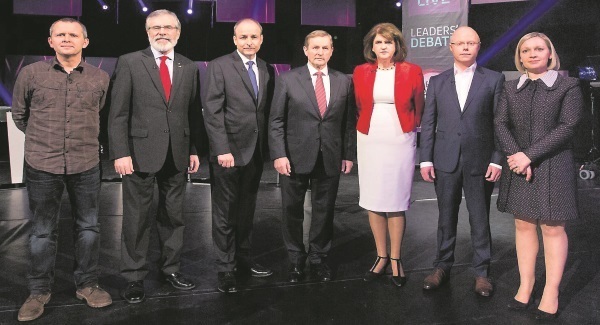
Monday, live from Limerick: For the only time during the election campaign, the seven key leaders stepped onto a single stage and in front of a prime time television audience.
Politicians and electorate all of a-twitter as the campaign heats up

However, it was not only the people on the stage of the second leaders’ debate that had a point to make. From living rooms, bedrooms, and pubs across the country, the watching public hurled thousands upon thousands of tweets about the debate into the digital crossfire.

At its peak, Twitter was a gushing deluge: Seven tweets a second; around 420 per minute; almost 70,000 tweets about the debate itself. Monday was no average day on the digital campaign trail. Well over twice as many tweets, 28,000, mentioned a candidate standing in the election as on an average day of the campaign trail so far. The debate was by some distance the single largest digital moment of the campaign so far.

Twitter has become an important digital battleground in the race for political power, and candidates have sent more than 51,000 tweets so far. The political parties were ready for the debate, of course, and Monday was also the day that digital electioneering reached its peak, as candidates went into overdrive to use Twitter to skewer their opponents’ leaders, and try to defend their own. Fianna Fáil candidates sent more than 200; Sinn Féin 267; and Fine Gael 365.

So, with barbs and arrows flying from all corners, how did the public respond? Demos has teamed up with the Irish Examiner to use new technology to listen to all the cheers, jeers, boos, and catcalls of the digital arena. Twitter is, in general, a hostile environment for politicians and a swarm of angry hashtags buzzed around the debate — #realitycheck, #finegaelscum, #brokenpromises.

The losers were easier to spot than the winners — and they were the incumbents. The most critical spotlight shone on Enda Kenny — 2,821 tweets mentioned him, and 82% were boos. Joan Burton didn’t fare much better, with 72% of tweets mentioning her being boos.

Only Gerry Adams, Lucinda Creighton, and Stephen Donnelly survived a digital mauling, with a greater proportion of tweets cheering and urging them on than criticising them.

However, and especially for Mr Adams, this is a sign of an active and engaged group of digital supporters rather than a broader base of public support. If a winner had to be found, it was the joint leader of the Social Democrats, Stephen Donnelley, who was mentioned more on Twitter than his more famous competitors, and most of it was good.

However, among all the boos and cheers, we heard something else on Twitter too: A giant, collective yawn.

Many people took to Twitter not out of enthusiasm for the debate. They were tweeting simply to liven up the viewing. Some of the loudest messages swirling around the digital ecosystem during the most important digital moment of the campaign so far were — whether satire, pastiche, or irony — just trying to make things a bit more interesting.

The third most shared message on Twitter that mentioned a candidate was an image of Homer Simpson silently disappearing into a hedge.

Naturally, the Photoshop satirists went into overdrive, and a cloud of images rapidly began to swirl around Twitter poking fun at the candidates on the stage.

It is not surprising, then, that a Twitter poll in the aftermath of the debate handed victory to the moderator, Claire Byrne. Yet all the yawns and anger on Twitter during the debate point to something that has been true since the beginning of the campaign, both online and offline: The mainstream parties, and especially the incumbents, have flatly failed to electrify the election or excite the electorate.

Kenny’s message has been a simple one: There is no reasonable alternative.

His vision of Ireland’s future comes drenched with warnings of capital flight, job losses, and tax hikes in the wake of a Fianna Fáil or Sinn Féin victory. Prudence, economic competence and gradual economic recovery might squeak Kenny the election, but it is hardly the stuff to get delighted crowds out onto the streets.

Kenny’s strategy also doesn’t seem to be working. A poll by Red C, conducted shortly before the debate and released shortly afterwards, puts Fine Gael on 26% — down five percentage points from the beginning of the year. And while Fine Gael is dropping, none of the other mainstream parties has managed to break through the melee of the campaign and get in front. Fianna Fáil continues to hover at 17%; Sinn Féin about the same; and Labour around 10%.

The two real winners over the last week were not standing on the stage in Limerick on Monday. The same poll that put Fine Gael on a new low, showed support for Independents (together with the Greens) at 29%, greater than any single party.

If they come close to this on election day, that will be an astonishing increase on the 12% of first preference votes Independents won in 2011 and 5.1% in 2007.

The Greens and Independents have also been scoring real digital successes since the campaign began. Independent candidates have been, by far, the most avid users of Twitter. Over the campaign, they have sent thousands more tweets than any party. And while the Independents are noisiest, the Greens are the most popular. They have received a warmer reaction than anyone else on Twitter. Over the last week, 82% of tweets sent about them were supportive, in comparison to only 40% about Fine Gael.

Independent candidates were close behind the Greens with 76% of tweets mentioning them supportive.

After a week of high-stakes primetime clashes and unprecedented digital electioneering, it was the people not on the stage, not in the debate, that came out stronger and more popular.

However, this is not as surprising as it would once have been. True to form, on the night of the debate itself, the Independents and the Greens were louder on Twitter than anyone else.

Thanks to platforms such as Twitter, debate stages, TV cameras, and newspaper column inches matter a little less than they once did. The debate is happening in the digital world now, too, and anyone can join it.

More in this section

Revoiced

Newsletter

Sign up to the best reads of the week from irishexaminer.com selected just for you.

Cookie Policy Privacy Policy Brand Safety FAQ Help Contact Us Terms and Conditions

© Examiner Echo Group Limited