SPECIAL REPORT: Dementia in Ireland - Reminiscing is good for dementia patients (VIDEO)

Rita Cadoo’s life story is told through a series of lovingly selected photographs, laid out chronologically, and accompanied by neatly written explanatory notes that guide us from childhood into adulthood and on to gradual old age.
The fabulous photo album, housed in the memory room at Mallow Primary Healthcare Centre, was compiled by her granddaughter, Sheena Cadoo, and it was more than a labour of love.
As an occupational therapist, Sheena sees the intrinsic value of a photo album as a tool to jog the memory of those affected by both dementia-related and non-dementia-related memory loss.
“In terms of early memory loss, I can’t overemphasise the importance of reminiscence. It has real benefits,” Sheena says.
“The present is often confusing for the person affected by dementia. Often the longterm memories are preserved, and so the person feels more safe and secure talking about them.
“We always encourage families to go with that, go with the past, that’s where the person is able to communicate most effectively. They get to be the teacher then, the one who tells the story, so for self-esteem and confidence, it can be really useful for someone with dementia.”
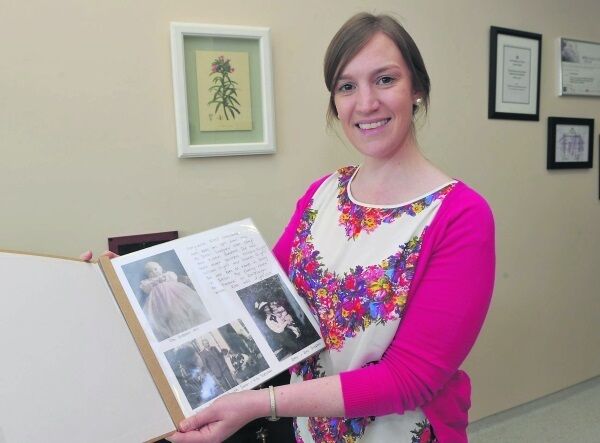
Ideally the person with dementia should get to help fill the pages of their own ‘life story’. The end product is a reference point for themselves, with the added value of being an enjoyable read for those visiting the dementia patient where conversation can sometimes be difficult.
“For relatives who call, it can be hard to know what to talk about, and they may stop calling, which is really of no benefit to anyone. But the life story book is something everyone can relate to,” Sheena says.
She shows me a wooden ‘memory box’ that looks a little like a small treasure chest.
“There are no rules for what you put in,” she says. “It’s for the person with dementia to rummage through and maybe something in it will trigger a memory. It also gives them something to do, because they can get quite bored.”
The memory room is effectively a one-stop shop for those dealing with dementia, from the information stand inside the door to practical tips for everyday living.
There is a table laden with little bits of technology designed for assisted living: A telephone with extra large buttons for when co-ordination becomes an issue; an ‘object locator’ that looks a lot like a small mobile phone and is linked electronically to a fob. The fob is placed in a wallet or attached to house or car keys; if any of these essential items gets lost, you simply switch on the locator which emits a beep that heightens in pitch as you approach the lost object.
The table also contains a pill box that vibrates and sounds an alarm reminding the patient when pills are due to be taken; there is a large-scale digital calendar and clock; there is a motion sensor that can be linked to both a monitoring centre and family member/relative/carer.
When the sensor is triggered, it sends a signal so, for instance if a person with dementia left home and did not return, those monitoring the sensor would be aware. In terms of helping maintain independent living while at the same time reducing the stress for family/carers, it is a very useful tool.
Then there is the simple, but ingenious ‘message in a bottle’, a small plastic container with just enough room for a form detailing a person’s medical history and the medication they are on, but also, essentially for the dementia sufferer, the contact details of the person’s main carer.
The container is kept in the fridge (as the object most likely to withstand a fire) and a sticker on the fridge, familiar to emergency personnel, indicates its presence. Two matching stickers are placed at the front and back doors so emergency personnel know where to find the resident’s medical details. The brainchild of the Lions Club, it could make all the difference in accessing vital information.
There are some little blasts from the past: a jar of bullseye sweets, a tea set of granny’s china, sprigs of lavender, an old-fashioned sideboard. There’s a jar of mixed spice designed to provoke memories associated with cooking.
On a more practical level, there is a talking photo album which tells you what you are looking at; a bulletin board divided into days of the week; prompt cards for boiling a kettle and making tea; and colour-contrasted crockery, which studies suggest help Alzheimer’s suffers distinguish between different objects, and also, one study found, improve their food and liquid intake.
Then there’s the calendar, created by the Crystal Project, of which Sheena is a director. The Crystal Project is a vital cog in the wheel driving dementia care in Mallow, bringing together a range of specialised services in a shared initiative between the HSE, the Alzheimer Society of Ireland, families affected by dementia, University College Cork, local community groups, and GPs.
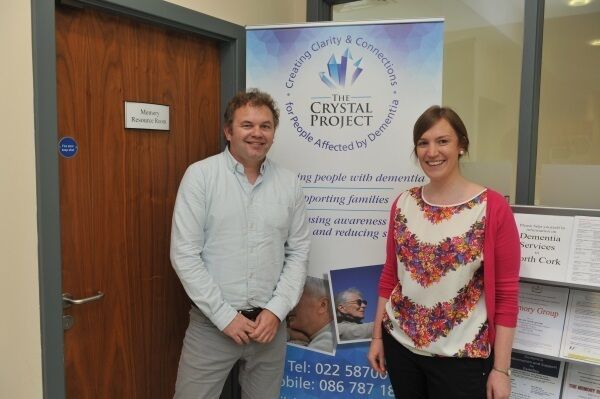
One of a number of initiatives nationally that are designed to increase awareness and reduce the stigma of dementia, the Crystal Project aims to make Mallow a dementia-friendly town. As such, it oversees monthly support meetings for families at the Cafe de Mentia, held in a local daycare centre; it facilitates family information sessions held in six-week blocks, and offers goal-focused therapy, where the person with dementia can work on specific goals over six to eight weeks.
“It may be things like remembering grandkids’ names, it might be money management — we had someone recently who could add and subtract but didn’t recognise the value of smaller coins — or it may be about booking a holiday, we take them through the steps gradually,” Sheena says.
The project’s latest initiative is ‘Cairde Maith’ (Irish for ‘Good Friends’), where volunteers are asked to spend two hours a week with a dementia patient in an effort to reduce the loneliness and isolation that can be part and parcel of the illness.
The calendar itself is an effort to challenge the perception that out-of-character behaviour, or agitation, or withdrawal is “just the dementia talking”. In fact, boredom or pain or depression may be key, and the calendar carries a message for each month that encourages us to look for the reasons for certain behaviours.
At the end of the day, Sheena says supporting people with dementia is “not rocket science” and many can continue to lead reasonably independent lives.
“It’s about reducing the confusion and making things simple — putting labels on drawers and cupboards, helping the person to stay organised,” she says.
“If it’s summer time, get rid of the winter clothes. Get clothes ready the night before. Get them to keep a diary, write things down, keep memo boards around the house, and use phone reminders.
“And a dementia diagnosis doesn’t necessarily mean the person can’t drive. What we would say is to monitor it. Maybe every few weeks get into the car with the person to see if their driving habits are changing.”
A dementia diagnosis is devastating enough without stripping independence away, Sheena says.
“Try and maintain normality as much as possible. The person might need more support, but that can happen over time. You have to maintain normality, that’s what works for people, that’s what people need, it’s what all the research says.”

CONNECT WITH US TODAY



Be the first to know the latest news and updates