Q&A: Assessing the issue as teachers strike
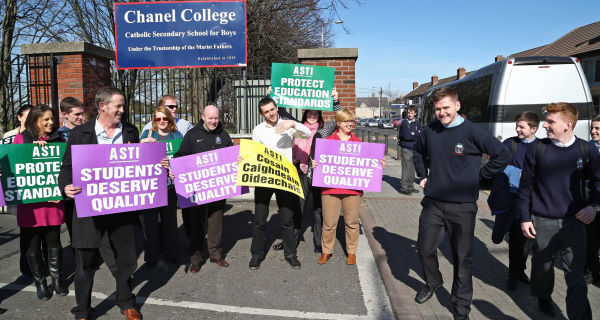
Primarily, because they are not happy that the Education Minister Jan O’Sullivan is requiring that they agree to teachers marking their own students for two pieces of coursework – one in second year and another in third year – such as projects, portfolios or performance, for the reformed Junior Certificate.
That was the name that previous minister Ruairi Quinn decided the new qualification would be called, but it is unclear if Ms O’Sullivan proposes to retain this or to keep the Junior Certificate. She has significantly altered her predecessor’s proposal, the main change being that teachers would not be required – as had been Mr Quinn’s idea – to correct their own students’ final written exam worth 60% of marks in each subject. She has also agreed to teachers’ demands – and this was an issue of some concern, also, to school managers and parents – that the award at the end of junior cycle remain State-certified, rather than a school-based award which Mr Quinn had proposed in October 2012.
Yes. That was largely supported by the teacher uions, but the NCCA advice to the minister came with the caveat that the unions were completely opposed to any element of a state-certified award being examined by students’ own teachers. They say it would impact the student-teacher relationship and raise questions about the trusted and transparent system run by the State Examinations Commission (SEC).
Ms O’Sullivan rejects suggestions this is about saving money and says considerable spending is allocated to prepare teachers on new curriculum and, eventually, on new assessment methods. She said last week it will not save money, although her department cannot say what the cost would be of running the Junior Cert (or its successor) after the training programme for teachers over the next few years is completed.
The teachers are not considered to be in this for extra pay. However, they do say resources for schools are vital for the implementation of any changes, regardless of who eventually does the marking work.
That is what the teacher unions argue. They say their members are highly professional but that they could come under pressure from parents, or that perceptions could emerge of good results being easier or harder to get in one school compared to another. The minister says that 15% of marking in all exams would be randomly checked by the SEC to avoid any such perceptions, and that external examiners can not give the kind of meaningful feedback that would be available from school-based assessment.
Yes, despite strict policies of the ASTI and TUI (the ASTI bans teachers marking their own students, the TUI allows it for Junior Cert oral Irish in certain limited circumstances), there has been a sharp rise in recent years in numbers of students doing an optional oral test for Junior Cert Irish, and other languages. Although it cannot definitively be stated who is doing the work, 27% of students who did Irish this year got marks in oral Irish, for which the SEC does not recruit, pay or train examiners in the same way that it does for Leaving Cert orals. According to the Department of Education, this increase is largely down to pressure from parents since the proportion of marks in Irish available for the oral test was increased at both Junior and Leaving Cert level in recent years, raising questions about the unions’ insistence that teachers and parents are concerned about the risk to consistency between marks in schools, in the absence of external examiners.
No, the issue of who does the examination work is only a very small part.
The idea from the start has been to reform the way young people are taught and how they learn in the first three years of junior cycle, given the emphasis on exam preparation that research has found begins as soon as early in second year. Some of the main features would include: replacement of A, B, C, etc, grades with more general awards of: distinction (90% to 100%), higher merit (75%-89%), merit (55%-74%), achieved (40%-54%), not achieved (0%-39%).
Except in the early years for English, Irish and maths, final written exams in each subject would be set at a common level, instead of the higher and ordinary level papers currently offered.
Two short courses – not as long as the curriculum in a main subject – could be assessed in place of a traditional full subject. So a student could count, for example, Chinese and artistic performance, or coding and physical education, instead of another subject towards the total number in which they are assessed.
Neither side looks like budging on the question of assessment. Perhaps, however, a solution is possible if the Department of Education could secure extra funding for IT resources and the creation of posts within schools to allow a particular teacher oversee implementation of the changes. This remains a concern of school principals and management, given that the reforms are coming on top of years of cutbacks to staffing and other resources in second-level schools.
It’s hard to see how, although the unions have yet to decide a date in January for their second planned strike. They are unlikely to want the dispute extending beyond that, as further disruption would do them no favours with parents as Junior and Leaving Certificate practical and oral exams get nearer. They might also come under pressure to re-ballot their members on what are now significanly-different proposals to those for which strikes were backed earlier this year.