Irish farmers need barriers to beef trade in Britain addressed
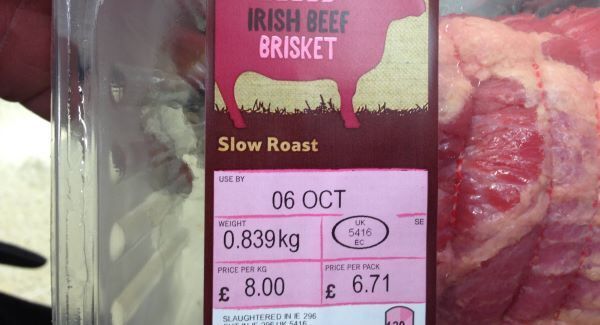
PICTURE the scene, a British consumer picks up two packets of fresh beef in the aisles of their local supermarket. One piece is from Britain and the other is from Ireland. Both are quality-assured and both are priced at £8 (€9.74) per kilo. Sounds like a fair deal, but that is not so.
The Irish farmer who has meticulously cared for their livestock, and who has produced that meat to rigorous, Irish quality-assured standards, is receiving 15% to 20% less in payment than their British farming counterparts. This is as much as €200 less per head of cattle being sent to Irish meat factories for processing.
The British consumer isn’t getting the benefit of that price difference for the Irish meat, and the Irish farmer definitely isn’t getting it, so who is getting the extra profit margin? Look no further than the Irish meat processors and their allies, the British multiple retailers.
Meat processors are manipulating the market, they have effectively usurped the Bord Bia quality assurance scheme and together with British multiples, they are controlling prices. A further part of this coup involves Irish processors creating barriers to prevent live exports of Irish cattle to Northern Ireland and Britain. Again, together with the multiples, they have placed a stranglehold on all Irish beef supply channels into British.
The provisions of the excellent Bord Bia Beef Quality Assurance Scheme are fully legitimate and they are intended to facilitate the free trade of livestock in a quality-assured manner.
However, the Irish meat processors, in their wisdom, have chosen to regulate this scheme with measures of their own, and to their own advantage. They have put in place an unnecessary range of preconditions around the trading and movement of livestock which go beyond the true spirit and intent of the Bord Bia scheme.
Over the last number of years, meat processors have introduced what they call a quality bonus payment for cattle that fulfil certain “quality” criteria. This bonus payment represents an average of €40 to €60 per animal.
However, in effect, it is not a bonus payment but a penalty on all the other animals produced by Irish farmers. It may be a “payment” but it is used as a price-setting mechanism — you can take it or leave it if you want your cattle processed.
Adherence to the Bord Bia Quality Assurance Scheme (QAS) is an integral part of qualifying for this bonus payment. The Bord Bia scheme states that animals must reside in a quality- assured farm for 70 days or more to qualify for the quality-assured mark.
Crucially, the scheme allows for animals to trade freely between similar, quality-assured farms in that period. If the cumulative days an animal resides on farms amounts to 70 days, then the animal still retains its quality assurance status. But this well-regulated and highly regarded scheme isn’t good enough for the meat factories.
The meat plants insist that their “bonus” will only be paid if an animal has stayed 70 days or longer in its very last herd. It must go directly to slaughter from that farm and it must only ever be moved a total of four times in its lifetime.
The effect of these additional conditions excludes the possibility of these animals being traded in the last 70 days before slaughter and it also prevents factory-fit animals being traded in livestock marts.
While somewhat technical, the sum total of these measures is to reduce competition, fair market pricing and to inhibit open livestock trading in Irish co-operative marts.
The meat industry says that the bonus payments, or penalties depending on how you look at them, are a customer requirement led by the large British multiples arising from “animal welfare concerns”.
As outlined above, one of the main criteria to enable a farmer to achieve the meat processor bonus is having only four movements or less in the animal’s lifetime. Due to the structure of the Irish beef sector, the smaller farms in the West traditionally supply younger animals to other farmers in the Midlands, the East of Ireland and Northern Ireland.
These animals require several movements on various farms before the cattle are finally finished on the last farm before slaughter. This benefits everyone in the livestock industry and it ensures a fair and open price. The marts are an integral part of this process but their trade is being stifled by the processors.
As if this stranglehold is not enough for the meat processors, research by ICOS Marts in Britain has identified that there is an Irish-inspired boycott of our own Irish live cattle exports going on in Britain. No Irish-owned factory in Britain will kill Irish-born cattle, effectively cutting off live trade from Irish marts into Britain.
Additionally, smaller British abattoirs and food service operators who supply over 45% of beef in Britain, find it impossible to have their offal processed by Irish-owned British factories if the live cattle processed in their abattoir has come from Ireland. There is also an effective ban by Irish-owned meat plants in the North on killing cattle from the Republic of Ireland.
IRELAND has over 6.5 million cattle, producing 2.2 million calves annually. This results in almost 1.5 million cattle being presented for slaughter, of which we export almost 90% of meat. Additionally, we have approximately 200,000-300,000 of live exports. Ireland has always been a provider of cattle for the North and Britain for hundreds of years. As a nation we are only consuming about 10% of what we produce and in 2013, Ireland produced over 472,000 tonnes of beef meat for export.
Britain, on the other hand, is only approximately 75% self-sufficient in beef meat and must import approximately 350,000 tonnes of additional beef to satisfy national demand.
Ireland supplies the vast majority of this imported beef meat as you would expect due to our proximity. In 2013 Ireland produced and exported over 250,000 tonnes of beef meat to Britain, representing almost 70% of their total imports.
The British market is the only EU market where these effective barriers to the free trade of live cattle exist. Ireland is exporting 200,000 tonnes of live beef to continental Europe without restrictive stipulations introduced for exports to Britain, allegedly for quality and welfare reasons.
Unfortunately, if the British consumer is buying quality Irish beef, the Irish-owned factories and British multiples are ensuring there will be no competition from the Irish live beef sector in accessing that market. The outcome is a calamitous situation for Irish livestock farmers. It is one that the relevant authorities need to step in and investigate in the interests of free trade, fair market conditions and quality and value for consumers.
Michael Spellman is national marts committee chairman of ICOS (the Irish Co-operative Organisation Society Ltd).
CONNECT WITH US TODAY



Be the first to know the latest news and updates