Is Pope Francis the Church’s saviour?
The Swiss-born theologian, 85, in what may well be his last book, paints a bleak but realistic picture: “The Catholic Church is in its deepest crisis of confidence since the Reformation, and nobody can overlook it.”
Grave though the situation is, Kung believes it is still redeemable. “With the appointment of Pope Francis, we have an unprecedented opportunity, not seen since the days of John XXIII, to fulfil the aims and promises of his Second Vatican Council, and truly bring the Church into a meaningful dialogue with the modern world.”
But is Pope Francis truly committed to reform? Kung is clear about the “big question” for the new Pope — “Where does he stand on serious church reform?”
The signs, it must be said, are encouraging. This Pope has already shown a willingness to abandon what Kung calls the “monarchist-absolutist” model of the papacy to which his two predecessors, John Paul II and Benedict XVI, clung.
In his recent apostolic exhortation Evangelii Gaudium (The Joy of the Gospel), Francis, having issued a call for renewal, acknowledges that “since I am called to put into practice what I ask of others, I too must think about a conversion of the papacy”.
What form will this “conversion” take? “This is a maverick Pope, who won’t be bound by convention,” John Allen, Vatican correspondent of the National Catholic Reporter, told CNN. The papacy, however, is enveloped by powerful conventions which have an inhibiting effect on holders of this august office.
One of these conventions is that a pope does not openly repudiate the policies of his predecessor. And this is undoubtedly a stumbling block where Humanae Vitae (the deeply divisive 1968 encyclical from Paul VI, condemning all forms of artificial contraception) is concerned. Kung is not by any means alone in his view that this encyclical was just plain wrong — but what pope is going to publicly state this? Breaking free from the conventions in which the papacy is wrapped will not be easy.
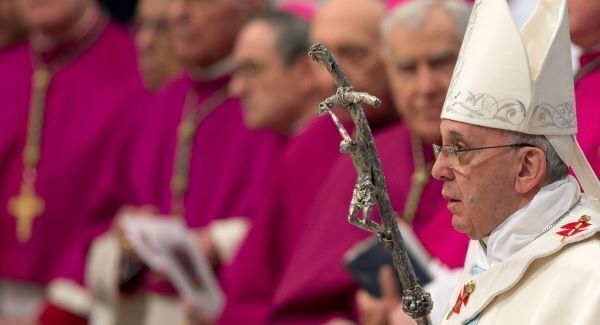
In addition, there is the Roman Curia — the Church’s central bureaucracy where different factions and cabals pursue self-serving agendas. Benedict XVI was utterly incapable of dealing with the Curia’s intrigues, and his papacy was in a shambles when he resigned last February.
Paul Vallely, author of Pope Francis: Untying the Knots, tells us that, shortly after his election, Jorge Mario Bergoglio received a call from an old friend in Argentina. “Be careful Jorge, because the Borgias are still there in the Vatican.” The new Pope, Vallely tells us, laughed and said “I know.” The thing is, if Francis is serious about reform, he will encounter all sorts of opposition from within the Curia.
Even today, 35 years after the death of Pope John Paul I in mysterious circumstances, there are solid grounds for believing the Machiavellian mindset attributed by David Yallop to some of the top prelates in the Curia in his 1987 book In God’s Name remains deeply rooted in the Vatican. Pope Francis referred to it as “leprosy”.
When Kung’s book was published in German in 2011, the title was: Can We Save the Catholic Church? Between that and the preparation of an English language edition in 2013, Benedict XVI resigned and Bergoglio was elected his successor, taking the name Francis. The result was a dual title for the English edition — Can We Save the Church? We Can Save the Catholic Church! Kung also revised much of the text. He casts himself in the role of physician, and his prescriptions are radical.
Francis, he says, can go in one of two directions: “If he embarks on a course of reform, he will find broad support, even beyond the boundaries of the Roman Catholic Church. He will also win back many of those who have long since abandoned the Church.
“If he continues the present course of retrenchment, the call to rise up and revolt will grow ever louder in the Catholic Church and increasingly incite people to take things into their own hands, initiating reform from below without hierarchical approval and often in the face of all attempts to thwart them.”
It is now very evident, he says, that the “restoration policies” of John Paul II and Benedict XVI — two Popes who actively worked to restore a pre-Vatican Council II paradigm of the Church — have failed. As for the papacy itself, that too must change.
“The Pope should not act as a demi-god and spiritual autocrat, nor as a military commander or as a corporate chief executive, but instead he should see himself as nothing more than the leading bishop of the Catholic Church, bound by collegial links to all the other churches and exercising his pastoral primacy within the collegiality of the whole episcopate and in the service of the whole ecumenical movement.”
Among the reforms Kung regards as necessary is the restoration of women to positions of leadership in the Church. “The traditional arguments against preaching by women and the ordination of women are not merely outdated, they are also theologically dubious and untenable.”
However, even as the English language version of Kung’s book was just appearing in bookshops, the Pope’s apostolic exhortation Evangelii Gaudium was published, and in it Francis reiterated the opposition to the ordination of women first spelled out by John Paul II. “The reservation of the priesthood to males, as a sign of Christ the Spouse who gives himself to the Eucharist, is not a question open to discussion.”
This gives substance to the warning from the papal historian and former Jesuit Michael Walsh against expecting any sudden lurches from orthodoxy from Francis. “He shows no signs of being anything but conservative on theological matters, so sometime, somewhere, somebody is going to get a nasty shock.”
Even Kung, notwithstanding his admiration for Bergoglio, notes that at the moment the new Pope is giving mixed signals. “Although he has introduced a new, more simple and humble style into the Vatican, there are also indications that he will take the same hard line on dogmatic, moral and disciplinary issues that his immediate predecessors have taken.”
But Kung is still optimistic about Francis bringing about reforms. He wonders if he might even usher in a “Vatican Spring”. Kung knows better than most that real reform must mean more than “a new style, a new language, and a new collegial tone”.
He stresses that the realisation of any reform programme will require a new Ecumenical Council — Vatican III. “Thus, we can hope that Pope Francis or one of his successors will follow the example of Pope John XXIII by convoking such a council.”
Is Francis ready for such a bold move? 2014 will tell a lot.
*

CONNECT WITH US TODAY



Be the first to know the latest news and updates