Carer of the Year: Mary's 50 year labour of love
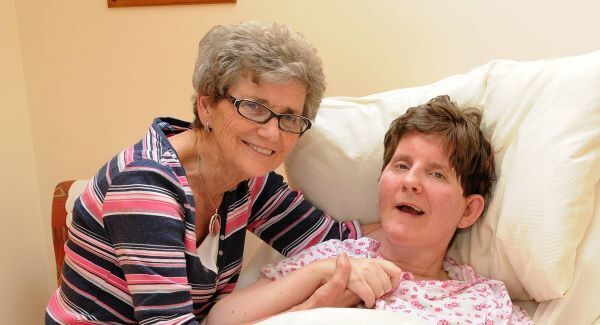
“She said ‘in four years time you’ll be 80, who’s going to look after me then?’” recalls Mary, 76. “It’s a worry for me and it’s a worry for her.
“She would never receive the level of care from anyone else that she does from me, and that’s not to criticise anyone else.
“She says to me ‘my memory is going, I can’t remember things now.’ I used to say she was better than a computer. She was always good to remember dates. She would remind me of things.”
Mary, who lives with her husband Denis and their daughter Sinead in the Cork suburb of Douglas, has had a few extra things to remember of late. Yesterday she was in Dublin for the annual Carer of the Year dinner, having earlier won the Cork Carer of the Year award. Ahead of her date with the other winners and presenters Marty Whelan and Mary Kennedy, she was afraid she would forget all the people and groups she had to thank.
Speaking on Monday ahead of the awards ceremony, Mary admitted she was “terrified”, particularly at the thought of maybe having to say a few words. She had written out a micro speech and very kindly allowed your correspondent to read over it.
“I feel the older I get the less I am able to retain stuff,” she says, seated at her kitchen table.
The truth is that over the past 50 years she hasn’t had a chance to forget too much. In a spotless room off the back of the kitchen of the McDonnell home is Sinead’s bedroom. She is the eldest of Mary and Denis’s three children, and for all the years in that half century they have cared for her. Mary is her primary carer, and she says the effort, while sometimes almost overwhelming, is worth it.
Sinéad has profound cerebral palsy, is doubly incontinent, has suffered a dislocated hip and has scoliosis. Her food needs to be minced and moist and she needs to be spoon fed. In latter years, she has been taking a lot of medication to ease her physical spasms, but this can cause sedation which means there is a danger when she is eating that she does not swallow properly and food can — as has occurred — accidently go into her lungs.
She needs a series of verbal prompts to ensure she swallows her food, while the medication has also impacted upon her bowel management. The problems have mounted in recent years and are more a result of age than anything else. She has gained almost four stone since an operation in 2008, meaning her wheelchair is now almost too small. A dislocated hip, the curvature of the spine, the osteoporosis and constant pain in her bones, amplified by periods of spasm: They all add up. It means her programme of medication now resembles the periodic table and that her care requirements are the very definition of 24/7.
“It’s terrible for her and awful for us,” says Mary. “We are up nearly every night to re-position her.
“In latter times, since 2008, all that went downhill, she developed all these multiple problems. She is on multiple meds that has a huge sedative effect.
“She is drowsy a lot of the time and living in a sort of twilight zone. She has been in horrific pain, shouting out, screaming out. Nothing can sort it out.
“Her condition is a deteriorating condition and it’s getting worse and worse.”
She goes through some of the routine they follow every night when placing Sinead into her bed. It takes just shy of an hour and involves comfort brackets being fitted to help keep Sinead’s spine straight as she sleeps, a type of bookend for the body placed at the arms, hips and feet and complemented by heel rollers that prevent them from digging into the sheets and chafing the skin. The hoist near the bed is used to lever her delicately into position, and seldom does a night pass without her position having to be changed.
Her bedroom is a lovely, light-filled room, with a painting over the hoist depicting a table with a card on it, the envelope bearing Sinead’s name and address. Photo collages of relatives dot the walls, books are stacked on a chair nearby. Pictures of Sinead feature in the hallway, and her role in the daily life of the family is apparent in her sometimes knockabout family conversations.
“She has a very good sense of humour and of the ridiculous,” says Mary. Her “high awareness” levels mean she is more than capable, for example, of knocking out a poem in honour of her mum. A collaborative effort with two of her friends, it has nine verses, one of which is “My legs go into spasm, she can make the pain go away, her touch it sure is magic, her cooking too, I say.”
Back in 2010 when she spent time in Cork University Hospital undergoing tests as to her suitability for an abdominal implant, the doctor told her directly that while she did qualify, unfortunately it was in the run-up to Christmas and she would have to return in the new year.
“She said ‘no way’,” Mary recalls with a chuckle. “‘I am not going out of this bed.’ So the doctor looked at her and said, ‘OK — Sinead has spoken’.”
Sinead’s powers of insight have the drawback of not shielding her to the reality of life. “She called me a few months ago and told me ‘you know I’m not going to get any better and I am going to get worse — that’s cerebral palsy and aging’”, says Mary.
Earlier this year the Irish Examiner featured Mary’s story as part of our series on the impact of austerity. Back then, Mary was candid about her views on how carers are perceived. More than once Mary repeats the figure of 187,000 family carers around Ireland — a group that consistently feel undervalued by the state.
“Undervalued, under-recognised, underpaid” is how she sums it up.
The half carers’ allowance was left alone in the budget, but carers did not escape entirely. Mary said she was angry at the scrapping of the telephone allowance and the bereavement grant. Mary alludes to the national carers strategy, launched in July last year, as a document which could form the blueprint as to how carers should be treated. “Nothing will happen until the economy improves. It would be wonderful then if they could look at this strategy again,” she says.
Mary has her issues with the HSE and its “monstrous bureaucracy”, but stresses that “the front line and second line staff in the HSE in Douglas are first class”. She also praises Enable Ireland, who have been with Sinead since she was first diagnosed at 10 months and have her four days a week, and family and friends who have helped over the years and continue to be involved in Sinead’s life.
She recently received her Cork Carer of the Year Award, and even then it was only because Denis, her husband, nominated her without her knowledge.
“It was a fait accompli by the time it got to me,” she says, recalling how the local Carers Association manager rang her to give her the good news. “I am happy that he did it,” she says of Denis’s covert application
At 76, Mary can’t avoid thinking ahead, even if she is remarkably spry for a woman of her age, more so given her immense responsibilities.
“It’s a labour of love,” says Mary. “The bond between all of us is amazing. That’s why it would be such a terrible wrench….”
There was no need for her to finish the sentence. As the penultimate verse of Sinead’s poem goes: “My Mum is so, so caring, And I want everyone to know, She is someone very special, and how much I love her so.”
Congratulations to Cork Carer of the Year 2013 Mary McDonnell. Well Done Mary! http://t.co/tkgHL5AeOY
— Family Carers Ireland (@CarersIreland) November 1, 2013
Carer of the Year Mary honoured by award | Irish Examiner: http://t.co/TBBrhav01t via @irishexaminer #Health #Carer #Award
— Michael O' Keeffe (@MikeOshea_1) November 1, 2013
CONNECT WITH US TODAY



Be the first to know the latest news and updates