Ageing parents of children with disabilities 'run ragged full-time caring have to be lobbyists too’
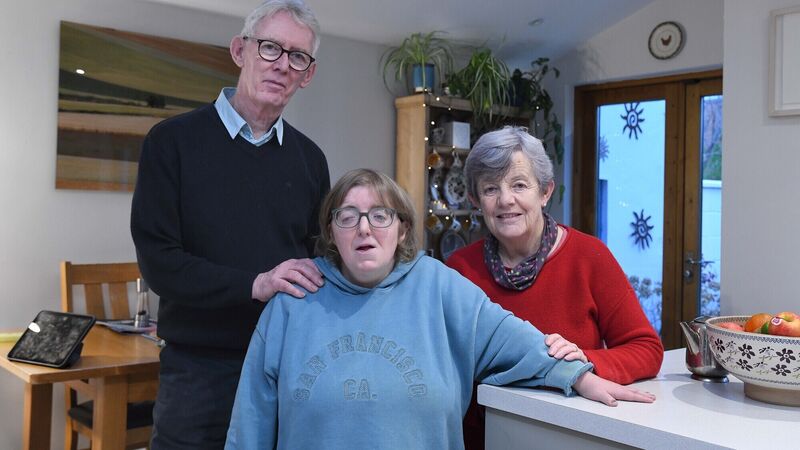
Tony Murray at home with his wife Susan and their 42-year-old daughter Aoife, who has an intellectual disability and is cared for by her parents. Tony has set up Before We Die, an organisation aimed at changing the system so that a plan is in place for care to be provided for people like Aoife. Picture: Moya Nolan
The Irish healthcare system, a vast labyrinth of services and vested interests, has things which it does well and many things which it handles poorly.
Dental care, waiting lists, budgetary oversight — three areas where the public system could do a lot better than it currently does for patients.
You can add caring for people with intellectual disabilities to that list. Or rather, planning for the future needs of that cohort.
Its issue is a familiar one across Irish society: An awful lot of money being spent without necessarily getting the expected return, with little practical improvements being made to the affected peoples’ lives despite the outlay.
In recent months, the revealed that the number of residential placements for those with intellectual disabilities in private, for-profit accommodation centres nearly doubled between 2021 and 2024. More recently, we highlighted that despite the HSE’s budget for disability residential services surging 32% — more than €500m — between 2024 and the present, the health service is unable to say how much of that money goes directly to for-profit organisations.
The reason given is that such organisations provide so many services to the HSE that it is not possible to differentiate residential expenditure from the rest.
As always, the human factor gets lost in the numbers.
Dublin man Tony Murray is 71. He and his wife Susan are the full-time carers for their 42-year-old daughter Aoife, who is living with an intellectual disability.
They have one simple question they would like answered: “Who will care for our daughter when we are no longer able to do so?”
“Nobody is able to answer that question,” Mr Murray said.
“It’s frankly shocking. There are 2,000 adults with intellectual disabilities who live with their parents or primary carer who are over 70 in Ireland today. 500 of them are over 80. Some are in their 90s,” he says, while noting that the numbers cited are likely an under-estimation.
“I find that very cynical.”
Along with a lack of planning in place for how to manage the situation of adults with intellectual disabilities when their carers are no longer able to be there for them, Mr Murray believes the situation has been created by the Government’s move to decongregate residential placements. That situation leads to emergency placements, mostly with for-profit providers, often in areas far removed from where the people in question have spent their whole lives.
Those placements are typically very expensive. With nobody to represent them, some of the most vulnerable people in our society may never leave that placement.
“The emergency response is always to go to for-profits, and they can charge a premium because they know they have the HSE over a barrel,” Mr Murray said.
Last year, he set up advocacy group Before We Die. Its goal is to find a solution for this specific problem.
“It’s an absolute complete mess. The more we have dug into it, the worse it gets. It’s not just funding. The Taoiseach has told us that money for housing is not an issue. The issue is spending it properly,” he said.
“It’s Kafkaesque. We’ve gone from a situation with a charity model where the [Catholic] Church did it all to a civic model where the State has not stood up to the mark.”
The numbers that the HSE has released are eye-watering: €3.8bn for disability services in 2026, up €600m year-on-year. Overall funding for the five costliest for-profit companies (Nua Healthcare, Talbot Group, Resilience Healthcare, Galro, and Orchard Community Care) was €296m in 2024, up 129% from the €129m spent on the same services four years prior.
The cost per person per year for this largely emergency care ranges from €420,000 per year with a for-profit provider to €620,000 for an internal HSE placement.
Granted these costs are largely reflective of situations which require a lot of staffing to support people who typically have intensely complex needs, but planning to spend that money in advance on more sustainable, economical solutions would seem to be basic prudence.

Liam Quaide, the Social Democrats’ spokesperson on disabilities whose parliamentary questions first brought the HSE’s spending on these placements to light, described the situation as “remarkably haphazard and disjointed”.
He noted that many State-funded services have developed in geographic areas “largely on the basis of tradition rather than population need or coherent national planning”.
“We are seeing increased outsourcing to for-profit providers, often dispersed around the country without any strategic roadmap for building integrated, community-based supports.
“What we urgently need is a comprehensive national framework that sets out clearly what levels of support should exist in every community, and how they should be delivered,” he said.
The HSE was queried as to what moves are being made to ensure that adults with intellectual disabilities who are placed in emergency residential accommodation do not remain there indefinitely, along with what structures are in place to plan for the care of that same cohort before their carers are no longer able to care for them. A response had not been received at the time of writing.
“The most humane, human rights-compliant, and cheapest and economical approach to these situations is to plan with people well in advance,” said Derval McDonagh, the chief executive of Inclusion Ireland.
“All it would take is some forward thinking. We know the individuals we’re talking about. All have gone to school or are accessing HSE services. They’re known in the system.
She added that, unfortunately, it is “a sad reality that we know many who have gone into an emergency placement and never come out again”.
“What we’re hearing from people all the time is that the system is in emergency mode constantly, things are being dealt with only at an absolute crisis point when the affected person is in such overwhelming distress.
“That isn’t sustainable, there needs to be a plan. At present, the system isn’t designed to intervene early.”
Mr Murray added: “We know there are no votes in disabilities.”
“We don’t want to give sob stories, the politicians know the issues. But parents like myself and Susan are run ragged full-time caring, and now we’re being told that we have to be lobbyists too.
“There is a systemic problem here, and there is no mechanism to work with parents and service providers to fix it.”
Read More
CONNECT WITH US TODAY



Be the first to know the latest news and updates