Jennifer Horgan: Nathan Fielder's 'You Can See Everything' is a satire — trust me
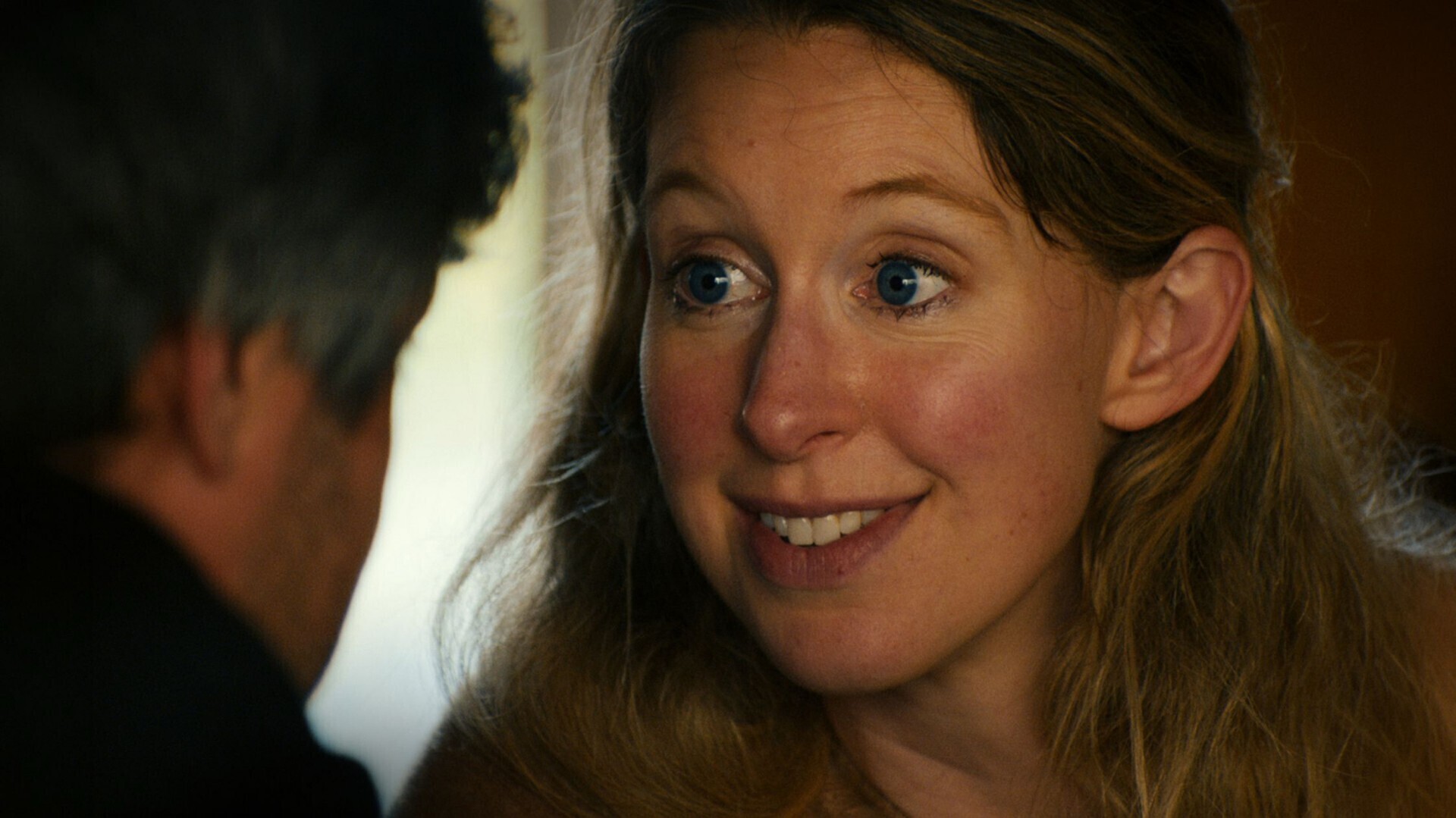
'You Can See Everything' follows Elizabeth Holmes during the weeks before her imprisonment. Its main aim is to fight for the objective truth she ignored. Picture: A24

You can relax. This column won’t give away anything specific about You Can See Everything, the record-breaking documentary about Elizabeth Holmes, tipped for an Oscar.
I only want to suggest what everyone seems to dispute. I want to suggest that Nathan Fielder, (the creator, along with Lance Oppenheim,) does believe in objective truth, and that he is angry at America for letting it slide into the abyss.
For anyone who isn’t up to date on Holmes, her company, Theranos, began marketing cheap, rapid diagnostic tests directly to the public in 2013, claiming the test could check a drop of blood for approximately 200 conditions.
She was backed by big investors who believed her shtick long before the science was proven. Over three years, while her face was appearing on magazine and she was being hailed a genius, 1.5 million tests were done on thousands of ordinary people.
Whistles were blown, patients were harmed, and the company was eventually brought to court. One woman testified during trial that her Theranos test suggested she was having a miscarriage when her pregnancy was perfectly healthy.
Read More
Another was told she was showing signs of being HIV positive. Yet another patient (dangerously) stopped taking their blood thinning medicine because of a false reading.
follows Holmes during the weeks before her imprisonment. Its main aim is to fight for the objective truth she ignored. America certainly needs someone to fight for it, not just because of Theranos, but because of the growth of the anti-vax movement there, with the country currently experiencing its worst measles outbreak since 1991.
The story of measles is also the story of Theranos. In both cases, objective truth has been disregarded in favour of belief and fear, hunches, unscientific nonsense, and celebrity.
So, instead of offering us a straightforward documentary, Fielder and Oppenheim opt for a parody of one, to reflect America’s descent into irrationality. The bigger point of the film is that Elizabeth Holmes would not exist if American society hadn’t turned into one similarly, pulsating, dizzying, vibe-check.
is not a serious documentary. Its aim is not to analyse the psychology of Elizabeth Holmes. The film is a satire. A satire, a comedy, in which Nathan Fielder plays the part of a person who spends more time on Instagram or staring into people's eyes, than he does researching his subject.
Fielder is playing the part of a bad documentarian with bad habits and blurred boundaries. He is playing the part of an idiot but he is (I hope!) not one.
I wonder how Fielder and Oppenheim feel about the fact that people aren’t getting the joke. Reviewer Catherine Shoard, writing for , really didn’t get the joke, when she asserted that its "vibes-check approach" was "an insult to objective truth".
That is the point of the project. Fielder is demonstrating on screen what has happened to serious news and commentary in America.
If you want to get a sense of it, spend an afternoon watching , the brilliant 1976 thriller about the Watergate scandal. Then sit through .
is not a documentary. It is a fiction, but it is bursting with facts, with fast talk, intelligent talk. It is an entertaining fiction, deeply interested in and respectful of fact.
pretends to be serious, but really it is silence-filled fiction. Fielder is giving America what it wants. America has more interest in fiction and hot air, in puff. That’s what the film is saying. America has more interest in the pretty celebrities who play real people (Seyfried), than in the people themselves (Holmes).
It’s a joke. Only nobody’s laughing. And the fact that everyone seems to be viewing this project as a serious documentary shows us the scale of America’s (and our) problem.
Because although we are told that we can "see everything", we have lost the ability to see what’s right under our noses — that Nathan Fielder and Lance Oppenheim are ridiculing our willingness to turn a convicted criminal into an Instagram sensation.
They are highlighting our eagerness to debate motivations and feelings and beliefs; to pore over looks and behaviours (how do you beat an egg?) instead of analysing facts, instead of acknowledging criminal behaviour, and the dire consequences of it.
Amanda Seyfried is Fielder’s glorious partner in this — and she plays her comic role brilliantly. Their exchanges are as spicy and as over-boiled as any chinwig after dark. It’s a game, a tumble of fact and fiction, a mesh of anything whatsoever, so long as it is titillating and salacious and exciting and entertaining.
The duo of Fielder and Seyfried provides the red meat, and we, the animals, salivate over the dripping blood. And (slight spoiler alert!) Fielder doesn’t fall in love with Holmes… He suggests it only to test if we have a shred of intellect left.
He’s undermining his reliability to add to the overwhelming sense that there is no objective truth. But he is doing this in the hope that we will realise he believes the exact opposite, and that this is a parody.
I write this hopefully. It’s possible that all the critics are correct, and this truly is a film without any regard for fact or for the details of Holmes’s abhorrent crimes. It’s possible.
It’s possible that Fielder and Oppenheim have created a film about someone who has no regard for the truth by reflecting that same blurriness in their methods. If this is the case, as Shoard suggests, then it’s a mesmerising but disappointing film.
If I’m right, it’s a masterpiece. Because the truth does exist and it does matter, especially when exploring a real life case with real consequences. I’m keeping the faith. I’m betting that the filmmakers’ tongues are firmly plugged into their cheeks. It’s all a bit of play-acting with one very serious message.
The film is warning us that America has lost its soul. Specifically, America has lost the rational part of its soul, the bit that, according to Plato, is meant to control the other parts.

What are they, these other parts? They are what’s abundant in this film. The spirit — the part that makes us act from belief and conviction and passion. Holmes and Fielder’s characters have that in spades.
The appetite, the part that wants attention, wealth and glory. That’s all over the screen too.
Elizabeth Holmes fooled America despite having no rational soul. Silicon Valley gobbled up her nonsense because it had no rational soul either.
If we can’t see what’s missing in this film, the rational part, the facts, we’re on a similar track.
The question is whether Fielder and Oppenheim are lacking their rational soul. I choose to believe they are highlighting what a ‘documentary' looks like without one.

BLACK FRIDAY
Already a subscriber? Sign in

CONNECT WITH US TODAY



Be the first to know the latest news and updates