Colin Sheridan: When an emergency is permanent
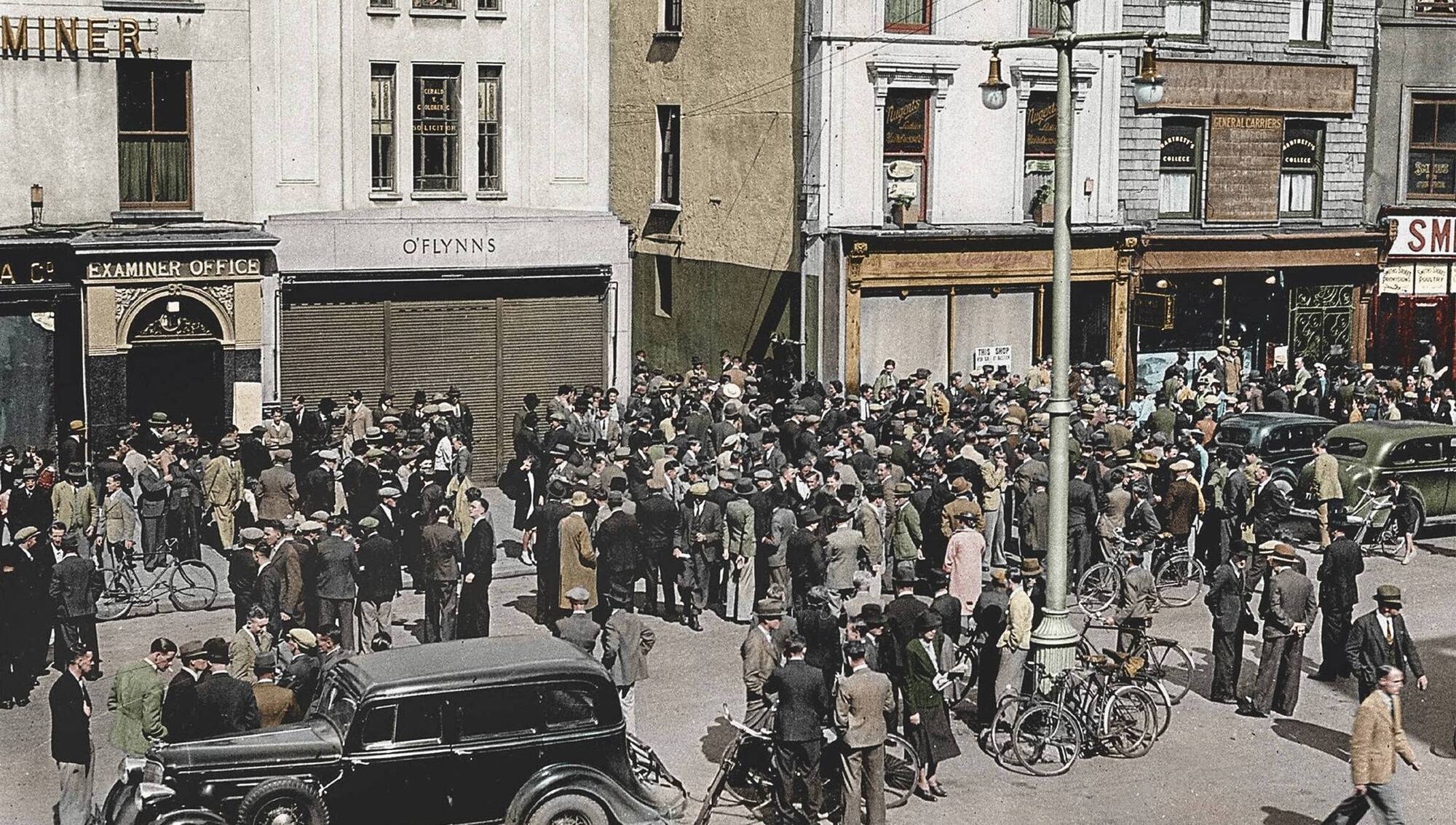
In May 1940, people mill outside the offices of the Cork Examiner as they seek news about the German invasion of neutral Belgium and the Netherlands. The Emergency Powers Act allowed government to regulate supplies and transport, control property and communications, restrict movement and censor newspapers and periodicals.

By September 1, 1976, Adolf Hitler had been dead for over 30 years. The Third Reich was gone. Hiroshima and Nagasaki had been destroyed and rebuilt.
Germany and Japan were allies of the West. Stalin had died. JFK had visited Ireland and been assassinated. The Beatles had formed, conquered the world and broken up. Men had walked on the moon.
Ireland had changed too. It had declared itself a republic, abandoned the last formal links with Britain's commonwealth, joined the United Nations and entered the European Economic Community. Seán Lemass had overseen an economic transformation. RTÉ had begun broadcasting television. The old, isolated Ireland was slowly becoming something else.
One thing, however, had survived all of it. The Emergency. On September 2, 1939, the day after Germany invaded Poland, the Oireachtas had declared that a national emergency existed. It was an entirely understandable response to an extraordinary moment.
Ireland was small, militarily weak, barely two decades removed from independence and determined to remain neutral in a European war whose eventual dimensions nobody could yet comprehend.
HISTORY HUB
If you are interested in this article then no doubt you will enjoy exploring the various history collections and content in our history hub. Check it out HERE and happy reading
Thirty-seven years later, on September 1, 1976, the Oireachtas finally revoked that resolution — only to declare a new state of emergency on the very same day in response to the violence of the Troubles. That second fact transforms a curious anniversary into something rather more interesting.
Read More
Ireland did not actually emerge from constitutional emergency in 1976. The resolutions dating from the Second World War were revoked and immediately replaced by new ones, this time responding to the violence of the Troubles.
That second resolution lasted until 1995. For 55 of the first 57 years of Bunreacht na hÉireann, Ireland existed under continuous emergency resolutions. This was not a dictatorship — ordinary life continued, and wartime powers like censorship lapsed — but the emergency remained because no government felt urgency to remove it. The exceptional became background noise.
In some ways, though, that makes the story more revealing. The Emergency remained not because governments were constantly exploiting it, but because nobody felt sufficient urgency to remove it.
The powers granted in 1939 had been anything but theoretical. The Emergency Powers Act allowed government to regulate supplies and transport, control property and communications, restrict movement and censor newspapers and periodicals.
In wartime Ireland, censorship became one of the defining features of the Emergency. Éamon de Valera made the democratic dilemma explicit when introducing the legislation. A democracy facing mortal danger had to be capable of protecting itself. If a democratic government proved incapable of acting decisively in a crisis, democracy itself could fail.
It is difficult to argue with the circumstances. Britain and France would declare war on Germany the following day. Within months, much of Europe would be occupied. Britain would face invasion. Ireland's neutrality would be tested repeatedly and its government confronted with shortages, espionage, the threat of invasion and the activities of the IRA.
Extraordinary circumstances produced extraordinary powers. Then the circumstances changed.
The war ended in 1945. The principal Emergency Powers Act ceased to operate the following year, but the constitutional emergency did not.
It survived the post-war years, the 1950s and the transformation of the Lemass era.
It survived Ireland's entry into the UN, the Cuban missile crisis, the beginning of the Troubles and Ireland's accession to the EEC.
It had, for most practical purposes, become a switch nobody was using but nobody had bothered turning off.
That was not entirely unnoticed.
A committee reviewing the Constitution recommended in 1967 that future emergency resolutions should automatically expire after three years unless the Oireachtas explicitly renewed them.
The recommendation went nowhere.
Nine years later, circumstances provided Ireland with a very different emergency.
The summer of 1976 was a bloody one. In July, the newly arrived British ambassador to Ireland, Christopher Ewart-Biggs, and Northern Ireland Office official Judith Cooke were killed by an IRA landmine near Sandyford in Dublin.
Violence associated with the Troubles had increasingly demonstrated that the Republic was not insulated from the conflict across the border.
The Fine Gael-Labour government led by Liam Cosgrave concluded that the State faced a serious security threat.
And so came the constitutional manoeuvre of September 1. The emergency created by Hitler's invasion of Poland was finally declared over. The emergency created by the Troubles began immediately.
The Cosgrave government responded with a new Emergency Powers Act, granting controversial detention powers to gardaí.
Though the key detention provisions lapsed in 1977, the emergency declaration itself remained in place for another 18 years. These were formidable powers, and controversial ones.
Yet here the story becomes stranger again. The principal detention provision was allowed to lapse after Fianna Fáil returned to government in 1977. The emergency declaration itself stayed. For another 18 years.
By then Ireland had acquired a peculiar constitutional habit. The emergency was no longer necessarily a response to something government urgently needed to do. It was simply there.
It took the ceasefires of 1994 to finally force the question. The IRA announced its ceasefire in August. Loyalist paramilitaries followed in October.
As the peace process gathered momentum, the continued existence of emergency resolutions became increasingly difficult to reconcile with the political message that Ireland was trying to send. That should make this more than a historical curiosity 50 years after the events of September 1976.
Because we have rediscovered the language of emergency. The attacks of September 11, 2001, produced an enormous expansion of counter-terrorism and surveillance powers across democratic states. Some proved temporary, but others became part of the permanent architecture of security.
Covid offered an even more intimate demonstration of the bargain. Governments faced a genuine and frightening public health emergency and assumed powers over movement, commerce, travel and ordinary social interaction that would have appeared extraordinary only months earlier.
Many of those measures were necessary. Some remain contested. That is precisely the point.
The lesson of Ireland's long emergency is not that emergency powers are inherently illegitimate, still less that every government which invokes them is engaged in some authoritarian project. Sometimes there really is an emergency.
There certainly was one in September 1939. Liam Cosgrave's government also had substantial grounds for believing that the security of the State was threatened in 1976.
Ukraine has been fighting for its survival since Russia's full-scale invasion. Governments across Europe increasingly describe migration, climate change and energy security using the vocabulary of emergency.
Israel has invoked emergency and wartime powers since October 7, 2023, with devastating consequences for the region. Emergencies are weaponised to win, or avoid elections. Ukraine and Israel stand as contemporary examples of that.
The harder democratic question comes afterwards. Who decides when the emergency is over?
There is an asymmetry to extraordinary state power. Governments generally acquire it at moments of fear, when public demand is for action and opposition can easily be characterised as complacency. Surrendering it happens later, after the fear has subsided and public attention has moved elsewhere.
There is rarely much political reward in voluntarily reducing the power of the State. Ireland discovered the consequences almost accidentally.
CONNECT WITH US TODAY



Be the first to know the latest news and updates