Clodagh Finn: The real-life Cork woman who was Eisenhower’s wartime chauffeur and confidante
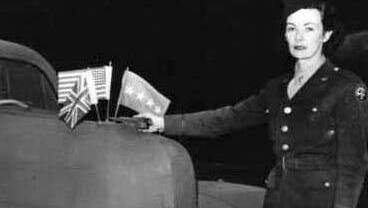
This 1944 US army photo is captioned: 'Kay Summersby, an Irish girl from County Cork, is mighty proud of the company she keeps, for there is always one important Allied leader behind her when she takes the wheel. Attached to the American Forces as General Dwight Eisenhower's personal driver when he first came to England, she has been driving him ever since over roads in North Africa, Tunisia, Italy, and now England.'

There’s a moment in , the tense drama on the fraught run-up to D-Day, when Kay Summersby (Kerry Condon) gives a kind of potted CV of her wartime activities to meteorologist Group Captain James Stagg (Andrew Scott).
She tells him she drove an ambulance during the London Blitz and saw bodies lined up in a cinema-turned-morgue. She then describes herself as secretary, driver and aide to Dwight D Eisenhower, the Supreme Allied Commander of the Allied Forces who is trying to get an accurate weather forecast before launching the largest seaborne invasion in history.
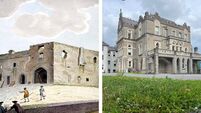
That vignette gives us a true flavour of the real woman but it captures only a portion of the life and times of Kathleen MacCarthy Morrogh who was born near Schull, Co Cork, on November 23, 1908, and spent her childhood at Inish Beg island, near Skibbereen.
Indeed, she was known as ‘Skib’ in army circles and her Irish heritage is celebrated in one US Army photo. The jaunty caption reads:
“Kay Summersby, an Irish girl from County Cork, is mighty proud of the company she keeps, for there is always one important Allied leader behind her when she takes the wheel. Attached to the American Forces as General Dwight Eisenhower’s personal driver when he first came to England, she has been driving him ever since over roads in North Africa, Tunisia, Italy, and now England.”
HISTORY HUB
If you are interested in this article then no doubt you will enjoy exploring the various history collections and content in our history hub. Check it out HERE and happy reading
The business of war, of course, was far more dangerous. She was on board the ‘Strathallan’ en route to North Africa when it was torpedoed by a German U-boat in December 1942. “She narrowly escaped death during an eight-hour ordeal in which she saw the ammunition-laden ship explode and sink,” the reported.
All of that, of course, is outside the scope of , but it is heartening to see Kay Summersby get so much screen time. Kerry Condon presents her as an unflappable model of cool-headed efficiency, but one who is also resourceful and compassionate.
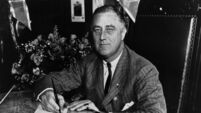
The film also makes it crystal clear that the only way to the commander was though her — although, unlike the David Haig play on which the film is based, it doesn’t hint at any romantic spark between them.
Much ink has been spilt speculating on the nature of their relationship, but we’ll come to that.
I find it much more interesting that two real-life Irishwomen feature in the cinematic retelling of the high-stakes discussions that took place in the stifling (and very male) atmosphere of Southwick House, the so-called nerve centre of D-Day.
I was beyond pleased when Maureen Sweeney of Blacksod Lighthouse in Co Mayo got a mention. It is well-known, by now, that the conscientious post-mistress’s report predicted a storm that would have made a June 5 operation disastrous.
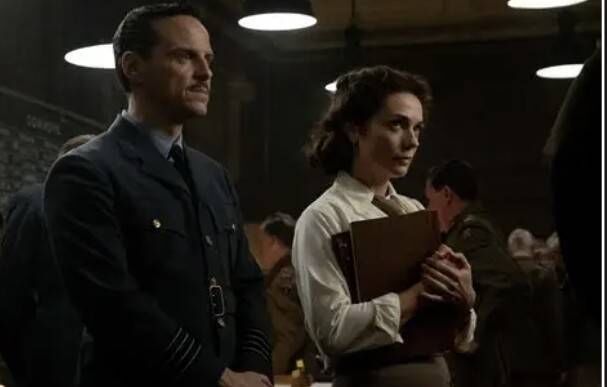
Less well-known is the crucial nature of her later report, identifying a window of calm weather, which allowed the mission to go ahead on June 6. She gets a name-check for that.
While Kay Summersby wasn’t at the final decisive meeting in real life, she did meet Eisenhower shortly afterwards, at 4.15am on the morning of June 5, as she recalled with exceptional clarity during documentary series which aired in the 1970s.
“I drove in there [to Southwick House]. He came out and he really looked so serious. As he got in the car, he said, ‘D-Day is on, nothing can stop us now’.”
In that documentary, you can hear she spoke with an English accent rather than the Irish one of the film, but she considered herself Irish. Or at least when the occasion demanded it, as her nephew Michael MacCarthy Morrogh explains in a wonderful essay, “Kay Summersby – ‘helping Ike win the war’”, published in the in 2020.
She was not of conventional Anglo-Irish ancestry — being of Gaelic background and Catholic — but she happily announced herself as Irish, while being British in political loyalty, he explains.
Shortly after the war, in 1948, she was persuaded to write a memoir, , which became a bestseller.
In it, she recalls her childhood on Inish Beg where she was the eldest of four children born to retired Lt-Colonel Donal MacCarthy Morrogh and Vera Hutchison, a woman who spoke several languages, had travelled widely and wrote poetry.
The couple’s only son Seamus was sent to public school in England but the girls, Kathleen — her name was shortened to Kay later when she lived in the US — Evie and Sheila were educated at home by a series of governesses who suffered endless practical jokes at the hands of their charges.
Kay recounted how she distracted her boss in wartime with stories of how she and her sisters tried to make the horses bolt when governesses were being driven in a cart.
“Our home, Inish Beg,” Kay wrote, “was a somewhat run-down estate on a small but lovely emerald island in a river in County Cork… There was a succession of governesses, hunts, spatting parents, riding in the fields and along the long avenue fringed with old trees . . . the usual pattern of life in that obsolete world.”
When she moved to London in the 1930s, she was “utterly unprepared to do much more than sit a horse properly and pour tea correctly”.
She did get work though, as a model and an actress. In 1936, she married Gordon Summersby, described as “a raffish, witty, qualified accountant”, after a whirlwind romance. There was a second short marriage in the 1950s to stockbroker Reginald Morgan, but she filed for divorce on grounds of cruelty.
“Kay’s real love,” writes MacCarthy Morrogh, “had been for Dick Arnold, her American fiancé, killed in North Africa in 1943. To the end she kept his letters and mementos.”
Interest in the nature of her relationship with Eisenhower was reignited in the 1970s when a book claimed he had contacted his boss, chief-of-staff of the US army, General Marshall, to say he wanted to divorce his wife and marry Summersby.
The general told him, in no uncertain terms, if he did he would be out of the army and his political ambitions would be ruined. He dropped the idea and was later elected US president.
By the early 1970s, Kay had cancer and, with a ghost-writer, began a second book, this time one with the provocative title: . It wasn’t near finished when she died, on January 20, 1975, but it’s hard to say how much of it is artistic licence or the work of a woman trying to pay her medical bills.
Kay Summersby was in the spotlight at several times during her life, often for the most reductive of reasons.
With the release of , she’s back in focus, but this time let’s do as the obituary did in 1975 and recall a woman who sat alongside Eisenhower at meetings attended by President Roosevelt, Winston Churchill, King George VI and other leaders.
In 1944, she was commissioned a second lieutenant in the American Women’s Army and later rose to the rank of captain. After the war, she got US citizenship and worked as a fashion consultant and set and costume designer for television and stage production.
When she died, a friend described her as a no-nonsense person who knew she was dying and did all she could to stay out of hospital. She instructed there be no funeral service, just a gathering of close friends.
Her final wish was to have her ashes returned to her native country to be scattered in Co Cork.
CONNECT WITH US TODAY



Be the first to know the latest news and updates