Terry Prone: Mooney controversy not as wild as BBC’s case of mistaken identity
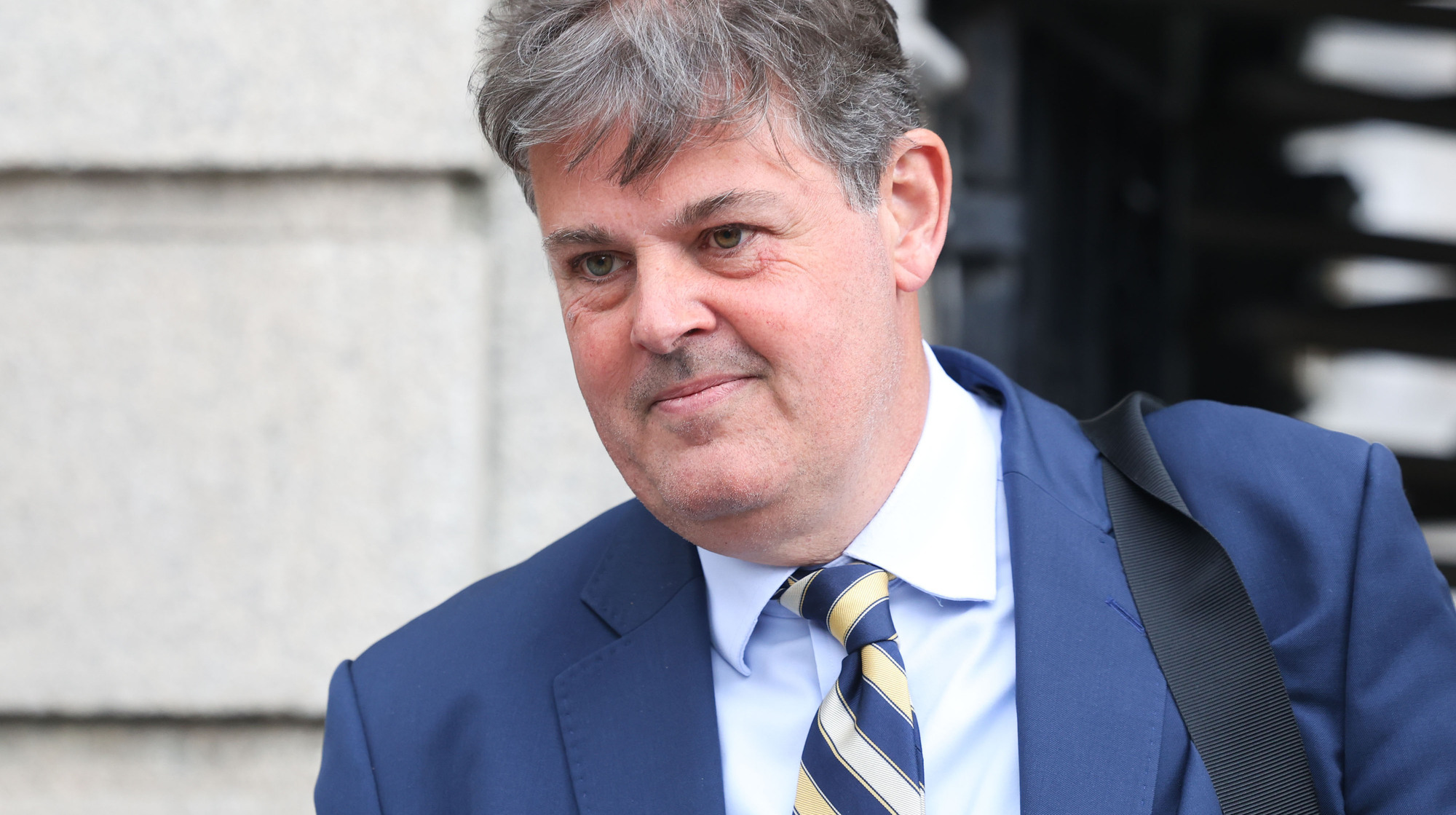
RTÉ director-general Kevin Bakhurst at Leinster House after appearing before the media committee meeting examining the Derek Mooney payments controversy. Picture: Leah Farrell/ RollingNews.ie
Kevin Bakhurst got a bit ratty, last week, over the Derek Mooney re-boot. RTÉ did the computer thing — they turned Derek off and back on. They turned him off as a producer and back on as a presenter.
Which the director general thought was a good move. He further thought going public about it was an exercise in openness and should have been warmly welcomed. Which neither media nor an Oireachtas Committee obliged him by doing.
On the other hand, in the pantheon of RTÉ war stories, it’s not actually that memorable. Every station and broadcaster have their war stories. The guest who arrives drunk or otherwise incapable, like the eminent late Scottish psychiatrist RD Laing on Gay Byrne’s .
Byrne called him on it and — in a wonderful example of the unpredictability of a live broadcast — was promptly attacked by audience members eager to defend what they clearly believed was Laing’s basic human right to go on Irish television pissed as a newt if he so chose.
Sometimes, the war story emerges from technical failure, as happened repeatedly to the BBC’s great Richard Dimbleby during his later years, when he was dying painfully of cancer, although he had kept his illness secret. Dimbleby was presenting the BBC’s live coverage of a royal tour of Germany during the mid-60s by Queen Elizabeth II.
Everything that could go wrong, did go wrong. Video links failed. Audio was hit-and miss. Just as they were about to go on air, Dimbleby’s own monitor failed, which meant he was guessing what pictures, if any, were reaching the viewers, and to what degree if at all those pictures matched his commentary.
In fact, what the viewers were seeing, back home, seemed flawless, but Dimbleby didn’t know that, and his frustration grew when the production crew told him the feed to London had failed. “Jesus wept,” he muttered, sure his microphone was not working. Except that it was, and millions of viewers heard his desperation.
What happened was that a man from Brazzaville in the Republic of Congo, having survived murder and mayhem in his homeland, became a refugee, reaching the UK, where he gained permission to stay. His career prospects were not helped by poor English, but, as a graduate in finance, he was also tech-savvy, and eventually received notice he should turn up for a job interview at the BBC at 10am on May 8, 2006. The job would entail detecting and removing inaccuracies from online databases. He was delighted and turned up in plenty of time.
So far, so good. As Guy arrived for his interview, a TV programme was already being broadcast from the same building, and that programme was lining up to cover a legal case involving the Apple logo. A computer expert had been booked to talk about this, and one of the production crew — named Elliott Gotkine — was told to get that expert from reception and bring him to studio.
He asked the receptionist if a guy named Guy Kewney had arrived and she nodded him towards the man who was there for a job interview. Somewhere along the line, the fact this was Guy Goma got missed. Gotkine grabbed Goma and led him to the studio, where Goma sensibly waved off an offer of make-up. What would he be doing with make-up on during a job interview?
He then found himself in a bright-lit studio, listening to a presenter introducing the bare bones of the court case judgment before turning to him, and asking if he was surprised by the verdict. At this point, Goma knew he was in trouble. “I’m in the wrong place,” he thought. “Please don’t blame me. I’m gonna do my best.”
Doing his best consisted of him mixing a hamfisted response to her question with an attempt to relate it to the job interview he was supposed to be doing.
“I am very surprised to see… this verdict… come on to me, because I was not expecting that,” he said. “When I came, they told me something else and I am coming. ‘You got an interview,’ so it’s a very big surprise anyway.”
In print, it looks semi-coherent. It wasn’t, and the “interview” got quickly worse, during which time, people in the control room yelled at each other that the guy on camera knew nothing, that they had to get away from him and to alert the reporter at the court that they were cutting to him.
Which they did. Now, the reporter had not had time to read the judgement, so as the hand signal came to tell him he was on air, he started winging it like he had never winged it before. On the other hand, he spoke creditable English and most viewers were paying damn all attention to him anyway, because they were going “What the hell just happened there?”
One viewer was asking that with particular focus, he being Guy Kewney — the real, the actual and the white Guy Kewney — who was watching the disaster unfold on a monitor in another part of BBC reception, mystified by the chyron running across the black man’s chest, falsely identifying him as Kewney.
All hell broke loose. Other media began cobbling stories together, some wrongly claiming Goma was a taxi driver made famous — or infamous — by pretending to be someone else.
Next, international media bombarded the Beeb with requests for information. One of those reached was the controller, Kevin Bakhurst, who’d been on a day off when it happened, and whose initial reaction to queries was to truthfully say: “Sounds very unlikely.”
Unlikely it may have been, but it had happened, and Bakhurst suddenly found himself being asked if the BBC could prevent other broadcasters — like CNN — from using the clip. No, he decided. Time to put the corporate hands up and let it run.
He denied being angry about it, but he certainly did not, as most viewers did, find it funny. The recently published book about the episode says that over time his view “may have mellowed a bit”.
“It was funny,” he admitted to the author, “but it was reputationally not helpful.” In that context, an RTÉ broadcaster wrongly categorised by the previous DG as a producer, rather than a presenter, is, bluntly, small potatoes.
Minuscule spuds, in fact. Petite prátaí, even. Which may explain why Bakhurst got so shirty with members of the Oireachtas committee who didn’t see it that way. The shirtiness availed him nought. It had been decided this was a scandal, whether he liked it or not. And he clearly didn’t like it.
But, in fairness, the producer/presenter controversy doesn’t come near to the earlier, 20-year-old disaster. That’s a broadcasting war story for the ages. Goma goes wild…
- , Elliott Gotkine with Guy Goma, Liberalis Books 2026 UK £13.99