David O'Mahony: Tracing family history requires a stubborn streak
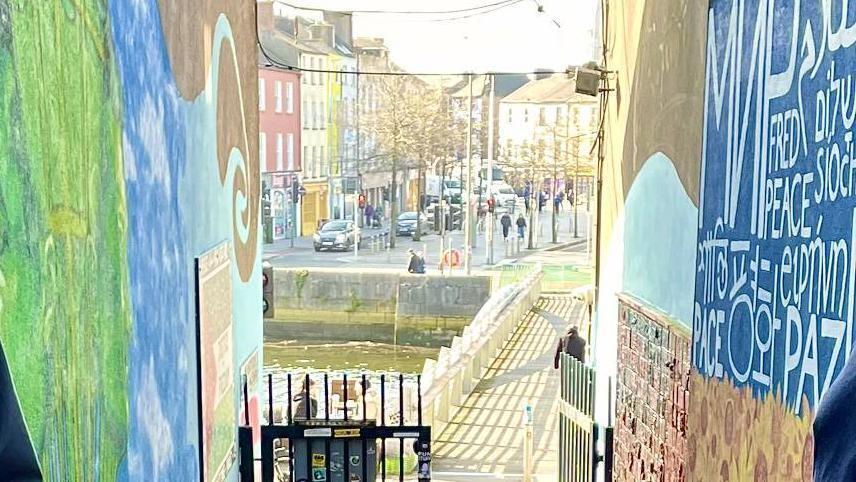
The end of Widderlings Lane which leads to Pope's Quay, one of many historic laneways in the area.

A brief foray into Cork City reminded me I have unfinished business.
Not the brooding, mafia vendetta sort of business — would that I were so interesting — but more like a detective who hasn’t closed a case. When you’re a historian by training, everything in the past can be unfinished business; when it involves family history, there’s always a high chance it will never be quite resolved.
Daughter, with a richer social life at seven than I ever had, was at the Firkin Crane to practice for a dance show. Having dutifully dropped her, and ultimately been dismissed with an imperious and somewhat dramatic wave, I wandered down Widdering’s Lane — if I’d made one misstep, I would have been sliding down it — in search of one of my few vices, coffee.
I had forgotten, or perhaps not really thought, that emerging onto Pope’s Quay would put me facing Cornmarket St, where at least two strands of my family lived in the latter half of the 1800s. My great-great-grandfather Michael Verling might have even dragged cargo on and off the quays I was standing on. Maybe even butter from the market next to what’s now the Firkin Crane.
That’s not the unfinished business, though.
Michael had two wives in his lifetime, having left (or, given his drinking and volatility, been thrown out of) the home he shared with Martha Kenneally on Cornmarket St to live with my great-great-grandmother Mary Madden and their daughter Mary (aka Minnie) on Shaw’s Alley, which shows up as late as the 1901 census, but is gone after that.
That’s one strand of unfinished business, I guess, but right now I’m more focused on Martha. While I’m not related to her, I am related by blood to all of her children — and given the difficult person her husband appeared to be, part of me feels a responsibility for making sure she, and her little ones, are not forgotten. Much like Doireann Ní Ghriofa said recently, “I feel that’s what I’m for, to attend to the dead, to the past”. Maybe I won’t scale the same artistic heights as her, but maybe it’s why I like writing ghost stories.
But, as a country, we have spent too much time erasing our women; it is incumbent upon us all to push back against the weight of that tradition.
I know some details about her, but not enough. She and Michael had at least 12 children, and from what I can tell, eight of those died in childhood, many of them in infancy: Mary (possibly Maria), Thomas William, Michael John, Mary Kate, Mary Margaret, another Mary, James, Patrick Joseph. When I can’t find a death record, the reuse of a name suggests the older baby had passed away. The year Thomas William died at the age of one, his brother William James was born, for instance. The 19th century was brutal, even after the Famine.
I know where she baptised her children (SS Peter and Paul’s, just off what’s now Rory Gallagher Plaza). I know where her descendants live in the United States — three of the children made it to Missouri, with three of the sisters (Mattie, Hannie, and Catherine) going to where William James had been working in the mines. I’ve even seen photos of Catherine, aka Kaddy because she didn’t pronounce the TH, and I look enough like her that you can tell we’re related.
I can even tell how Martha probably pronounced her surname, because although the official death records and such say “Kenneally”, some of the baptismal records say “Kinnelly”, which suggests that’s how she said it.
But what I can’t find are details of her personally.
For a long time, I couldn’t even find where she might have been buried, until I found Martha in a recent trawl through the scanned records of St Joseph’s cemetery on Tory Top Road. It even lists where she was buried, roughly — it’s down as “James Kenneally headstone”. So that, presumably, is her father. Although it may not be — my Mahoney and O’Mahony relatives buried in that cemetery are listed as in the Humphry Mahony headstone, and he appears to be the one who paid for it but, crucially, doesn’t appear to be buried there (this is the only proof he ever existed). Still, it’s information I didn’t have six months ago.
And then I found one, two, three of her children buried in the same plot. So they’re not lost in some pauper’s grave, like I feared. They’ve actually had some place to rest in peace all these years.
Quite where the grave is is another question. As the cemetery has been in use since the 1830s, there are 220,000 people buried and more than 5,500 headstones. Still, if I could track down my father’s relatives in Glasnevin, I’m reasonably confident I can do this.
I had great ambitions of trekking out to Tory Top Cemetery during the week and poking through the headstones looking for them. Alas, I was undone by the weather, which kept teasing me with windows of apparent sunshine, only to shut them resoundingly with downpour after downpour. Trying to make out the names on lichen-encrusted, sometimes crumbling gravestones while also shielding your eyes from rain that’s coming at you sideways is not the best use of one’s time. Not the worst, either, mind.
But I am stubborn, and I will find them.
And who knows — maybe you’re descended from a Kenneally in the South Parish and recognise the names.


CONNECT WITH US TODAY



Be the first to know the latest news and updates