Gareth O'Callaghan: The sense of childlike curiosity when we look up to the skies is magic
As a small boy, I had no idea about the scientific genius and innovation that went into making the Moon landing a success
Gareth O'Callaghan: The sense of childlike curiosity when we look up to the skies is magic

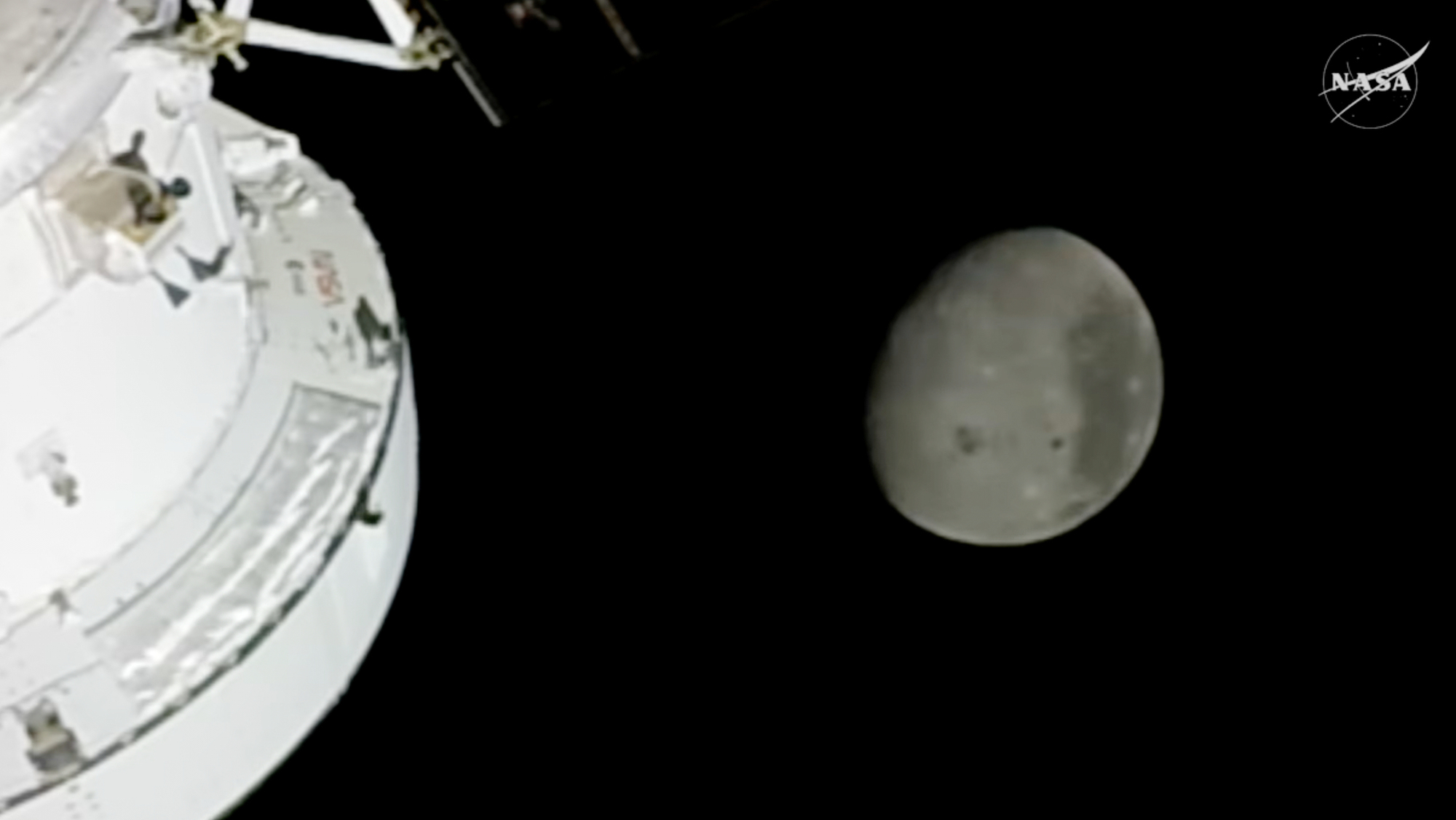
A view of the Moon from Nasa’s Orion Spacecraft earlier this month. Picture: Nasa/AP

July 21, 1969. It was after four in the morning when I held my father’s hand as we stood in the dark in our back garden and stared into the clear night sky. I was only eight years old, but already I shared his lifelong curiosity about the planets, and how someone had told me that we dance among the stars after we die.

Earlier, we watched live the grainy black and white television images of two men, Neil Armstrong and Buzz Aldrin, as they climbed down from the LM Eagle, having just landed in the beautifully-named Sea of Tranquillity. After years of planning, they walked on the moon.

As a small boy, I had no idea about the scientific genius and innovation that went into making the mission a success, but I was acutely aware that these men barely had enough fuel to land; and if that was the case, how were they going to take off after their walk-about up there was done.

I was genuinely afraid they could be stranded in a place Aldrin described as “magnificent desolation” forever.

It was one of the most exciting moments of my childhood as I stood there thinking that if I focused, I might catch a glimpse of Columbia, the command module piloted by Michael Collins, as it continued its lunar orbit. It didn’t occur to me that it would take them three days to reach the moon.

You could say we had a vested interest. My uncle, Denis O’Sullivan, a high energy physicist at the Dublin Institute for Advanced Studies, had come to the attention of Nasa who were keen to learn more about radiation exposures in space, far beyond the protection offered by Earth’s atmosphere.

Radiation levels climb with altitude. During our conversations in later years, I learned from Denis that a passenger flying from Dublin to New York is exposed to the same amount of radiation as a chest x-ray.

When you climb even higher to the altitude at which astronauts orbit, radiation levels pose a serious risk to life.

Denis’s expertise was in the field of cosmic rays which are high-energy particles sent out by the sun’s flare ups and other supernova explosions out in our galaxy.

They travel at almost the speed of light, interacting with Earth’s magnetic field which then redirects the rays away towards the north and south poles, while the atmosphere renders what’s left as mostly benign.

During a sabbatical at University of California Berkeley, Denis’s team developed the first device ever that could accurately measure cosmic radiation. However, the detector needed more refining, which meant it wouldn’t be ready to fly on the Apollo 11 mission.

In 1972, Denis’s team achieved their goal when their cosmic rays detector travelled on the Apollo 16 mission, attached to one of the legs of the lunar module as it settled down on the moon’s surface.

His ongoing research work with Nasa would later include experiments linked with 1984’s Challenger Space Shuttle mission, and on the International Space Station (ISS).

He was a gentle genius.

Denis’s expertise was in the field of cosmic rays which are high-energy particles sent out by the sun’s flare ups and other supernova explosions out in our galaxy. File picture

Some 57 years later, the moon was full and the night calm and clear earlier this month when once again I stood in the back garden.

Artemis II had lifted off from Kennedy Space Centre in Florida. I watched the moon, almost in a trance. I knew I wasn’t going to see a space rocket climbing into the nighttime sky, but that didn’t take from the fascination I have always had for the influence that the moon exerts on our planet and its occupants.

After all the years, I still felt a sense of excitement and boyish curiosity as I spent the night watching Nasa’s live streaming of the astronauts’ journey to the moon’s orbit, thinking about how Denis’s work had made the final frontier safer to travel in for these four heroes.

It’s often said that we shouldn’t waste money on space exploration when there are problems that should be addressed here at home. In the same breath, it’s difficult to make sense of a world we call ours when it ends up being controlled and destroyed by a bunch of warmongering narcissists. Which is more beneficial to the human race — war or space exploration?

Space travel isn’t all about prestige or a race to be first. Without it, we would have no communication satellites — no television, no phones, no radio, no internet.

There would be no way to monitor weather patterns, which all global transport structures rely on.

Then there’s biomedical research. Canadian technology on the ISS has created huge innovation for operating theatres over the years.

Take NeuroArm for example: a highly precise robotic arm capable of performing brain surgery that would otherwise be impossible, while Modus V is a robotic digital microscope that helps patients with a variety of brain and spine conditions.

Scientists have now invented systems that can monitor astronauts’ heart rates, blood pressure and blood samples while in space orbit which can then be screened and the results provided back to Earth within two to three hours. Such technology is reducing wait times for test results for hospital patients, while also improving patient health care.

And then there’s the heart — the body’s command module. Studying the responses and reactions of the cardiovascular system in space gives doctors a better insight into heart failure and how our arteries age here on Earth.

Now they can examine how changes in space due to an absence of gravity affects astronauts’ blood vessels before, during, and after their space missions.

One of the greatest medical inventions of recent years is the heart pump, which keeps people in need of heart transplants alive by controlling the blood circulation until a donor heart becomes available.

Space engineers were able to design the heart pump by modelling fuel and fluid flow through rocket engines.

And then of course there’s the moon itself — the subject of beliefs and myths, horoscopes and dreams, and generations of conversations.

The Artemis II crew captured this view as the Earth sets behind the Moon during a lunar flyby on April 6 File picture: Nasa/AP

Poets and artists have contemplated it for thousands of years. It affects human minds and bodies, the trees and the tides; in fact everything that grows and thrives.

It was also once a rich symbol in prophesy and religious contexts, in love, moods and insanity. It stabilises our climate by moderating how the planet wobbles on its axis. It affects each of us differently, whether we believe it or not.

There is a strong connection between lunar cycles and women’s menstrual cycles — a long-held theory that no one has ever been able to disprove. Ancient astrological charts that tracked the moon and fertility in women were still being used as recently as the 1950s.

I’ve spent the past fortnight reading reports and features that have been released by Nasa following the return of Integrity to Earth, while marvelling at the photographs its astronauts took while in space. There’s a sense of otherworldly awe about those moments.

The picture of astronaut Christina Koch looking out at Earth from one of the Orion spacecraft’s windows was a reminder to me of the ‘overview effect’ — a phenomenon caused by seeing Earth from space that shifts an astronaut’s perspectives on everything they once assumed and took for granted.

We all share more in common that we know or realise, and that’s something I take away from Artemis II’s journey.

When you look at our beautiful planet from space, borders and divisions aren’t visible. And that’s how it should be.

As I watched the night sky earlier this month, hoping for an unlikely glimpse of a rocket on its lunar orbit like I did many years ago, I thought of my father whose anniversary was last week, and I thought of Denis. Wherever they are, I hope they were watching the space mission from the brightest star.

More in this section

Revoiced

Newsletter

Sign up to the best reads of the week from irishexaminer.com selected just for you.

Cookie Policy Privacy Policy Brand Safety FAQ Help Contact Us Terms and Conditions

© Examiner Echo Group Limited