Sarah Harte: Keeping boys alive becomes the main priority at a certain age
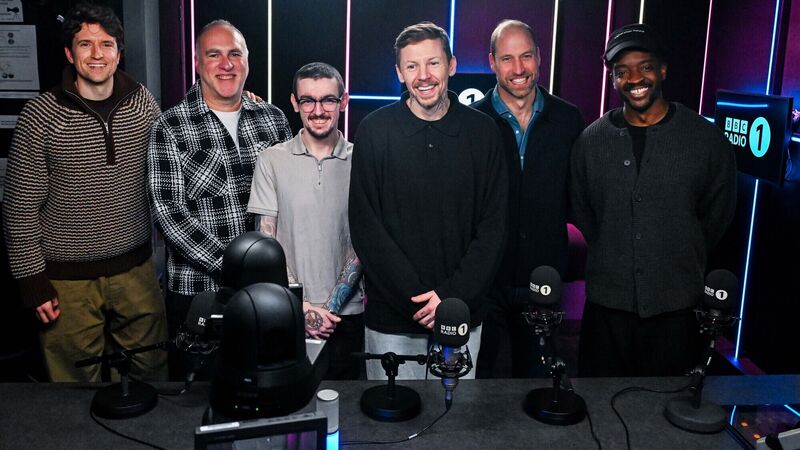
(Left to right) Nathan Riddell, Greg James, Allan Brownrigg (Director of Clinical Services at James’ Place), Professor Green, Britain's prince William and Guvna B (Isaac Borquaye) on the BBC Radio 1 Breakfast Show last month.

In a seismic week for the royal family, Prince William spoke to BBC Radio 1’s about the importance of male role models for young men in the context of mental health.
I’ll resist the urge to make a dark joke because it’s a serious topic. Along with the rapper Professor Green, he cited the catastrophic prevalence of male suicide and the need to encourage men to deal more openly with difficult emotions.
Suicide statistics show that in Ireland and the UK, men make up the majority of suicide deaths. There’s a delay in reporting deaths by suicide here, with deaths being verified by the coroner’s service, resulting in a time lag in receiving finalised statistics.
But to give you an idea of the numbers as of the end of 2023, the Irish male suicide rate was 14.9 per 100,000 people compared to the female suicide rate of 3.6 per 100,000 people.
We know from multiple sources that suicide remains a leading cause of death among young men aged 15-29, with that age group accounting for high suicide rates.
I have been around young male suicide and seen the cruel impact on the friends left behind. Reaching boys and getting them to open up can be hard anyway. Their social development is later, and they’re not socialised to express themselves, because we don’t grant them that right.
If you have raised boys, you may reflect that at a certain juncture, keeping them alive becomes the main priority.
I remember being at a talk in a South Dublin boys' school when our sons were about 11, when the headmaster said firmly: "When it comes to the summer of second year, an alarm will go off in their heads. It’s the boy version of the biological clock.
"I guarantee you, your little angels will act out. They will come through it provided you are realistic about what you are dealing with." I stiffened, thinking: "You got that wrong, buddy. Not in my house."

Yeah, a few years later, I had cause to reassess because, as the headmaster alluded to, there was a developmental stage when many boys seemed feral. They swam in forbidden reservoirs; they fell off walls and broke every bone in their bodies. In the city, they routinely got stopped by gardai when they were in clusters, who quizzed, "What’s in the bag, lads?"
A lot of parenting seemed to involve being a cross between a detective and an ambulance driver, practised in finding the emergency department with the latest broken limb. The primary goal was to ensure their physical safety as they were constantly in motion.
My strong memory is barking commands like: "Get down off the roof now." Usually bookended with a heated order, "because I said so." "Did I seriously see you running across the Luas tracks, or was I hallucinating because you couldn’t have been that foolish, surely?"
Having grown up with no brothers in a house where we constantly rewound the scene in where Mr Darcy/Colin Firth emerged from the lake, in between whipping the buns we’d baked out of the oven, this ‘spirited’ stage came as a shock.
Most girls are unlikely to jump from a diving board into a half-empty swimming pool, attempt to jump off a balcony into another one, only to miss, or cycle across a busy road with somebody on the handlebars and a third amigo on the carrier and get knocked down. These are real-life examples.
Most of them turned out to be functioning citizens, but there were near misses, and sadly, not everyone made it. So, we can agree that testosterone leads to a certain rashness.
But what about the emotional piece in raising boys, which is what the panel on BBC 1’s were driving at?
Boys may be more emotionally fragile than we think.
In an article from the Harvard Graduate School of Education, a professor of developmental psychology suggests that even though boys in "early adolescence express a strong desire for close, emotionally intimate friendships", as a society we pressurise them to suppress these feelings, resulting in a ‘crisis of connection’.
The dominant script for raising boys remains that they should be physically strong, tough, and emotionally stoic.
That script may need revision.
The social script for women and girls changed massively over the last 50 years.
Women stride through the world with greater confidence and opportunities.
Despite significant cultural changes in society and the labour market, and the success in reversing stereotypes about what’s possible for girls, it feels like we are still shovelling out the same stereotype to teenage boys about what it means to be a man; the one about ultimately becoming an economic provider and not showing his emotions along the way.
Those social cues may be partially redundant, given the economic and social reality that most families need two wage earners.
In reality, many women also may not envisage their future as homemakers.
Experts suggest that the redundancy of the cultural stories we feed boys leaves a vacuum filled by unhelpful voices in the manosphere.
A recent article in the posits that boys are exposed to ‘toxic content’ online, leading to ‘maladaptive identity formation’, particularly when parents are not ‘attuned’ to their emotional needs. As was discussed on the BBC 1 show, boys need meaningful offline relationships.
There’s a brilliant online resource, Addressing the impact of Masculinity Influencers on Teenage Boys, for parents and educators, from the DCU Anti-bullying Centre. It gives guidance on how to counter the negative impact of male influences on teenage boys aged 13-18.
It also offers tips on how to talk to teenage boys about masculinity in a positive way, avoiding words like toxic and tips on facilitating critical discussions on a range of topics, including mental health.
That mental health piece again. Boys are more likely to want to kill themselves. They are also more likely to lag educationally behind girls, to drop out of university, and to end up in prison.
We have spent years encouraging girls to fulfil their potential; we may need to recalibrate how we raise our boys, including letting them lean into their ‘soft sides’ and helping them form healthier social connections in real life, as the professor of developmental psychology suggests.
Cultivating emotional resilience means teaching that emotional vulnerability is not weakness. A lot of us struggle with that message because we grew up with a different philosophy.
Boys were not encouraged to show their feelings. Our fathers didn’t. This conditioning is unwittingly handed down to our sons.
When women are grappling with high levels of domestic and sexual violence, there is possibly a reluctance to examine a positive narrative for modern masculinity for fear of being anti-feminist.
This is short-sighted and unhelpful, as raising boys and girls is part of the same jigsaw. To care about boys is not anti-girl.
We need to talk about boys, about male disconnection, and about the place of boys in broader society. It’s positive that programmes like ‘Life Hacks’ are doing so.
CONNECT WITH US TODAY



Be the first to know the latest news and updates