Jennifer Horgan: Taoiseach must meet Trump. We must always choose dialogue over virtue signalling
By visiting the Oval Office Micheál Martin has an opportunity to remind Trump how valuable we are to one another. File picture

To post, or not to post, that is the question. Whether 'tis nobler in the mind to suffer the silence of going offline or to take arms against a sea of misinformation… Hamnet aside, we’re all a bit Hamlet these days, stuck in a dilemma, painfully aware that the very platforms we use to do good are, well, inarguably bad.
Many of us have no choice but to continue using social media but posting actively supports men like Andrew Bosworth, Meta's chief technology officer, whose 2016 email entitled 'The Ugly' claimed that any growth on Facebook is "de facto good", even if it leads to people being harmed or killed.
All we can do is to adopt an uneasy consequentialism, hopeful that the means are justified by the ends. Despite the sludge caking our channels of communication, we remain hopeful that we might make a positive impact.
As Oscar Wilde put it: “We’re all in the gutter, but some of us are looking at the stars.” And we really are in the gutter on these platforms. A picture released within the Epstein files shows the convicted sex predator (Yes, I’ve decided against ‘disgraced financier’) sitting at a table with Elon Musk and Mark Zuckerberg.
Nonetheless, few of us are willing to turn our backs on platforms like Instagram, Facebook, and X. It doesn’t make us bad people. If you live off grid, grow your own food, never travel abroad, and maybe even stitch together your own clothes, you’re able to judge. I’m not that person. I post rarely, but I certainly scroll. I travel abroad occasionally. I buy some stuff.
Most of us live our lives in the moral grey. We make the best of a bad situation. In this sense, Sesame Street’s Elmo taking to X to call Bad Bunny a good bunny, after his powerful Spanish language half-time show at the Super Bowl, is a positive thing — a positive thing on a morally dire platform.
Which brings me to the posts I’m seeing everywhere on social media arguing that Micheál Martin should not go to the White House. Whether we like it our not, our online interactions are unavoidably enmeshed with America.
As cyber expert Brian Honan writes, we cannot, as much as we might like to, “cut all ties with American technology at once. These platforms are deeply woven into how we live and work”. It feels horribly uncomfortable because it is uncomfortable. It is all as murky as our miserable weather.
As far as I’m concerned, if you’re posting online you don’t get to be sanctimonious about the Taoiseach’s visit to the White House — end of. The Taoiseach visiting the White House is a scaled-up version of what you’re doing when you post online.
We all understand that posting on Instagram does not make you an instant fan of Mark Zuckerberg. Similarly, Micheál Martin visiting Washington DC is no endorsement of the American president or his politics.
If we sincerely wish to cut all ties with America, we have a huge amount of work to do before it’s even possible, ideally alongside our European neighbours. We are not even close to being at that point of self sufficiency.
Offline and online, Ireland is wrapped up in America like a pig in a blanket at Christmas. That’s the reality. I’m the first to argue that we are culturally distinct (and let’s keep it that way) but economically, it’s hard to know where we end and America begins.
According to Niall Collins, the minister of state at the Department of Justice, around 400,000 people in Ireland make their livelihood either directly or indirectly through American foreign direct investment. Simon Harris recently outlined that Ireland is the fifth largest investor into the US, with investment by Irish companies worth some $390 billion.
“Our overall economic relationship is valued at more than one trillion euros,” he wrote in . “In 2024, Ireland was also the single largest source of new foreign direct investment into the United States at just over $30 billion, an unmistakable vote of confidence by Irish enterprise in America’s future.”
Our Tánaiste calls the two countries a "two-way engine of prosperity", suggesting that "the best years of the Ireland-US economic relationship are yet to come".
If all the money talk and focus on people’s livelihoods, makes you queasy, we also have a significant number of Irish people living in America who are in very real and present danger. Not turning up at the White House also turns our backs on them.
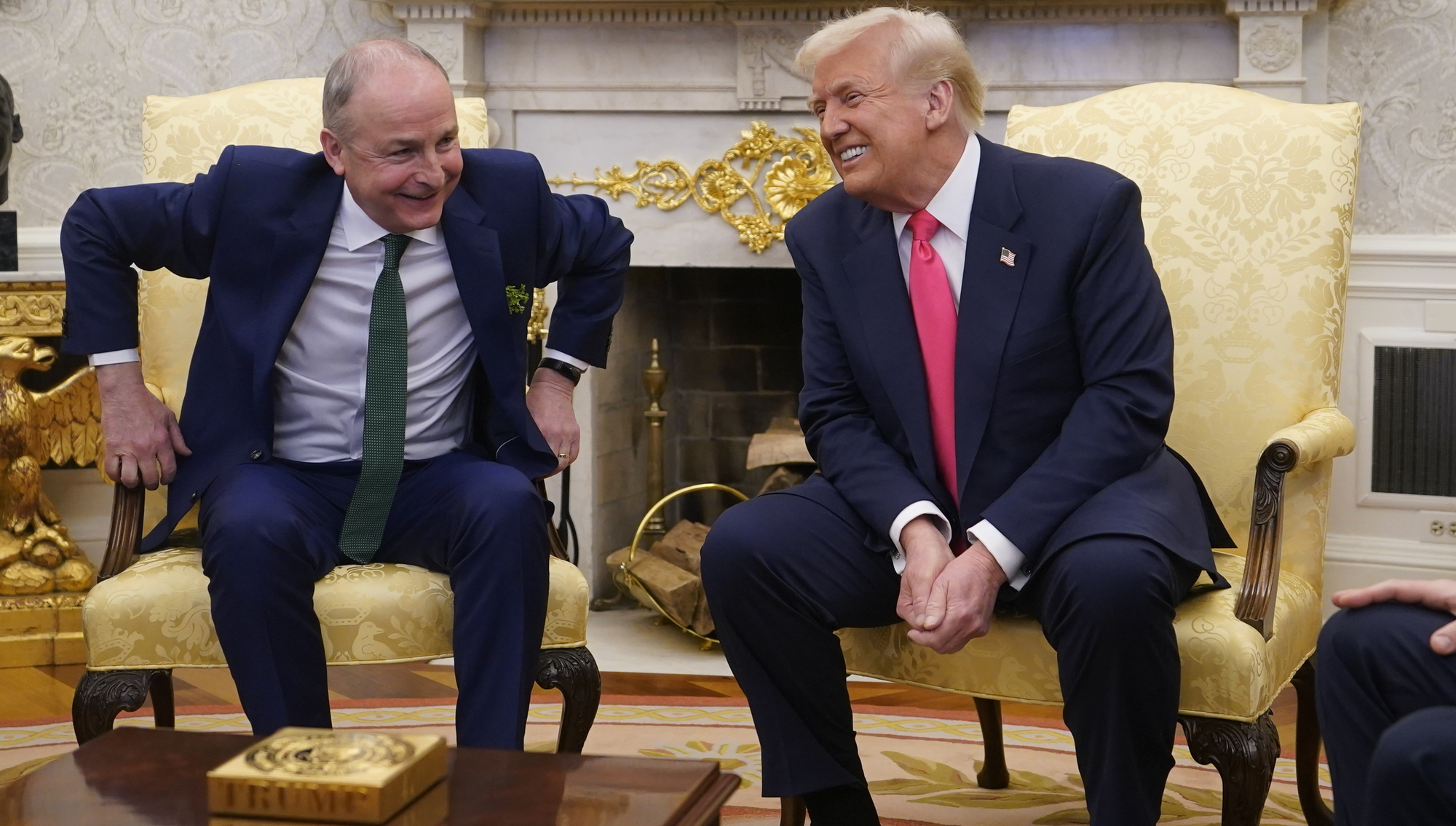
The world is incredibly messy and complex. By visiting the Oval Office Micheál Martin has an opportunity to remind Trump how valuable we are to one another. He has an opportunity to discuss the positive influence of immigrants on American society.
He might even, as he has promised, get to highlight the case of individuals like Seamus Culleton who has been in a detention facility in Texas for five months despite having no criminal record. Culleton’s story is not unique according to minister Helen McEntee.
Cases like these are why we should never cut contact with other nations regardless of their morality. I have had personal experience of relying on an Irish embassy abroad in a time of need — it is absolutely a service worth protecting.
Diplomatic isolationism increases conflict and makes dangerous leaders and regimes even more dangerous. We must always choose dialogue above virtue signalling. We need to keep our enemies close — especially when they have the power to imprison, threaten and kill our citizens and our diaspora.
Thinking about Seamus Culleton, I can’t help but think of other Irish citizens who have lost their basic human rights abroad. The Irish government was instrumental in Brian Keenan being released from captivity in Lebanon.
How? They negotiated with Iran. This was a time when relations between the EU and Iran were strained because of the fatwa placed in 1989 on the novelist Salman Rushdie.
But who would fault the Irish government for meeting with the Iranian ambassador? They achieved a positive in a dire situation. They endured a conversation with a power they abhorred to bring about the desired end.
When Mr Keenan was finally released in 1990, the Irish government said it was “overjoyed”. The State expressed its “deep appreciation to the government of Iran for the efforts they have made to secure his release”, noting “that both Iran and the European Community are intent on improving their relations”.
Iran in 1990, much like now, was a brutally oppressive place. This didn’t stop the Irish government from meeting with Iranian officials to get Brian Keenan home.
Diplomatic meetings don’t mean agreement, just like posting online doesn’t mean you love Zuckerberg and Musk.
Our Taoiseach must meet with Trump. He must make the best of an unbelievably bad situation. His job is to protect Ireland’s citizens. If Seamus Culleton or anyone else is still behind bars in March, let’s hope he can help.
Let’s also be clear that nobody is helped by keyboard warriors who don’t have the self-awareness to recognise the hypocrisy in their activism.

CONNECT WITH US TODAY



Be the first to know the latest news and updates